VICO FUTURE MONITOR · NEWSLETTER
Ahead of the Curve
We Called It: Fed Rate Hike, AI Regulation, Red Sea Houthis, UK Dissolution, Trump Xi Summit, We Called It: CLARITY Act, Midterms
This issue was published in the VICO Future Monitor newsletter and is archived here; edits and forecast links were added by the VICO editorial team.
Access VICO forecasts or make your own at www.vico.io as well as on the Bloomberg Terminal at WSL PREDICT<GO>, WSL ELECTION<GO> and WSL VICO<GO>.
What we are following this week:
Economics: We Called It: Fed Rate Hike, AI Regulation
Global Politics: Red Sea Houthis, UK Dissolution, Trump Xi Summit
Domestic Politics: We Called It: CLARITY Act, Midterms
Economics: We Called It: Fed Rate Hike, AI Regulation
We Called It: Fed Rate Hike
Issue: The Fed raises rates, VICO called it.
Yesterday, the Fed announced a 0.25% rate hike for the first time in three years.
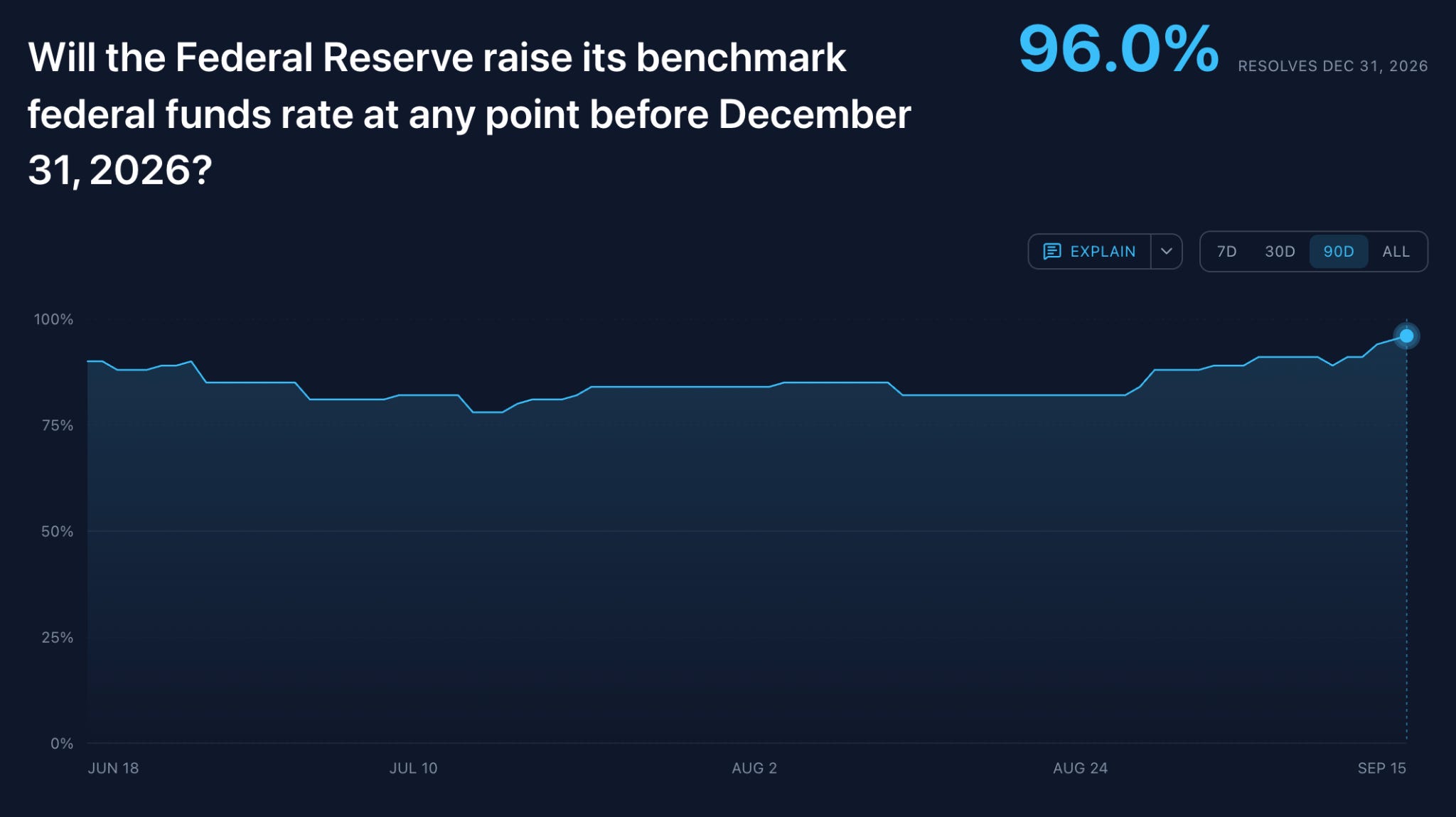
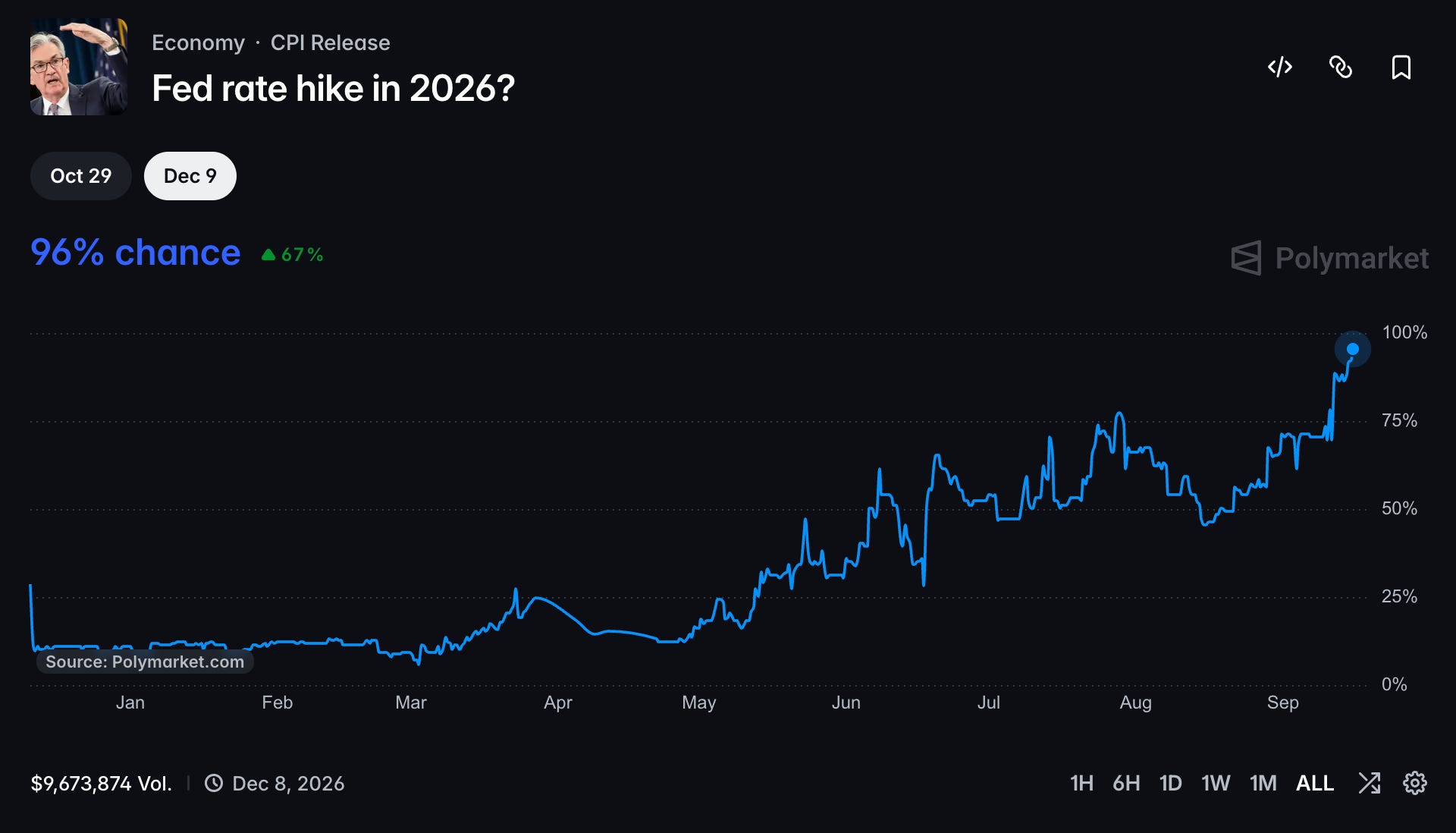
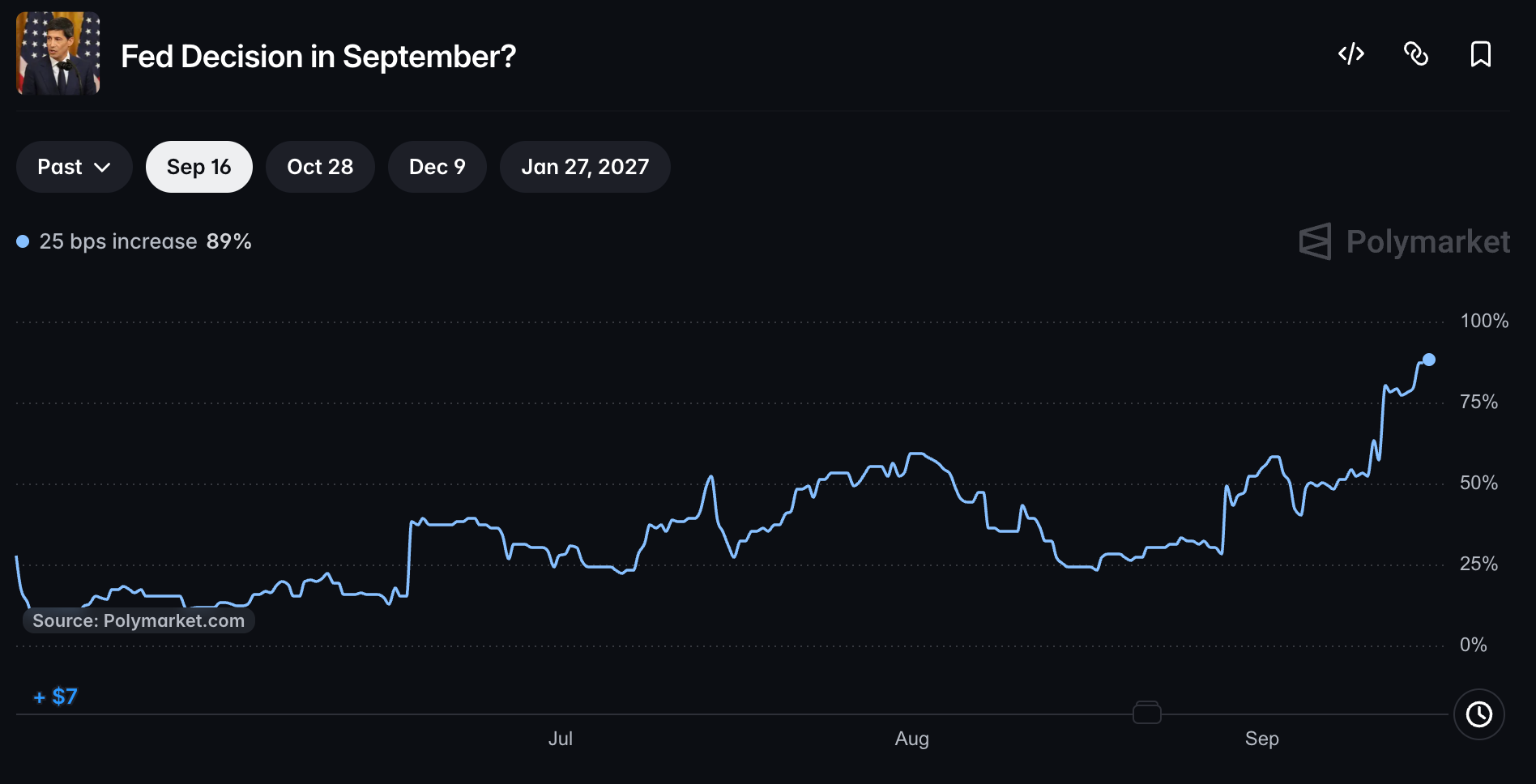
Back on June 12, the VICO model opened its “rate hike in 2026” forecast at 92%. That same day, Polymarket gave the same outcome just 40%.
Over time, that gap closed as the market slowly moved towards VICO, which stayed above 75% the whole way. The day before the rate hike, both VICO and markets sat at 96%:
The call on September
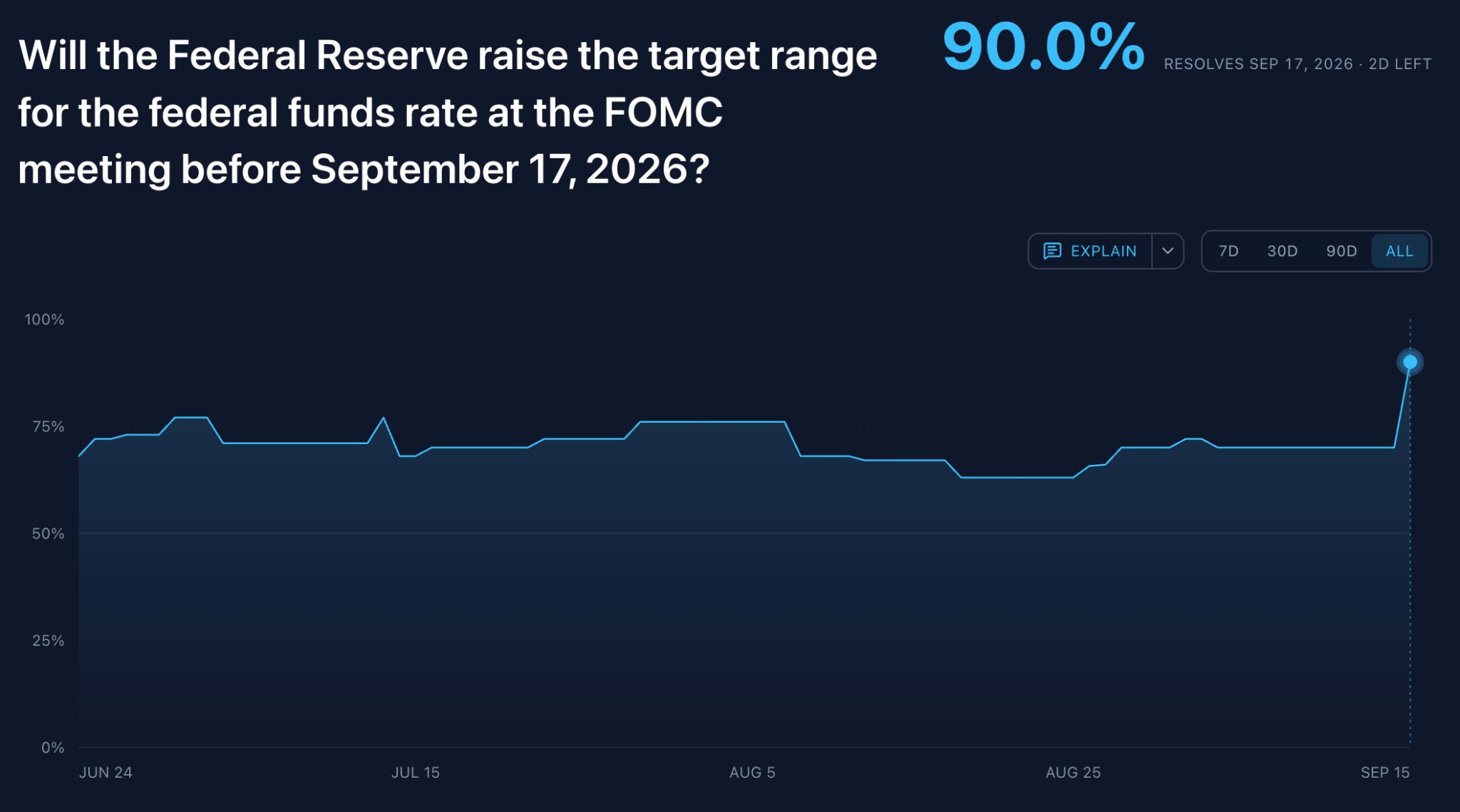
The VICO model also led specifically on the September meeting. VICO opened its September forecast at 68% on June 24, when Polymarket was at 38%. As late as August 28, Polymarket still gave a September hike just 28%.
The VICO model, by contrast, never dipped below 63% the entire time. On the morning of August 28, before Fed Chair Warsh’s speech, VICO already sat at 70%.
Warsh’s speech that day boosted market expectations above 50%. Prediction markets have climbed quickly every day since. VICO ticked up too, but only slightly, because it was already there. The day before the hike, VICO and markets converged around 90%.
So what: A months-long edge, and possibly another hike in 2026
The VICO model gave months of warning on both a hike in 2026, and the September decision, while the market needed a speech from the Fed Chair to see what VICO flagged back in June.
The model also believes another hike may be coming in 2026, as one increase is likely insufficient to tackle inflation.
52%: The probability that the Fed raises rates again in 2026.
Extra: Treasuries
Lurking behind the Fed’s decisions have been Treasury bonds, whose yields recently climbed to their highest since 2008:
72%: The probability that 10-year Treasury yields end the year at or above 5%.
The VICO model argues that Treasury yields are likely to stay up through 2026, as the Fed may raise rates again and the national debt continues to climb.
AI Regulation
Issue: AI Concerns Continue to Grow, Regulation Still Uncertain
Over the weekend, OpenAI and Anthropic CEOs Sam Altman and Dario Amodei called for an AI development slowdown following the resignation of an Anthropic researcher over fears the technology poses a serious threat to humans.
The weekend’s debate surfaced a full menu, from an outright ban to caps on development speed.
VICO reads the dramatic options as unlikely. The most plausible federal action is a safety checkpoint on frontier models, not a cap on how fast they are built.
Reasoning: China Fears Stall US Action
Licensing is the rare measure both parties and much of the industry can accept, because it screens models for danger without conceding the race to China.
50%: The probability that the US government requires licensing or pre-deployment safety inspections on frontier AI models before 2028.
A hard cap on development speed is far less likely, since it means slowing US labs while Chinese models keep advancing. VICO’s Causal Explorer pins the low number on two barriers, fear of Chinese dominance and political gridlock, with the only real path running through the labs themselves lobbying for it.
12%: The probability that the US government issues legislation limiting the speed of AI development within the next year.
Any actual pacing is likelier to come from the companies than Congress, though it is held under even odds by the difficulty of coordinating rivals without conceding growth to non-compliant firms.
38%: The probability that two or more leading US AI companies reach a deal to pace the speed of AI development within the next year.
The linchpin is a US-China pact. Neither side will concede a slowdown or trust the other to keep one, and that near-zero is exactly why Washington will not brake alone.
2%: The probability that the US and China reach a deal to pace AI development within the next year.
So what: Regulation as a moat
The market consequence lands on company size, not the technology’s pace. VICO’s Scenario Explorer finds that if the US creates strict AI regulations, the burden falls hardest on startups, turning safety rules into a moat for tech giants who can afford compliance.
88%: The probability that, under strict US regulation, smaller frontier-model firms are pushed out as compliance costs become surmountable only for tech giants.
The feared international leakage is real but not decisive. At 39%, the model does not expect regulation to hand most of the world’s business to European and Asian rivals, which undercuts the industry’s favorite argument against any rules at all.
39%: The probability that, under strict US regulation, European and Asian developers such as Mistral, AI21, and Falcon capture 30 to 40% of non-US enterprise AI contract volume.
Global Politics: Red Sea Houthis, UK Dissolution, Trump Xi Summit
Red Sea Houthis
Issue: Houthis capture vital Red Sea strait
Having seized Bab el-Mandeb, the narrow gateway between the Red Sea and the Gulf of Aden, the Houthis are moving to turn control into cash by taxing the ships that pass through.
VICO expects the toll threat to be real, but the group’s grip on the strait to be temporary.
Reasoning: Monetize Now, but the Clock Is Ticking
A formal toll is the likeliest next step, the obvious way to monetize a chokepoint that roughly a tenth of seaborne trade depends on.
70%: The probability that the Houthis formally declare a toll on Bab el-Mandeb traffic in 2026.
The Western response is more likely to be protective than punitive. Escorting ships through the strait is the path of least resistance, and it stays the favored option because the US has been reluctant to hit the Houthis directly, with the President having already declined Saudi requests for strikes.
So what: A temporary squeeze
Most important, the model expects the Houthis to lose control before the end of the year.
58%: The probability that the Houthis lose control of Bab el-Mandeb before the end of 2026.
For shipping and energy markets, the toll and the instability around it will push insurance and rerouting costs up in the near term, but the Houthis are unlikely to keep hold of the strait through the end of the year.
UK Dissolution
Issue: Leaders from Scotland, Wales, and Northern Ireland plot to leave the UK
Political leaders from Scotland, Wales, and Northern Ireland met this week to demand new votes on independence from the UK.
The declaration creates political pressure, but VICO’s model says it is unlikely to produce an actual referendum.
Reasoning: UK legal and political mechanisms keep the door shut
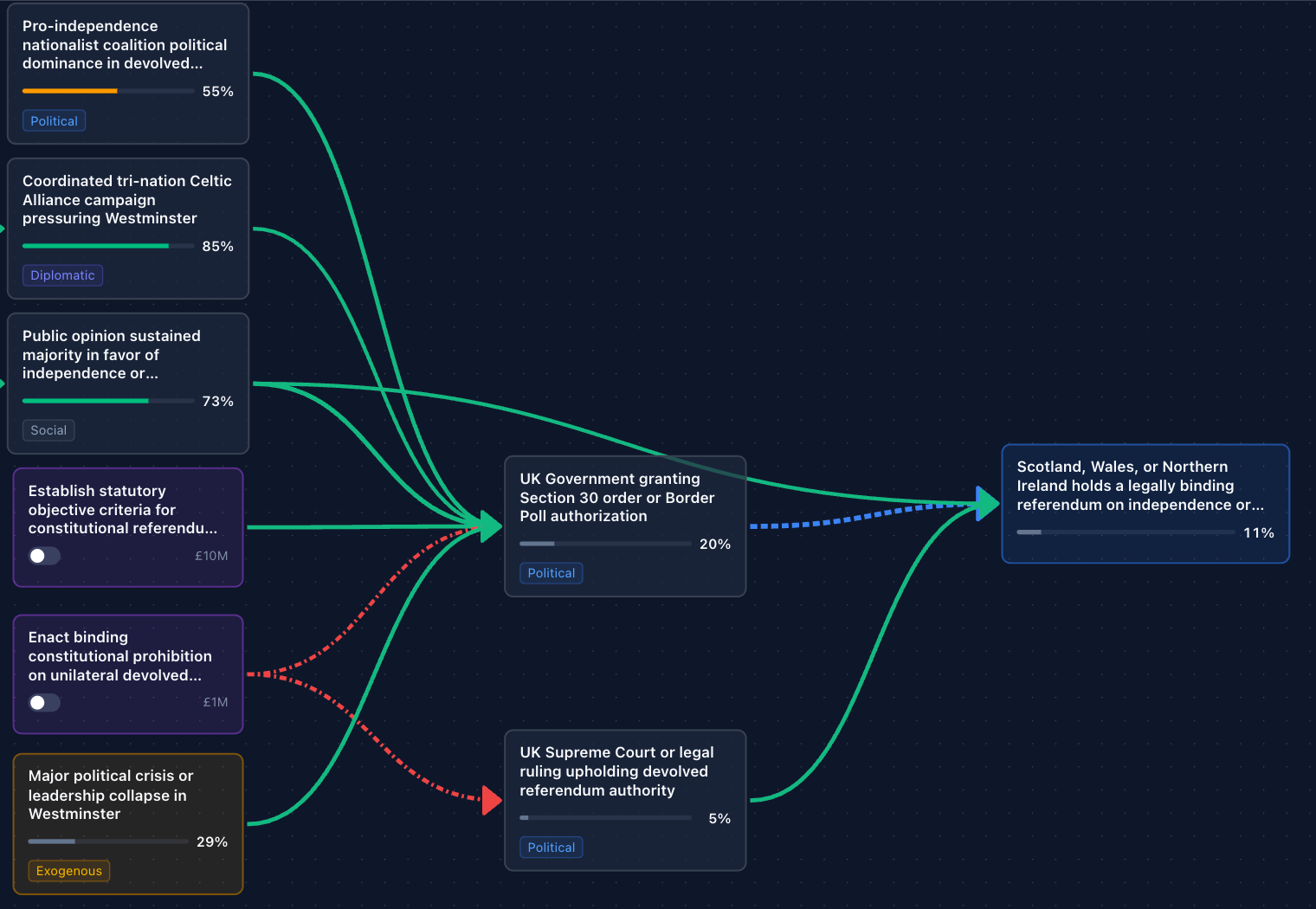
For a referendum to happen, someone first has to unlock the legal authority to hold it. The VICO model sees two ways of reaching a vote, and neither is likely.
The political option is a UK government granting a Section 30 order or a Northern Ireland border poll, but PM Andy Burnham has already ruled it “off the table” and a Prime Minister can simply refuse.
20%: The probability that the UK government grants a Section 30 order or authorizes a Northern Ireland border poll in the next three years.
The judicial option is even less likely: the Supreme Court ruled in 2022 that the devolved parliaments cannot authorize a referendum on their own, so a favorable ruling now would mean reversing that precedent.
5%: The probability that the UK Supreme Court or another legal ruling upholds devolved authority to hold a referendum in the next three years.
With both doors mostly shut, an actual legally binding vote stays improbable.
11%: The probability that Scotland, Wales, or Northern Ireland holds a legally binding referendum on independence or union in the next three years.
So what: A long way from a vote
The declaration is leverage, not a countdown, so markets are likely to treat the union as intact.
The VICO Causal Explorer finds that raising the probability over 50% would require an extremely intense campaign of political pressure, one that produces a major political crisis and the collapse of effective governance from Westminster.
Even in that scenario, the probability of a vote reaches only 58%, showing how reluctant UK leadership would be to allow disintegration.
Trump Xi Summit
Issue: Trump Xi summit to happen amidst trade tension
Trump and Xi are set to meet in Washington later this month, with the October 2025 trade truce expiring November 10 and rare earths, chips, and Taiwan all on the table.
The meeting will be framed as a chance to reset, but VICO’s forecasts point the other way: the two economies decoupling on rare earths and chips, and the summit is unlikely to reverse it.
Reasoning: Competition wins over collaboration
China has little reason to escalate with formal new controls, because it does not need to. Many Chinese firms have already materially cut rare-earth exports to the US, so the leverage is already being applied without any new formal controls.
26%: The probability that China implements the currently suspended secondary round of rare-earth export-control regulations in 2026.
And on security, the US looks likely to press ahead in a way that cuts against any thaw, advancing the arms package to Taiwan that Beijing most wants stopped.
55%: The probability that the US finalizes the pending $14 billion arms sale to Taiwan in 2026.
So what: No concrete deal in sight
The conflict culminates in a low probability for deals on either rare earths or advanced chips, with both sides leveraging their respective advantages.
A no-deal scenario is bullish for the ex-China supply chain. Domestic and allied rare-earth miners, as well as defense contractors tied to the Taiwan deal, are both likely to benefit.
Domestic Politics: CLARITY Act, Midterms
We Called It: CLARITY Act
Issue: CLARITY Act shot down in the Senate
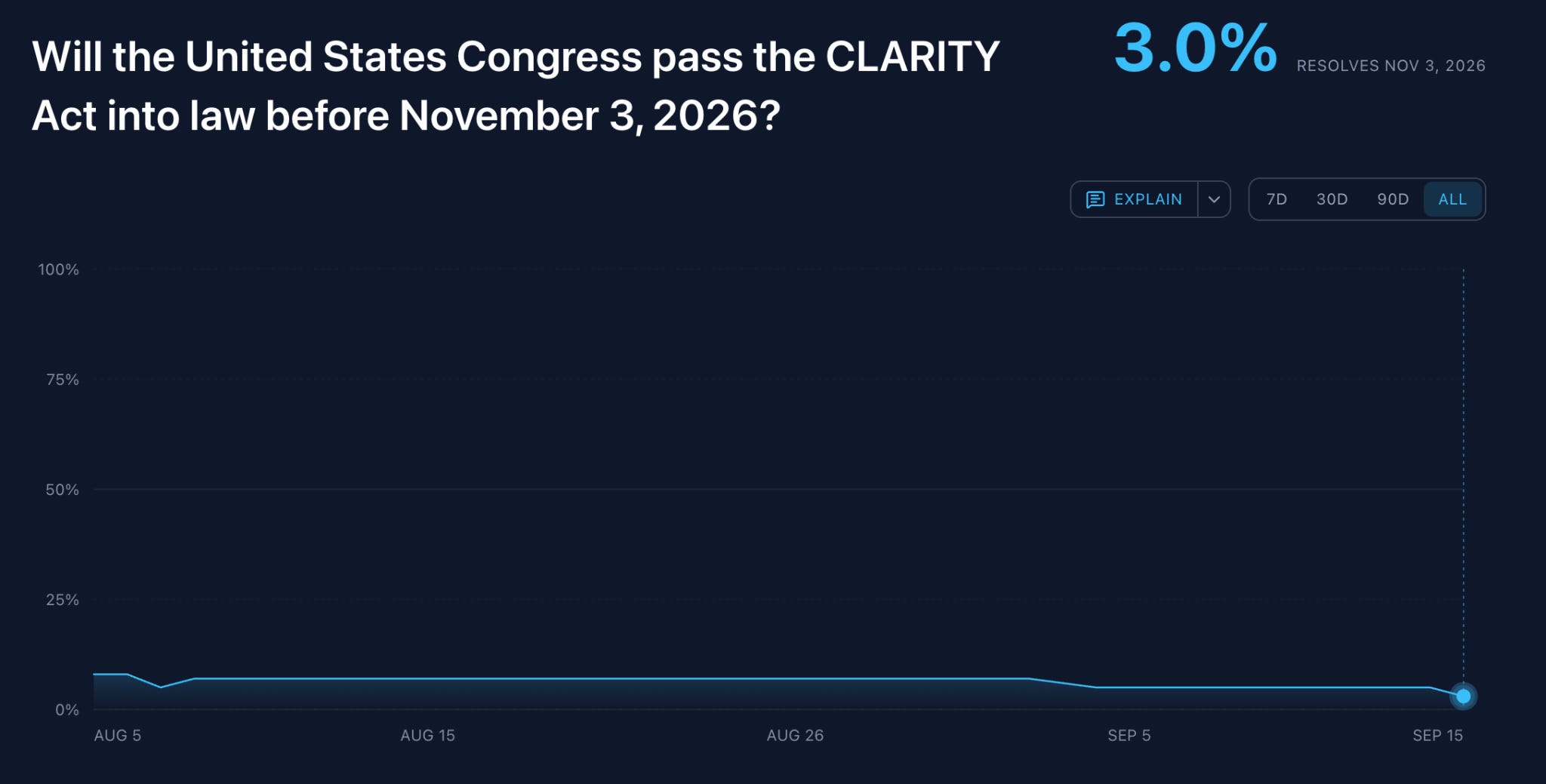
Since early August, VICO stayed consistently low on the CLARITY Act, never putting passage above 7% even as the industry treated it as alive.
The CLARITY Act was Congress’s attempt to write the first comprehensive federal rules for crypto markets, most importantly defining which digital assets fall under the SEC and which fall under the CFTC.
Yesterday the act failed a Senate vote, all but confirming it is dead until the next Congress, where a version would have to be introduced from scratch. The vote sent crypto-heavy stocks tumbling in its wake.
Reasoning: The fight is ideological, not just procedural
The legislative path stays narrow because VICO reads the bill’s problem as ideological, not procedural. The fight over how much ground to cede to crypto does not reset with a new Congress, so it likely carries over intact.
30%: The probability that the CLARITY Act is reintroduced and passed during the next Congress (2027 to 2029).
That pushes the action to the agencies, doing by rule what Congress would not do by law. But rules can only go so far: the agencies can clarify what counts as a security, not hand the CFTC the spot-market authority only a statute can grant. The likely future is an administrative patch that falls short of what Congressional legislation could achieve.
62%: The probability that the SEC and CFTC issue joint guidance or begin a formal rule-making to divide token jurisdiction before the end of 2027.
So what: VICO was early on the CLARITY Act, markets responded late
The edge was timing: VICO held under 7% for six weeks while the bill was still written up as alive. The market was caught off guard, sending Coinbase and Circle both down roughly 10% on the vote.
Midterms
Issue: Final primaries finish, moving eyes to the general
On Tuesday night, the final primary elections were held, officially cementing the general election slate for all 50 states.
This section is an overview of the VICO model’s projections for both the House and the Senate:
The House
Democrats are favored to retake the chamber, though VICO is more restrained than the betting markets, and it gives better-than-even odds that the majority will be at least 10 seats.
A Democratic majority in the House would effectively block any non-bipartisan Trump legislation. Importantly, a victory with a strong majority would strengthen Democratic leadership and weaken the influence of the party’s flanks who may break with Democratic leadership on key votes.
The Senate
The Senate is a genuine toss-up, and the tension is simple: Republicans are defending an unpopular president, but Democrats have a rough map and need to flip four seats for a majority.
43%: Ken Paxton (R) wins Texas. Versus Polymarket at 44%.
34%: Dan Sullivan (R) wins Alaska. Versus Polymarket at 35%.
52%: Abdul El-Sayed (D) wins Michigan. Versus Polymarket at 62%.
41%: Troy Jackson (D) wins Maine. Versus Polymarket at 69%.
49%: Josh Turek (D) wins Iowa. Versus Polymarket at 41%.
63%: Pete Ricketts (R) wins Nebraska. Versus Polymarket at 68%.
Ricketts is running against independent Dan Osborn, who has promised not to caucus with Republicans.
64%: Sherrod Brown (D) wins Ohio. Versus Polymarket at 56%.
72%: Roger Marshall (R) wins Kansas. Versus Polymarket at 75%.
Interestingly, the model is less bullish on Democrats than markets in two of the highest-profile races in Maine and Michigan. But the model is more bullish for Democrats in two of the less publicized races in Iowa and Ohio.
So what: Ds favored heavily in the House, and slightly in the Senate
53%: Democrats win the Senate. Versus Polymarket at 57%.
The VICO model has moved sharply towards Democrats, crossing above 50% for the first time, up from 30% in late July.
The VICO model expects a Democratic victory in the House, and argues the Senate is a toss-up with a very slight Democratic lean. A Senate victory would allow Democrats to block any Supreme Court picks, and bog down the administration with investigations.
About Us
VICO empowers decision makers to quantify and navigate event risk. Forecast, simulate and monitor political, geopolitical and economic events.
Learn more and obtain a beta account at www.vico.io or email us at inquire@vico.io
Methodology and Copyright Notes:
All percentage changes are over the last week except where noted.
Our proprietary AI models are rigorously backtested and do not rely on any betting market information.
All data and content are owned by and copyrighted by VICO Technologies Inc.