VICO FUTURE MONITOR · NEWSLETTER
Choke Points
US x Iran, Saudi Arabia x Houthis, Israel Elections, Saudi Arabia Civil Nuclear Deal, MAGA on Ukraine, Michigan Senate Primary, Mitch McConnell, Fed Decision, Inflation, AI and Jobs
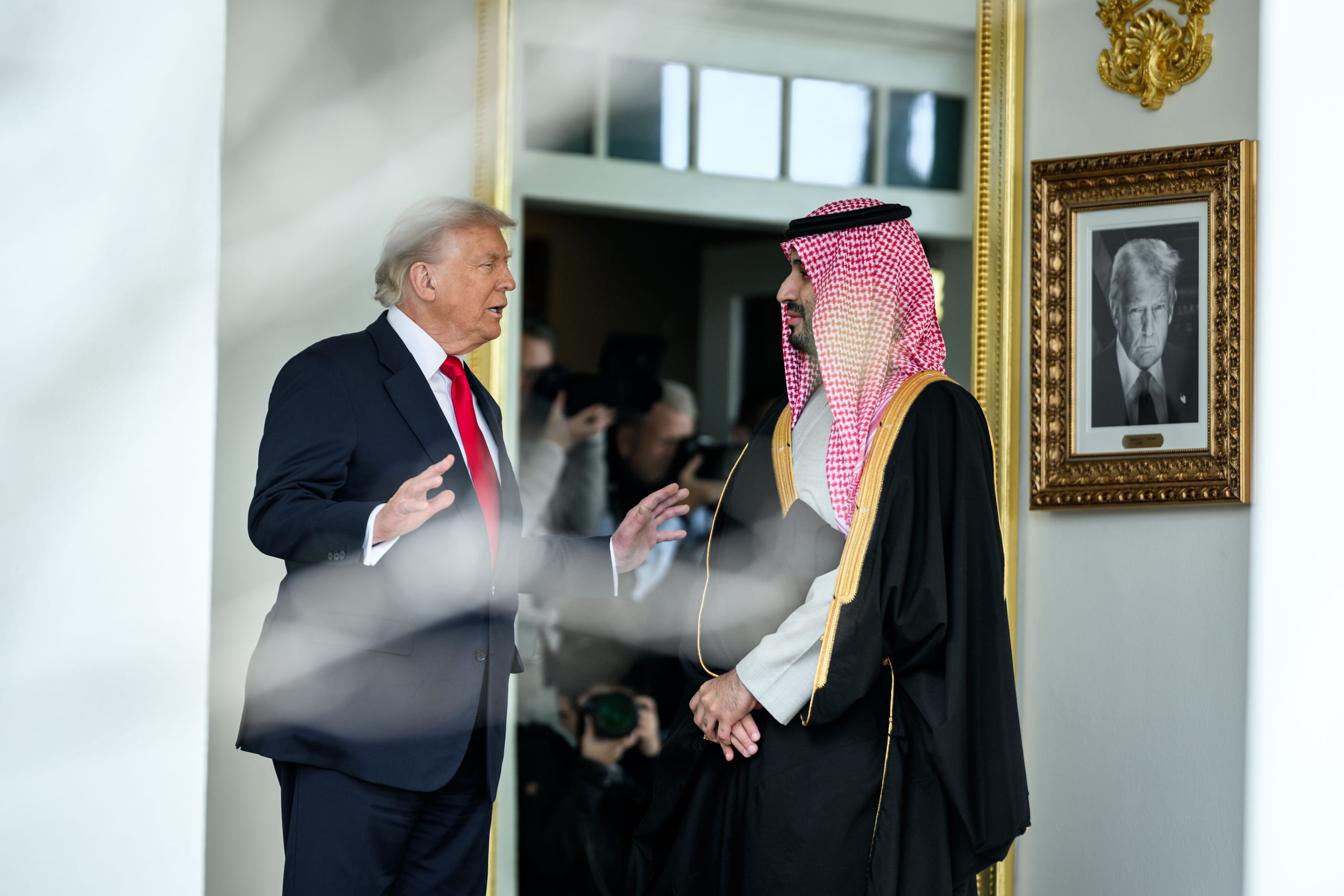
This issue was published in the VICO Future Monitor newsletter and is archived here; edits and forecast links were added by the VICO editorial team.
Access VICO forecasts or make your own at www.vico.io as well as on the Bloomberg Terminal at WSL PREDICT<GO>, WSL ELECTION<GO> and WSL VICO<GO>.
What we are following this week:
Global Politics: US x Iran, Saudi Arabia x Houthis, Israel Elections, Saudi Arabia Civil Nuclear Deal
Domestic Politics: MAGA on Ukraine, Michigan Senate Primary, Mitch McConnell
Economics: Fed Decision, Inflation, Paramount x Warner Bros. Merger
Special Section: AI and Jobs
Global Politics: US x Iran, Saudi Arabia x Houthis, Israel Elections, Saudi Arabian Civil Nuclear Deal
Following a meeting with Israeli Prime Minister Netanyahu, President Trump said the US would “hit [Iran] very hard” in response to Iranian strikes in the Middle East. Saudi Arabia is also caught up in conflict after the Houthis targeted Saudi Aramco facilities over the weekend. Netanyahu is facing a tough election season later this year, when he may lose his job as Prime Minister. And the President’s approval of a plan to cooperate with Saudi Arabia on nuclear reactors is drawing heat as some fear future missuse. This week:
US x Iran
15%: The probability that the US and Iran reach a formal permanent or temporary ceasefire in the next 30 days.
The VICO model dipped from 23% to 15% in a single day following Iranian strikes which ended a four day period of no strikes. Overall, the model continues to explain that both sides are simply too far apart in negotiations to expect a deal soon.
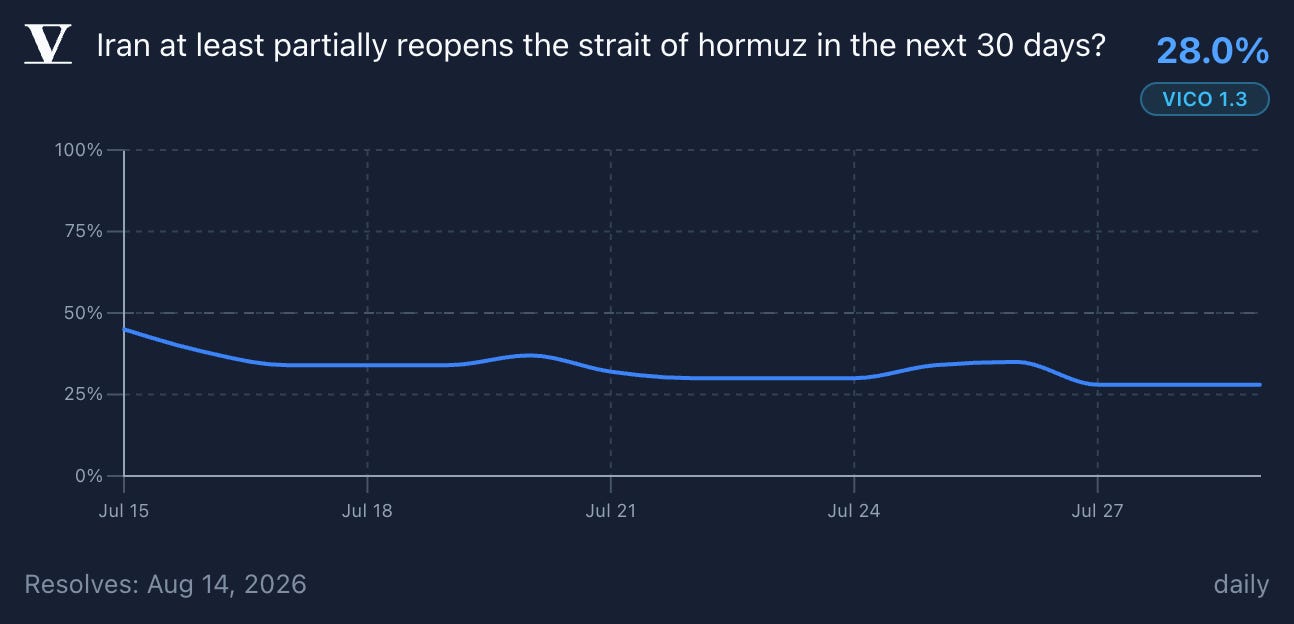
28%: The probability that Iran at least partially reopens the Strait of Hormuz in the next 30 days.
22%: The probability that Iran launches a strike on the Suez Canal in the next 60 days.
Saudi Arabia x Houthis
Conflict
5%: The probability that Saudi Arabia and the Houthis reach a ceasefire by August 31st.
6%: The probability that Saudi Arabia and the Houthis reach a formal permanent ceasefire in 2026.
The VICO model argues that historically Saudi Arabia and the Houthis rely on informal de-escalation over binding treaties, making a formal ceasefire unlikely.
28%: The probability that Saudi Arabia and the Houthis go 30 consecutive days without attacking one another at some point in 2026.
22%: The probability that Saudi Arabia launches a ground invasion into Houthi-held territory in Yemen in 2026.
68%: The probability that strikes in the Saudi-Houthi conflict escalate in the next 60 days.
Shipping
32%: The probability that Saudi Q3 oil exports decline by at least 3% compared to Q2.
The VICO model notes that Q2 exports were already low, with record low exports in May, meaning a Q3 decline would require a particularly catastrophic collapse.
82%: The probability that any commercial vessel in the Red Sea is sunk, seized, or suffers a crew fatality from a Houthi attack by August 31st.
85%: The probability that Maersk or MSC announce the suspension of Red Sea/Suez service and diversion of vessels around the Cape of Good Hope by September 30th.
Israel Elections
42%: The probability that Benjamin Netanyahu remains the Prime Minister of Israel after the elections. (Polymarket: 34%)
The VICO model explains that while Netanyahu faces poor polling results so far, he is “the most formidable campaigner in Israeli history.”
38%: The probability that Gadi Eizenkot becomes Prime Minister of Israel after the elections. (Polymarket: 52%)
The VICO model argues that while Eizenkot’s opposition enjoys a substantial polling lead, there are many possibilities that could keep him from being the eventual Prime Minister. Coalitions often fail to form in Israeli politics, and election victories do not always lead to a clean agreement on who will become the next Prime Minister.
82%: The probability that the currently governing coalition of Israel becomes a minority following the Israeli elections.
Even in this case, Netanyahu could still remain as PM if his party allies with parties that gained seats.
What if the opposition wins a majority and Eizenkot becomes Prime Minister?
80%: Eizenkot’s government implements a strategic freeze on the construction of 3,500-5,000 new housing units in deep West Bank settlements (Area C) within 60 days.
65%: The Eizenkot administration negotiates a phased transition of civil and security administration in Gaza, withdrawing IDF forces from the Netzarim and Philadelphi corridors within 180-270 days.
50%: Mediated by the US, Israel and Saudi Arabia resume formal normalization negotiations within 120-180 days.
Saudi Arabian Civil Nuclear Deal
22%: The probability that Saudi Arabia completes the construction of a nuclear reactor with American help in the next 10 years.
8%: The probability that Saudi Arabia enriches uranium beyond that needed for civilian uses in a reactor built with US help in the next 10 years.
Domestic Politics: MAGA on Ukraine, Michigan Senate Primary, Mitch McConnell
President Trump is reportedly warming to Zelensky and Ukraine on the back of Ukrainian progress against Russia. Meanwhile, the Michigan Senate primary is set for next week when progressive Abdul El-Sayed will face the more moderate Haley Stevens. And Kentucky Governor Andy Beshear called on Senator McConnell to either prove his capacity to continue serving as Senator or resign. This week:
MAGA on Ukraine
70%: The probability that President Trump signs a bilateral US-Ukraine drone framework agreement that explicitly establishes a joint venture in the next 90 days.
14%: The probability that the US provides Ukraine with an additional military aid package in 2026.
12%: The probability that President Trump calls on Russia to sign a peace deal that denies some Russian territorial claims in Crimea or the Donbas in 2026.
12%: The probability that President Trump publicly calls for NATO-like security guarantees to be given to Ukraine in the next 180 days.
18%: The probability that President Trump personally calls for more aid to Ukraine in the next 120 days.
While the VICO model is optimistic about continuing US-Ukraine military cooperation on specific programs like a joint drone venture, the model warns not to go too far. The President is still unlikely to completely switch course and throw all of his support behind Ukraine publicly.
Michigan Senate Primary
46%: The probability that Abdul El-Sayed wins the Michigan Democratic primary. (Polymarket: 95%)
Despite recent polling showing El-Sayed in the lead, the VICO model maintains that Steven’s financing edge, combined with powerful endorsements like Governor Gretchen Whitmer, make her a still formidable candidate who may well beat El-Sayed on Tuesday.
Mitch McConnell
38%: The probability that McConnell resigns before the end of his term.
The VICO model remains below 50% largely because Republicans have refrained from calling for his resignation. Calls from Democrats like the states Governor are unlikely to seriously impact McConnell’s decision making. Still, the model notes the lack of videos of McConnell, suggesting he may be unable to fully function in his capacity as Senator.
Economics: Fed Decision, Inflation, Paramount x Warner Bros. Merger
The Federal Reserve announced no change to the federal funds rate despite three dissenting Fed Governors pushing for a rate hike. The next Fed decisions are likely to be decided by inflation concerns as the war in Iran rages on. And Paramount’s $111 Billion merger with Warner Brothers was paused by an anti-trust challenge. This week:
Fed Decision
In our last week’s newsletter, we put the odds for the Fed to raise rates at just 24%, suggesting no change was to be expected.
62%: The probability that the Fed raises rates at the September meeting. (Polymarket: 53%)
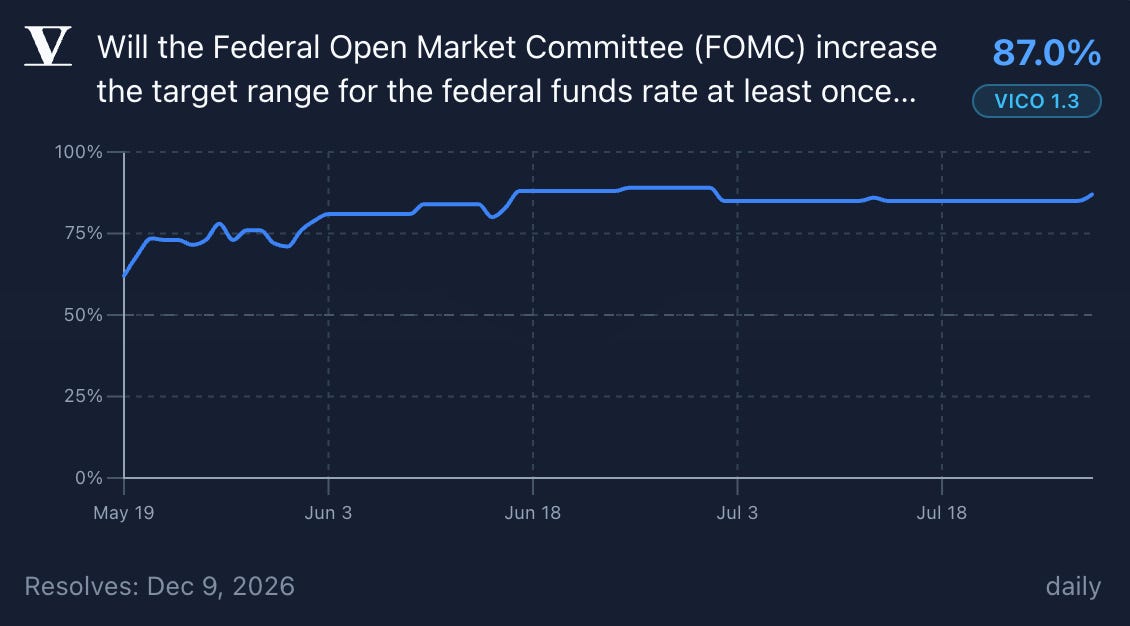
87%: The probability that the Fed raises rates at least once in 2026.
Inflation
52%: The probability that US inflation reaches at least 4% in 2026.
8%: The probability that US inflation reaches at least 5% in 2026.
The VICO model anticipates that while conflict in the Middle East may drive up inflation, the Fed is likely to step in with a rate hike making high end inflation estimates improbable.
Paramount x Warner Bros. Merger
28%: The probability that the Paramount and Warner Brothers merger is formally terminated or abandoned in the next 365 days.
What if the deal fails?
63% probability that another company swoops in with a successful bid to buy at least a part of Warner Bros.
Special Section: AI and Jobs
Large companies are beginning to hire again, complicating the effect of AI on the job market. We take a look at what VICO expects the impact of AI to be on various sectors over the next few years.
Services (consulting, law, accounting):
22%: The probability that any Big Four accounting firm or MBB consulting firm announces a global headcount reduction of more than 10% before December 31, 2027?
15%: The probability that they do so and explicitly cite AI as a primary driver.
72%: The probability that entry-level associate/analyst hiring at the top 100 U.S. law firms is reduced or frozen compared to 2025 levels, due to AI-driven efficiency gains, before December 31, 2028?
14%: The probability that the average starting salary for paralegals declines year-over-year before December 31, 2027?
32%: The probability that AI-augmented advisory roles account for a majority of new hires at a top-10 consulting firm before December 31, 2027?
The VICO model doubts firms will publicly blame AI for deep cuts. It instead expects quieter entry-level hiring freezes.
Manufacturing:
62%: The probability that total US manufacturing employment is lower than the level reported for July 2026 as of December 2028, according to BLS data before January 12, 2029?
22%: The probability that there are at least 20 companies with non-human controlled humanoid robots working in US manufacturing facilities before December 31, 2028?
14%: The probability that the number of unfilled US manufacturing job openings is lower in each calendar year compared to the previous year before December 31, 2028?
18%: The probability that a major automaker (Audi, BMW, Hyundai) reports a net headcount reduction tied to humanoid robots before December 31, 2028?
The VICO model is skeptical of the humanoid-robot story, favoring the more mundane explanation of ordinary automation-driven decline.
Science/Technology:
18%: The probability that any Fortune 500 tech company publicly reports that more than 50% of its newly shipped production code was AI-generated before December 31, 2026?
62%: The probability that time-to-hire for junior software engineering roles increases industry-wide by December 31, 2027?
8%: The probability that the number of open ‘AI/ML researcher’ roles exceeds the number of open ‘software engineer’ roles at a defined basket of major tech companies before December 31, 2027?
55%: The probability that new-grad software engineering postings are lower than 2025 levels as of December 31, 2027?
The VICO model doubts splashy AI-code disclosures and expects the real impact to show up as a quiet junior-hiring squeeze instead.
About Us
VICO empowers decision makers to quantify and navigate event risk. Forecast, simulate and monitor political, geopolitical and economic events.
Learn more and obtain a beta account at www.vico.io or email us at inquire@vico.io
Methodology and Copyright Notes:
All percentage changes are over the last week except where noted.
Our proprietary AI models are rigorously backtested and do not rely on any betting market information.
All data and content are owned by and copyrighted by VICO Technologies Inc.