VICO FUTURE MONITOR · NEWSLETTER
Hike-ing Season
Warsh Rate Hike, South Korea Tariffs, New Apple CEO, US x Iran, Russia x Ukraine, Shanghai Cooperation Organization Summit, House Back in Session, California AI Bills, Supreme Court Size
This issue was published in the VICO Future Monitor newsletter and is archived here; edits and forecast links were added by the VICO editorial team.
Access VICO forecasts or make your own at www.vico.io as well as on the Bloomberg Terminal at WSL PREDICT<GO>, WSL ELECTION<GO> and WSL VICO<GO>.
What we are following this week:
Economics: Warsh Rate Hike, South Korea Tariffs, New Apple CEO
Global Politics: US x Iran, Russia x Ukraine, Shanghai Cooperation Organization Summit
Domestic Politics: House Back in Session, California AI Bills, Supreme Court Size
Economics: Warsh Rate Hike, South Korea Tariffs, New Apple CEO
Warsh Rate Hike
ISSUE: Warsh’s Speech Sent Markets Towards VICO on Rates
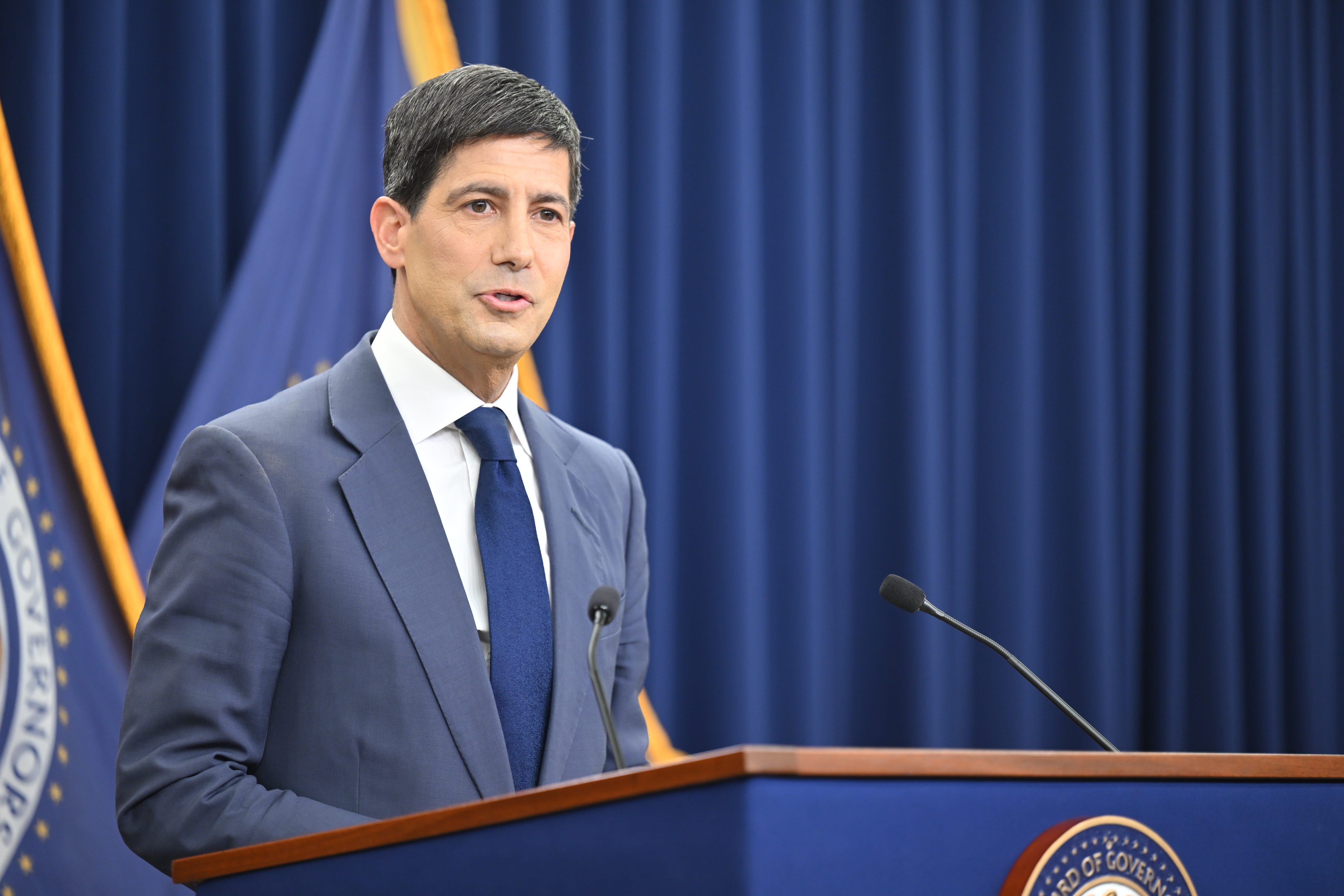
At the end of last week, Fed Chair Kevin Warsh delivered a speech at the Jackson Hole Economic Policy Symposium in which he said the Fed “still has work to do” to rein in inflation. The address nearly doubled prediction market expectations for a hike at the September meeting.
SHOWING OUR WORK: VICO was ahead the whole way
Prior to the speech, the VICO model was high on a September rate hike at 66%. Prediction markets, on the other hand sat at just 28%.
Even a Reuters poll of economists from August 17th found 90% of economists expected rates to remain steady in September.
Immediately following the speech, markets jumped to above 50% for a September rate hike.
The VICO model, by contrast, was high before the speech. The forecast moved upwards in the days prior on the back of hawkish statements made by Fed Presidents concerned about inflation.
With Warsh’s speech, the model reinforced its confidence and moved up slightly, rather than a doubling jump. (Also note the bump in the days leading up to the speech, where the VICO model was anticipating the remarks.)
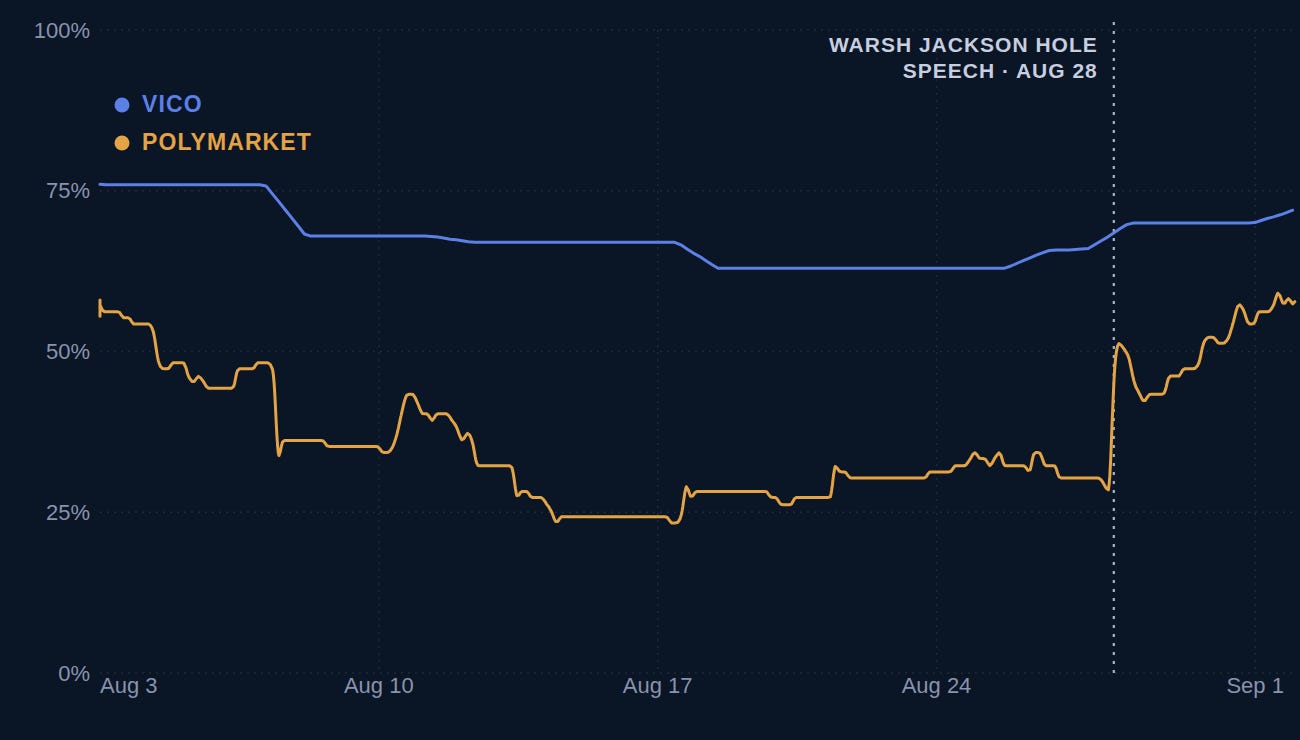
SO WHAT: The VICO model was ahead of markets on a rate hike, and still is.
72%: The probability that the Fed raises rates at the September meeting. Versus Polymarket at 56%.
89%: The probability that the Fed raises rates at least once in 2026. Versus Polymarket at 72%.
[Note that you can now click on highlighted VICO forecasts percentages and access the forecast on VICO Monitor to see back data and directly read the VICO forecast reasoning and evidence.]
Expect a hike in September, and watch the August inflation report for confirmation. If the September 11 report fails to show a cooling economy, the model anticipates even stronger chances of a hike.
72%: The probability that August inflation reaches at least 3.4. Versus Polymarket at 55%
South Korea Tariffs
ISSUE: A stalled pledge raises the tariff risk
As part of last year’s trade deal, South Korea pledged $350 billion in US investment, but the final $200 billion tranche is overdue. Seoul targeted announcing concrete projects by late August, and that deadline has now passed, again raising tariff fears.
50%: The probability that the US launches new or intensified tariffs on South Korea in the next 6 months.
REASONING: The investment stall is the trigger
The VICO Causal Explorer flags the investment rollout as the variable that moves everything else. If the investment start date continues to stall, the delay could provoke a frustrated Washington back into action on tariffs.
36%: The probability that the South Korean government fail to announce a specific investment project in the United States in the next 90 days.
SO WHAT: Miss the window, and the pressure climbs
50% → 75%: The probability of new tariffs if South Korea fails to announce an investment in the next 90 days.
Formal action is not the base case, but it is tied to one clock. Watch the next 90 days of investment headlines: if the rollout keeps slipping, the odds of tariffs or a probe climb.
New Apple CEO
ISSUE: The VICO model sees continuity at Apple, not a dramatic shift
New CEO John Ternus is a hardware engineer, and the VICO model expects Apple to lean into devices while its AI weakness lingers.
REASONING: Lean into the hardware
Where Apple is strong, expect a push. A hardware CEO is well placed to ship the long-rumored foldable iPhone.
78%: The probability that Apple releases a foldable iPhone for commercial sale before December 31, 2027.
In AI and acquisitions, expect more of the same. With Siri now running on Google’s Gemini, the model doubts Apple builds its own. On acquisitions, Apple’s largest ever is $3 Billion, and the model doesn’t see a departure soon.
SO WHAT: New CEO, same Apple
The model’s read is an Apple that stays a hardware leader while renting its AI from Google, a dependency neither an in-house model nor a big deal is likely to end soon. For investors, that is a strong product pipeline sitting on top of an unresolved AI gap.
VICO Scenario Explorer: Apple continues using Google Gemini and does not build an in-house AI
84%: The capital that would have been used for AI investments is rerouted. $8-12 Billion goes towards custom Apple Silicon and device innovations, while the Apple share buyback program increases from $110 to $130 billion.
78%: Alphabet secures an extended multi-year distribution agreement with Apple. Under the agreement, Alphabet pays Apple an estimated $18–22 billion annually in Traffic Acquisition Costs (TAC) plus a 20–30% revenue share on premium Gemini Advanced subscriptions sold via iOS.
Global Politics: US x Iran, Russia x Ukraine, Shanghai Cooperation Organization Summit
US x Iran
ISSUE: The fight grinds on, and Iran’s grip on the Strait is loosening
The US and Iran resumed mutual attacks this week after nearly a month without strikes.
The VICO model’s read on Iran losing the strait has climbed sharply in two weeks, while an end to the conflict before the midterms looks remote.
REASONING: A Kharg strike is the threat, not the plan
Trump posted an AI-generated video of the US bombing Kharg Island, but an actual strike is unlikely, because taking Iran’s main oil terminal offline would trigger a global oil shock.
12%: The probability that the US strikes Kharg Island in the next 30 days.
The reason for such a low probability: oil prices.
69%: The probability that Brent crude spikes $25 per barrel within 72 hours of a strike that takes Kharg’s oil terminal offline according to the VICO Scenario Explorer.
SO WHAT: The squeeze continues despite the threats
The president’s threats represent an extreme edge case. The VICO model sees a long-term continuation of the current siege, with Iran possibly losing control of the Strait in that time.
Russia x Ukraine
ISSUE: Zelensky turns the skies into a weapon
On September 1, Zelensky warned that Russian airspace is “becoming completely unsafe” and will effectively close, as Ukraine’s expanding drone operations on oil refineries make the skies too dangerous to fly.
REASONING: The drones hit refineries, but Russia adapts
The campaign is aimed at Russia’s energy backbone, and the model expects it to keep knocking refining capacity offline. But hitting refineries is not the same as cutting off the money.
72%: The probability that Ukrainian deep strikes take an additional 10% or more of Russian oil refining capacity offline by the end of 2026.
SO WHAT: Real disruption, resilient revenue
When refineries go down, the crude they would have processed is diverted to export, so total oil sales hold up even as products are hit.
32%: The probability that Russia’s combined crude and refined-product exports fall 10% or more in Q4 versus Q3.
Expect the skies to grow effectively closed to civilian traffic while the refinery strikes keep landing. But Russia’s reliance on oil is also its shield. It can shift barrels from refining to raw crude and keep the money flowing.
Shanghai Cooperation Organization Summit
ISSUE: A bloc in photos, not in function
Xi Jinping, Vladimir Putin, and Narendra Modi shared a stage at the Shanghai Cooperation Organization summit in Bishkek, fueling talk of a rival to the G7 and G20. VICO’s read is more skeptical: the members are not as aligned as the picture suggests.
REASONING: One photo, many agendas
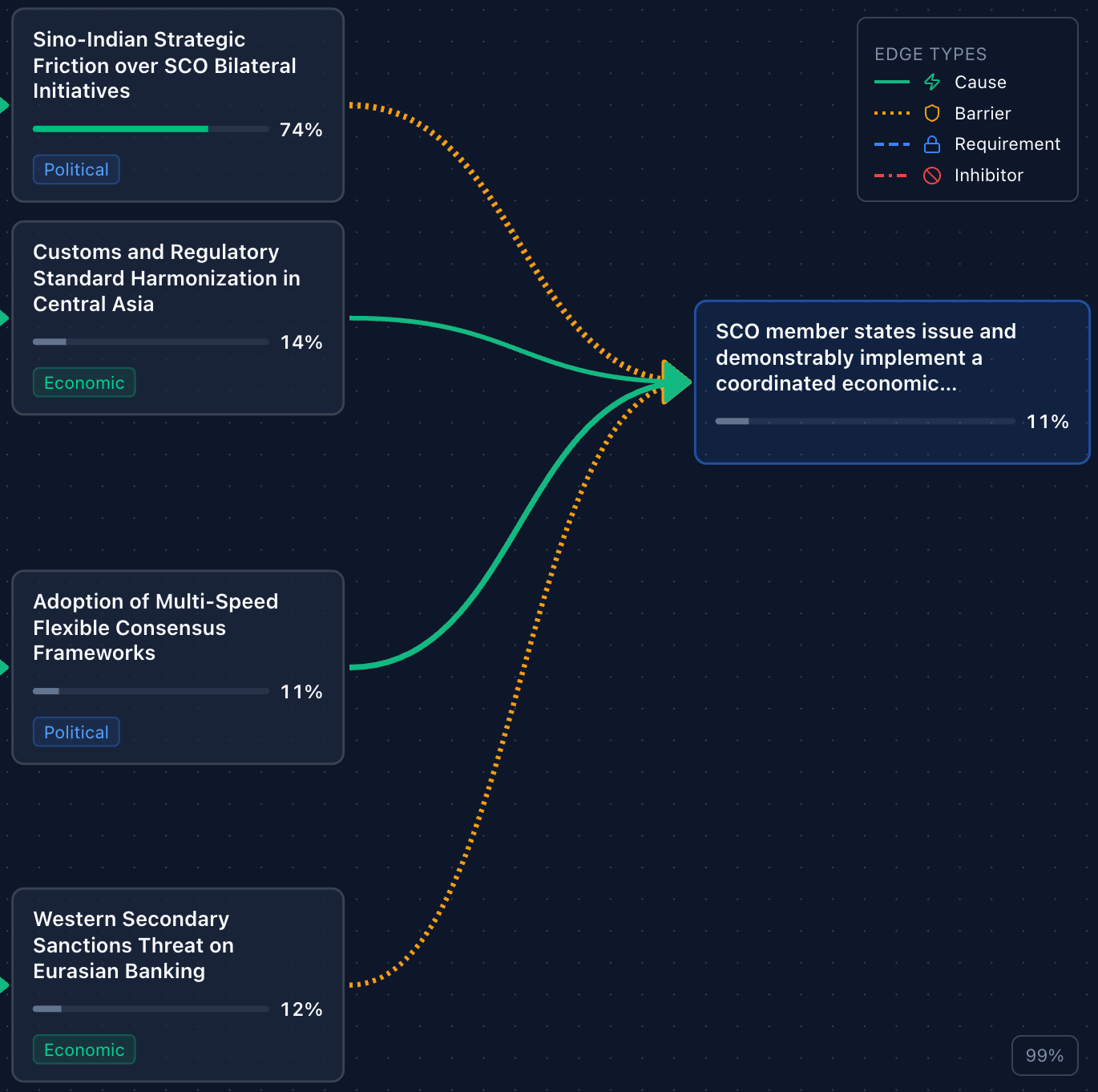
The VICO Causal Explorer finds the low odds of cooperation come from many places at once, because the members are simply too disparate. Sino-Indian tension is the clearest example, alongside the India-Pakistan rivalry, Central Asian states focused on investment, and NATO member Turkey.
74%: The probability that Sino-Indian strategic friction persists over SCO bilateral initiatives.
Stack those divisions together and real cooperation prices as a long shot.
11%: The probability that the SCO issues a coordinated economic commitment all members implement before December 31, 2027.
4%: The probability that all SCO members sign a binding, bloc-wide economic agreement before 2028.
VICO Causal Explorer behind the numbers:
SO WHAT: Separate states, not a unified bloc
The summit will generate striking headlines, but none of it should be mistaken for a functioning economic bloc. Beneath the group photo sits a set of members with clashing interests, and the groundwork for cooperation barely registers.
Domestic Politics: House Back in Session, California AI Bills, Supreme Court Size
House Back in Session
ISSUE: Back in session, but to what end
The House returned to Washington this week, and after passing a stopgap to avoid a shutdown this month, the VICO model is skeptical it accomplishes much, up to and including the simple act of sending itself home early.
REASONING: Paralysis in both directions
Little of substance looks likely to move. The Senate’s Russia sanctions bill faces Republican divisions deep enough to keep it off the floor, and even an early recess is a hard sell, since a vote to leave town could be politically twisted by challengers.
The one thing that approaches a coin-flip is dysfunction. While the recent bill delays an immediate shutdown, the model leaves the door open for the president to try to use one in an attempt to force the SAVE Act through.
45%: The probability of a government shutdown in 2026.
SO WHAT: Gridlock is the base case
Expect a House that struggles to pass legislation, and cannot easily even recess. For anyone watching Washington for action, the model’s message is to expect paralysis, with the only near-certainty being that little gets done.
California AI Bills
ISSUE: Newsom Unlikely to Stop California’s New AI rules
California’s legislature sent Governor Newsom a wave of AI bills, with a September 30 deadline to act. With no pocket veto, a veto is the only way any dies, and the model expects all four to become law.
REASONING: Low veto odds, then a federal challenge
Public appetite for regulating AI is strong, and a governor with national ambitions has little reason to spike popular child-safety and worker-protection bills. Even SB 1119, which OpenAI’s Sam Altman reportedly contacted Newsom about, sits at just 32%.
9%: The probability that Newsom vetoes AB 1709 (social media versions for minors).
22%: The probability that Newsom vetoes AB 1883 (workplace AI surveillance).
24%: The probability that Newsom vetoes SB 867 (companion chatbots in toys).
32%: The probability that Newsom vetoes SB 1119 (chatbot child-safety).
But passage is not the end. The fight likely moves to federal court.
52%: The probability that the DOJ challenges the California AI laws within six months if all four pass.
SO WHAT: Concrete costs, pending a court test
The country’s largest state economy is about to become the first major AI regulator, with real costs for platforms, toymakers, employers, and chatbot makers. Though it all rests on possible litigation down the road.
Supreme Court Size
ISSUE: A symbolic vote on Court size
House Democrats voted down a Republican amendment to lock the Supreme Court at nine justices, keeping the door to expansion technically open. But the VICO model reads the whole fight as theater: neither expansion nor a formal lock is close to happening.
REASONING: Both paths lead nowhere
Expanding the Court would take unified control and the will to break with a 150-year norm, and a constitutional lock would take a two-thirds supermajority and 38 states, a near-impossible bar in a divided country.
SO WHAT: The status quo wins by inertia
The size of the court is likely to remain a political issue, but the model sees very little chance it meaningfully changes. We are calling this story noise.
About Us
VICO empowers decision makers to quantify and navigate event risk. Forecast, simulate and monitor political, geopolitical and economic events.
Learn more and obtain a beta account at www.vico.io or email us at inquire@vico.io
Methodology and Copyright Notes:
All percentage changes are over the last week except where noted.
Our proprietary AI models are rigorously backtested and do not rely on any betting market information.
All data and content are owned by and copyrighted by VICO Technologies Inc.