VICO FUTURE MONITOR · NEWSLETTER
Huang Down, Inflation Up - November 12, 2026
Jensen Huang Resignation, Inflation/Fed, Shenzhen Summit, Russia x Ukraine, US x Iran, Hegseth Impeachment, Congressional Leadership and Immigration
This issue was published in the VICO Future Monitor newsletter and is archived here; edits and forecast links were added by the VICO editorial team.
Access VICO forecasts or make your own at www.vico.io as well as on the Bloomberg Terminal at WSL PREDICT<GO>, WSL ELECTION<GO> and WSL VICO<GO>.
What we are following this week:
Economics: Jensen Huang Resignation, Inflation/Fed
Geopolitics: Shenzhen Summit, Russia x Ukraine, US x Iran
Domestic Politics: Hegseth Impeachment, Congressional Leadership and Immigration
Economics: Jensen Huang Resignation, Inflation/Fed
Jensen Huang Resignation
Issue: Huang resigns, Kress steps in
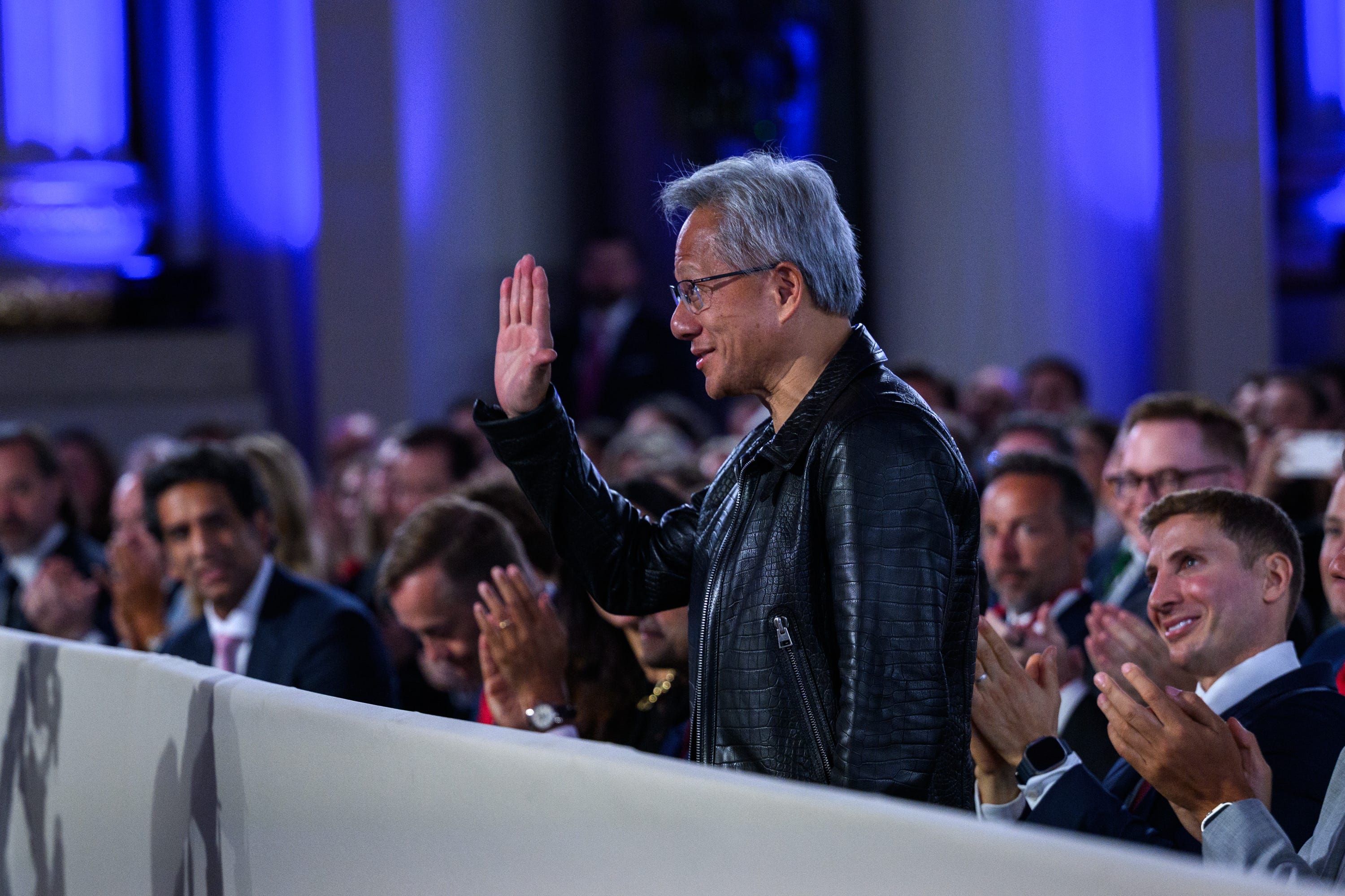
Jensen Huang resigned this morning as NVIDIA’s president, CEO, and board member following revelations of a second affair, this time with NVIDIA staff. CFO Colette Kress has taken over as interim CEO, but the company has no designated permanent successor.
The question that now drives the stock is not whether Huang survives, but who replaces him, and whether NVIDIA can run without its founder-visionary.
Reasoning: The race to replace him
With no permanent hire made, the field is broad. The VICO model identifies the two leading candidates: interim CEO Colette Kress, who was the CFO at NVIDIA, and Ian Buck, the Vice President and General Manager of Hyperscale and High-Performance Computing (HPC).
30%: The probability that Ian Buck is named NVIDIA’s permanent CEO before 2028.
20%: The probability that Colette Kress is named NVIDIA’s permanent CEO before 2028.
The remaining 50% is dispersed across a number of alternative candidates.
10%: The next permanent CEO of NVIDIA is currently the CEO of another tech company before 2028.
The pick reshapes strategy either way. The VICO Scenario Explorer forecasts what each pick could mean for the tech giant:
If Ian Buck is named CEO:
70%: cloud providers (Azure, AWS, Google Cloud) accelerate multi-sourcing to rivals like AMD during the transition.
65%: NVIDIA pivots toward monetizing its software stack, lifting software revenue by as much as 40%.
26%: NVIDIA delays commercial shipment of its next-generation Rubin GPU platform.
If Colette Kress is named CEO:
73%: NVIDIA halts its export-control lobbying and strips projected Chinese data-center revenue from its FY2028 guidance.
50%: Hyperscalers divert capex to custom silicon alternatives.
So what: The business, and the stock, probably survive
The VICO model argues that despite the chaos at the top, NVIDIA’s business fundamentals remain strong. Demand for NVIDIA chips is likely to continue, and as a result, the model sees a stock recovery to pre-scandal heights within the year.
65%: The probability that NVIDIA stock rebounds to at least $190, near its pre-scandal high, within a year.
The VICO model does, however, see a possibility for increased regulatory compliance. That would likely mean an outside monitor and new rules on vetting buyers and tracking its most advanced chips.
40%: The probability that NVIDIA signs a compliance agreement with the Treasury Department within two years.
What’s next for Jensen Huang?
But Huang may not be out of the game. Following the scandal, Elon Musk said it would be “an honor” to hire him at SpaceX. But the VICO model is skeptical he actually ends up there.
Inflation/Fed
Issue: Prices ran hot again in October
October headline CPI rose 0.4% on the month, above the 0.3% economists expected. The report is stoking fears of resilient inflation, which in turn makes a Fed hike more likely.
Reasoning: Sticky, but not spiraling
But the VICO model is not forecasting a large inflation spike after October’s hot report. Instead, the VICO model is under market expectations for November inflation. However, the VICO model sees a just 1 in 4 chance of headline CPI cooling to 3.5% in 2026.
So what: The hike is nearly locked, and a 50bp move is possible
Sticky-above-target is still too hot for the Fed, so the VICO model treats another December hike as highly likely. And after a hot October, with one Fed official already floating a half-point, a jumbo 50 basis-point move is over 10%. The open question is no longer whether the Fed moves in December, but how hard.
Geopolitics: Shenzhen Summit, Russia x Ukraine, US x Iran
Shenzhen Summit
Issue: Negotiating the negotiation
APEC’s leaders’ meeting is in Shenzhen on November 18 and 19, and Trump says he expects to meet both Xi and Putin there. It would be the first-ever Trump-Xi-Putin trilateral.
But neither Beijing nor the Kremlin has confirmed their attendance, and the three sides currently disagree over how the meeting should go.
Reasoning: Disagreements on formatting
The meeting happening at all is below 50%. China wants a rigid, scripted format the US is resisting, and the VICO model argues those format disagreements are more likely than not to kill the meeting before it happens.
40%: The probability that Trump, Xi, and Putin hold a trilateral meeting at the Shenzhen summit.
Note: this forecast increased 10% overnight, we assess that it may continue to increase.
As a result, the deliverables look thin.
32%: The probability that the US and China announce a trade, tariff, or export-control agreement by November 30, 2026.
22%: The probability that the US announces an expansion of sanctions relief or a broader energy or economic agreement with Russia before December 31, 2026.
8%: The probability that the United States formally opens negotiations on a nuclear weapons treaty with Russia or China within the next 180 days.
The real signal is quieter: the rare-earth truce holding. China dominates rare-earth processing, so extending the suspension keeps a critical input flowing to automakers, defense, and chipmakers — and keeps China’s biggest supply-chain weapon holstered.
72%: The probability that China extends the suspension of its additional rare-earth export controls beyond the January 10, 2027 deadline.
So what: Even with a summit, deals are unlikely
Even if the meeting occurs, not much is likely to happen. The VICO Scenario Explorer weighs the possible outcomes if it does:
22%: The probability that the US and China extend their bilateral trade truce in November.
25%: The probability that a Russia-Ukraine peace framework requiring Ukrainian territorial concessions is reached.
Russia x Ukraine
Issue: A prisoner swap, but no peace
The latest US-mediated round in Abu Dhabi, on November 10 and 11, ended with a major prisoner exchange but no broader deal, and envoys Kushner and Witkoff now head to Moscow and then Kyiv.
32%: The probability that Russia and Ukraine reach a ceasefire agreement to end the conflict before June 30, 2027.
Reasoning: What gets a deal
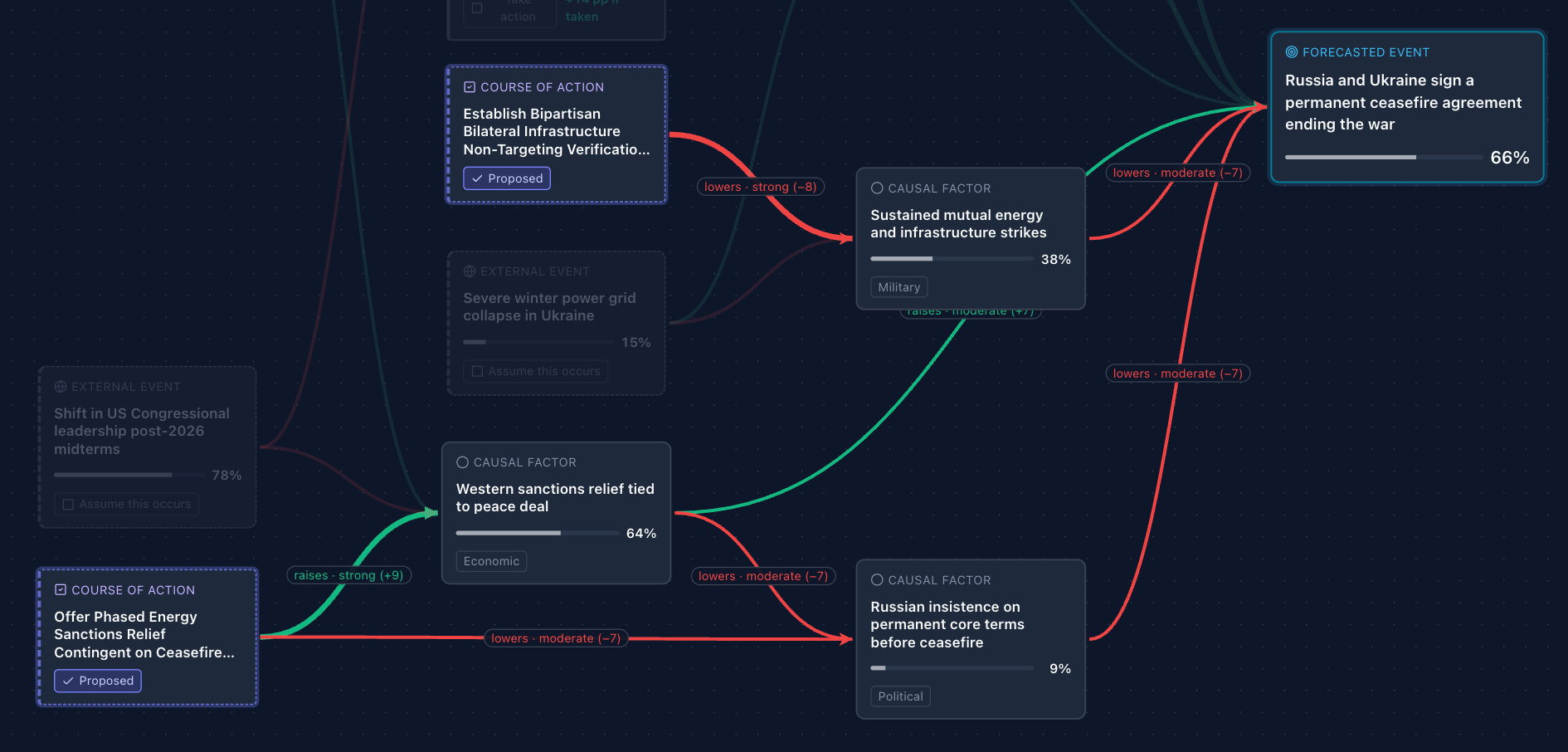
The VICO Causal Explorer’s pathfinder feature identifies three paths that would lift a ceasefire above 50%. None is likely on its own today, but each is a possibility moving forward.
The first road is energy for sanctions. Russia trades an energy-infrastructure ceasefire for Western sanctions relief, a narrow deal that could seed a broader one.
25%: The probability that Russia and Ukraine implement an energy-infrastructure ceasefire before February 28, 2027.
25%: The probability that the US expands sanctions relief or reaches a broader energy agreement with Russia before December 31, 2026.
If both of these events happened, the probability of a permanent ceasefire increases from 32% to 66%.
The second road is European security guarantees. A guarantee backed by European partners gives Ukraine the cover to stand down, but Europe is not yet admitted to the talks.
20%: The probability that a settlement provides Ukraine an Article 5-style security guarantee from Western allies before June 30, 2027.
12%: The probability that Russia allows European negotiators to participate in a future round of the talks before December 31, 2026.
If both of these events happened, the probability of a permanent ceasefire increases from 32% to 55%.
The third road is a Donbas special economic zone. A demilitarized, internationally monitored zone across the disputed Donbas defers the sovereignty fight under joint administration.
25%: The probability that Ukraine cedes or withdraws from any Ukrainian-controlled Donbas territory before June 30, 2027.
If Russia and Ukraine agree to this Donbas deal, the probability of a permanent ceasefire increases from 32% to 54%.
So what: A ceasefire is the off-switch for the fuel squeeze
For markets, the biggest piece is continued strikes on Russian oil refineries. No energy ceasefire means Ukraine will continue hitting Russian energy targets, which is likely to constrict supply by more than 10% in Q4 vs Q3.
89%: The probability that Russian crude or refined-product exports fall by at least 10% in Q4 2026 versus Q3, due to refinery strikes, before January 15, 2027.
US x Iran
Issue: Trump declares the war all but over
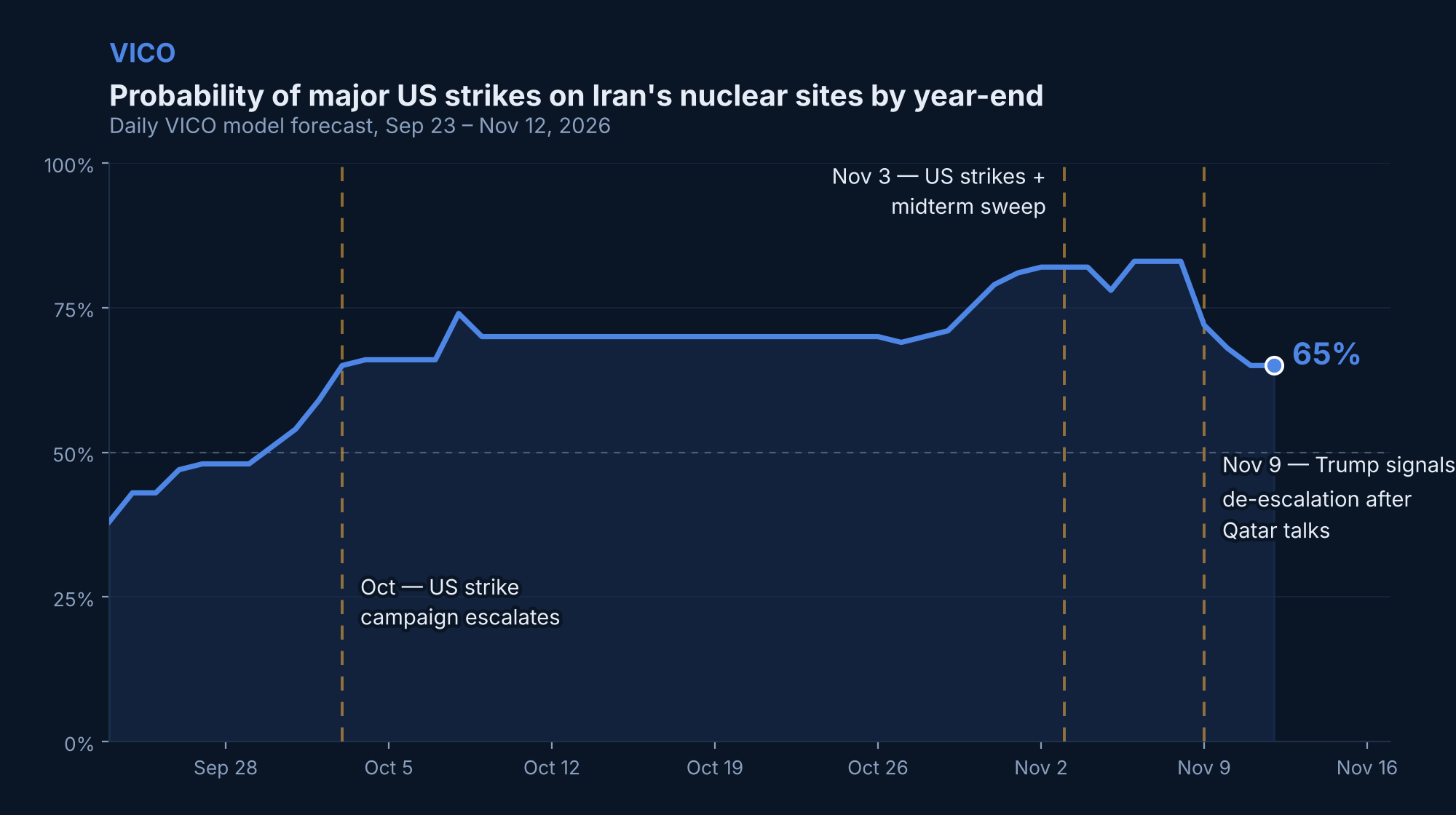
After meeting Qatar’s prime minister, Trump cited “momentum” toward ending the war, called fresh strikes “highly unlikely” if Iran reopens Hormuz and reaches a nuclear deal, and said the conflict is “effectively over.” Tehran denied any planned talks and answered with a warning.
The VICO model is not convinced: as the chart shows, his de-escalation signal knocked the probability of a major strike on Iran’s nuclear sites down only to 65%, still more likely than not.
65%: The probability that the US carries out major strikes on Iran’s nuclear sites before December 31, 2026.
Reasoning: A lull, not peace
The VICO model grants a near coin-flip on strikes in the short term.
48%: The probability that the US launches new strikes on Iran in the next 14 days.
But any de-escalation is unlikely to reach the blockade, or lead to direct negotiations.
So what: Strait (probably) stays closed
For markets, the real tell is the Strait of Hormuz. Even with strikes paused, the VICO model gives only about a one-in-three chance it fully reopens within six months, so the supply-disruption risk stays on the table, truce or no truce.
34%: The probability that the Strait of Hormuz reopens to unrestricted shipping within 180 days.
Domestic Politics: Hegseth Impeachment, Congressional Leadership and Immigration
Hegseth Impeachment
Issue: Round one of Hegseth impeachment efforts fail
Rep. Thomas Massie’s lame-duck impeachment push was blocked in the House, but the incoming Democratic majority is expected to target the Secretary of War with investigations and impeachment. The VICO model puts his probability of being gone by year-end at slightly under 50%.
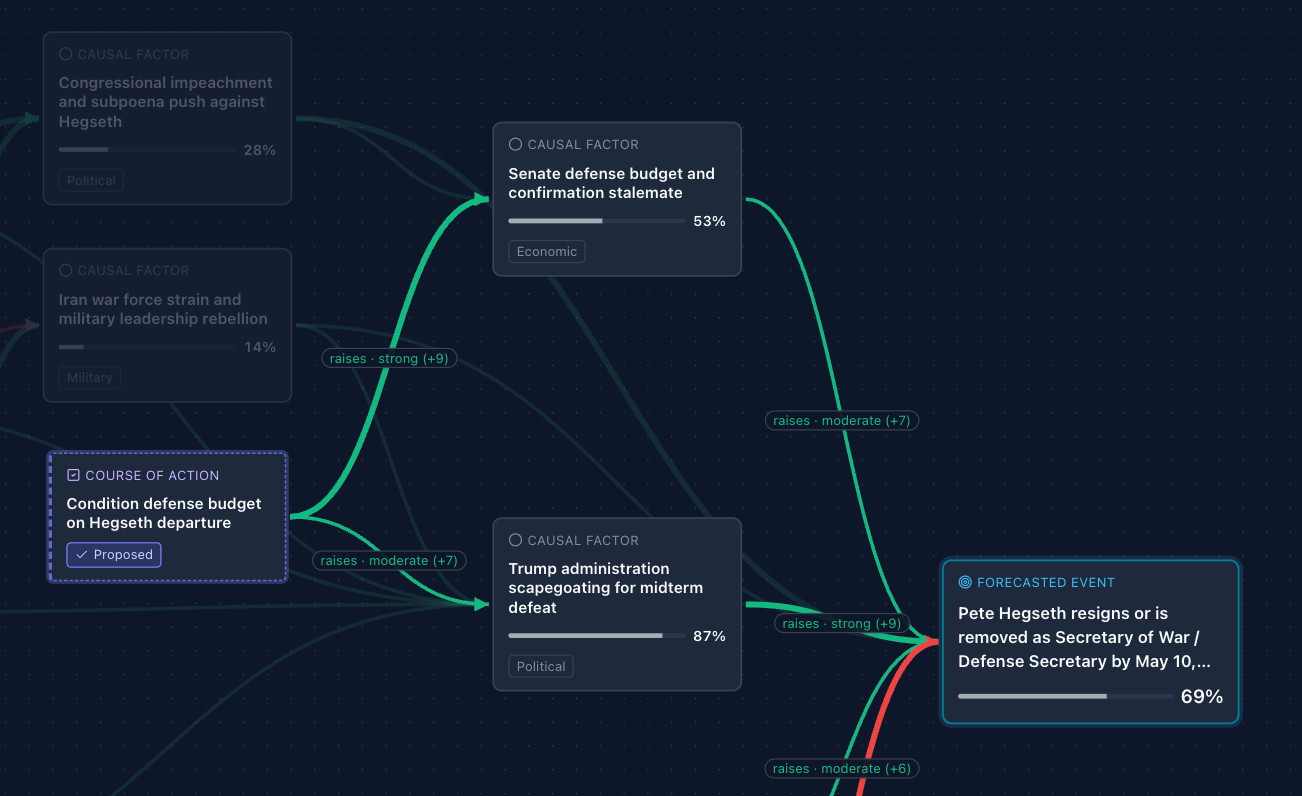
45%: The probability that Pete Hegseth is out as Secretary of War by the end of 2026.
Reasoning: Impeachment again, but no conviction
The VICO model argues that Democrats are likely to try again at some point after taking power, but even their 56 seat majority in the Senate falls short of the 67 votes needed to convict.
82%: The probability that the House impeaches Hegseth before the end of Trump’s term.
2%: The probability that the Senate convicts him in an impeachment trial before the end of 2027.
85%: The probability that a congressional committee subpoenas Hegseth or opens a formal investigation into him before June 30, 2027.
So the exit runs through Trump, not the Senate. The VICO Causal Explorer weighs the president’s defense of Hegseth against his incentive to scapegoat him for the midterm losses or trade him for an administration priority. One scenario that pushes Hegseth out is a bipartisan deal: Democrats back the president’s military budget in exchange for Trump removing Hegseth.
So what: Watch the defense budget
If Hegseth goes, it could be part of a deal on defense, which is also the fight that matters for markets. The deal that removes him is the one that clears the president’s requested defense authorization, so the signal to watch is not the Judiciary Committee but the NDAA, where the model still sees the full topline as a long shot.
15%: The probability that Congress enacts a FY2027 NDAA with a topline of at least $1.15 trillion before June 30, 2027.
Congressional Leadership and Immigration
Issue: Democratic leadership drama
The midterm sweep handed Democrats both chambers, but now House and Senate leadership are both facing potential challenges from their left. At a press conference on Tuesday, Senator Bernie Sanders announced he would not support Schumer for leadership. The VICO model is unconvinced.
Reasoning: Jeffries and Schumer to decide whether or not to work with Trump
The new majority has to govern opposite a Republican president, and Trump has named where he sees a deal: immigration. On “60 Minutes” he called his own deportation policy “too tough” for midterm voters and floated legal status for some unauthorized immigrants, before the White House walked it back.
Again, the VICO model leans toward gridlock over compromise, but leaves a possibility of a breakthrough.
And if anything passes, expect a trade confined to the narrowest slice, not a broad amnesty.
So what: The market signal is enforcement, not the bill
The market variable isn’t the bill but the crackdown. Tight interior enforcement has squeezed labor in construction, agriculture, and hospitality, keeping services wages and inflation hot. Enforcement easing would alleviate some of that pressure, but the VICO model is at just one in four.
25%: The probability that the Trump administration formally scales back interior immigration enforcement before June 30, 2027.
About Us
VICO empowers decision makers to quantify and navigate event risk. Forecast, simulate and monitor political, geopolitical and economic events.
The VICO model uses AI, data science and modeling & simulation to derive all of its forecasts. It does not use prediction market data.
Learn more and activate and account at www.vico.io or email us at inquire@vico.io
Methodology and Copyright Notes:
All percentage changes are over the last week except where noted.
Our proprietary AI models are rigorously backtested and do not rely on any betting market information.
All data and content are owned by and copyrighted by VICO Technologies Inc.