VICO FUTURE MONITOR · NEWSLETTER
MOU or IOU?
US x Iran, Russia x Ukraine, Iran Treaty, Alaska Senate Election, FISA 702 Expiration, SpaceX IPO, Claude Fable 5 Shutdown, Oil Prices, VICO Indices
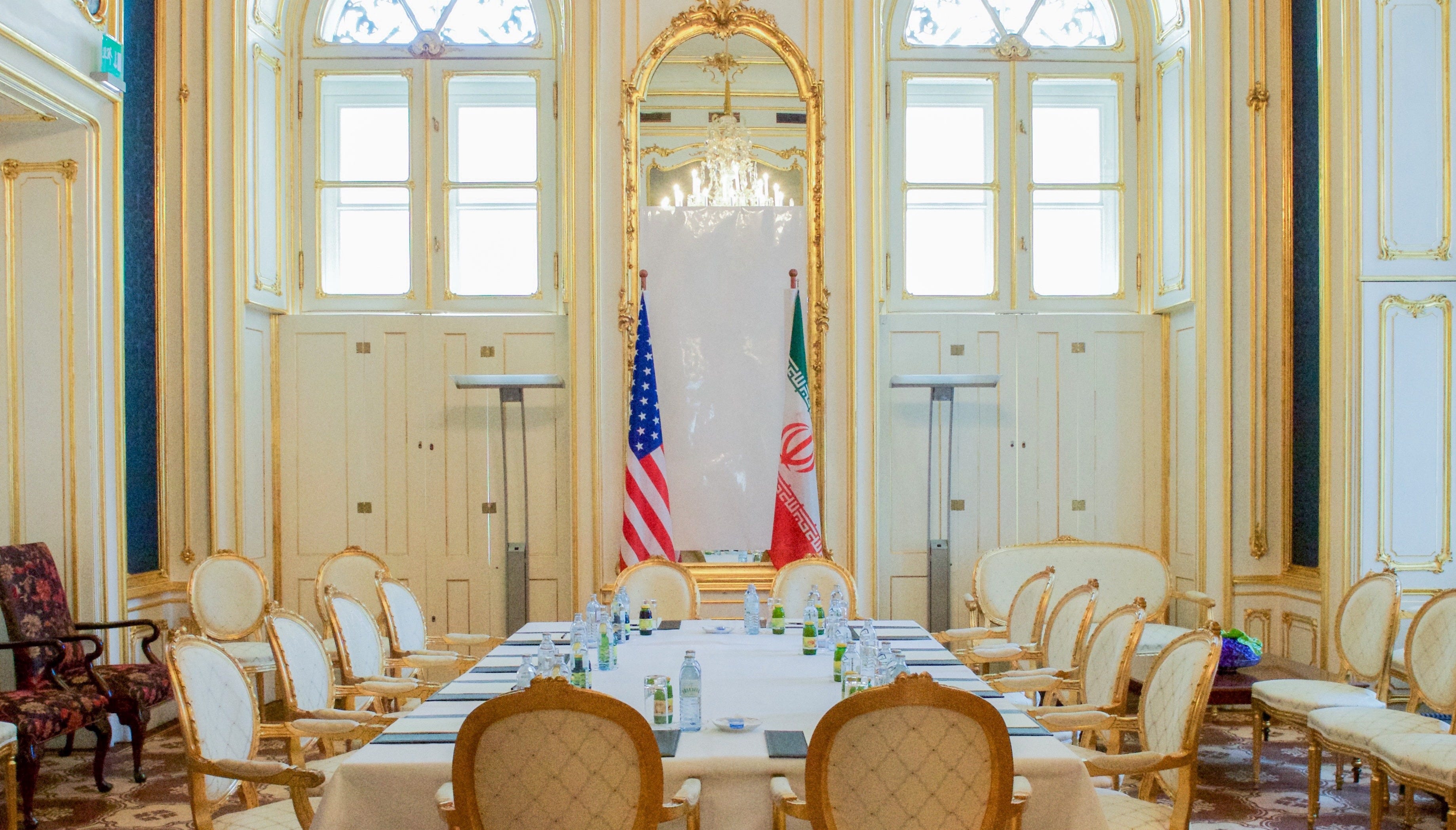
This issue was published in the VICO Future Monitor newsletter and is archived here; edits and forecast links were added by the VICO editorial team.
Access VICO forecasts or make your own at www.vico.io as well as on the Bloomberg Terminal at WSL PREDICT<GO>, WSL ELECTION<GO> and WSL VICO<GO>.
What we are following this week:
Global Politics: US x Iran, Russia x Ukraine
Domestic Politics: Iran Treaty, Alaska Senate Election, FISA 702 Expiration
Economics: SpaceX IPO, Claude Fable 5 Shutdown
Special Section: VICO Indices
Global Politics: US x Iran, Russia x Ukraine
After weeks of speculation over negotiations with Iran, President Trump announced that a deal has been reached to extend the ceasefire by 60 days and reopen the Strait of Hormuz. However, the specific details of the agreement remain private, and the American and Iranian officials have publicly disagreed over what the MOU actually stipulates. As details continue to come to light, the President is attending the G7 Summit in France, where European leaders are pushing for more aid to Ukraine. This week:
US x Iran - Deal Outlook
6%: The probability that the MOU leads to a permanent ceasefire deal in the next 60 days.
37%: The probability that the MOU breaks down and strikes resume in the next 60 days.
57%: The probability that the MOU leads to neither a deal nor a resumption of strikes, and a peaceful stalemate ensues.
The VICO model is highest on the probability of a peaceful stalemate, citing a mutual desire to end the conflict, but also political costs for both sides to reach a permanent agreement. The possibility of the deal breaking up is mostly driven by regional risks, namely Israeli strikes in Lebanon, which could provoke an Iranian retaliation.
Deal Details
3%: The probability that Israel will cease all military strikes in Lebanon in the next 60 days.
The VICO model points to the Israeli Prime Minister’s explicit repudiation of the deal’s prohibition of Israeli strikes to justify the low probability. However, in estimating the effect of continued strikes on the deal, the model notes that both sides have a desire to “decouple their bilateral de-escalation from local proxy skirmishes.”
68%: The probability that Iran agrees to keep the Strait of Hormuz toll-free in the next 60 days.
3%: The probability that Iran agrees to surrender enriched uranium in the next 60 days.
18%: The probability that Iran gains access to a majority of the $300 billion laid out in the MOU in the next 5 years.
Vice President Vance has emphasized that Iran will not gain access to the $300 billion if they do not comply with US demands around their nuclear arsenal, which the model believes Iran is unlikely to do.
Permanent Ceasefire?
In last week’s newsletter, we forecasted the odds for a permanent ceasefire deal before June 30th at 1%, while Polymarket was at 15%.
With the deal’s extension of the temporary ceasefire, the VICO model has moved to below 1% as the deal explicitly kicks the window for a permanent deal down the road.
However, Polymarket’s market resolved to yes for a permanent ceasefire.
The market has been formally disputed multiple times, with “no” traders arguing the deal does not constitute a permanent ceasefire. We agree.
The ordeal serves as a reminder that prediction markets are often a reflection of vague fine print rather than the natural understanding of a question. With VICO, forecasts can be tailored to match specific criteria laid out by the user.
Russia x Ukraine
28%: The probability that Russia and Ukraine reach a ceasefire in 2026.
Ticker: VICOBIZK
62%: The probability that the US provides more military aid to Ukraine in the next 120 days.
The VICO model argues that the President is more likely to support aid to Ukraine after a productive G7 Summit. The model also notes that the President needs allied help in Iran, which may make him more conciliatory in Ukraine.
Domestic Politics: Iran Treaty, Alaska Senate Election, FISA 702 Expiration
Senate Republicans are demanding a vote on the deal with Iran. Meanwhile, Alaska Senator Dan Sullivan’s primary challenger with the same name was expelled from the ballot, as the Republican prepares to face Democrat Mary Peltola in the general. And FISA Section 702 expired on Friday. This week:
Iran Treaty
6%: The probability that Congress holds a vote to ratify a deal with Iran in 2026.
The VICO model argues that the current MOU was designed to circumvent the need for Senate approval, and that a formal binding treaty (if one is agreed to) could get shot down in the Senate, especially as we near the midterms.
Alaska Senate Election
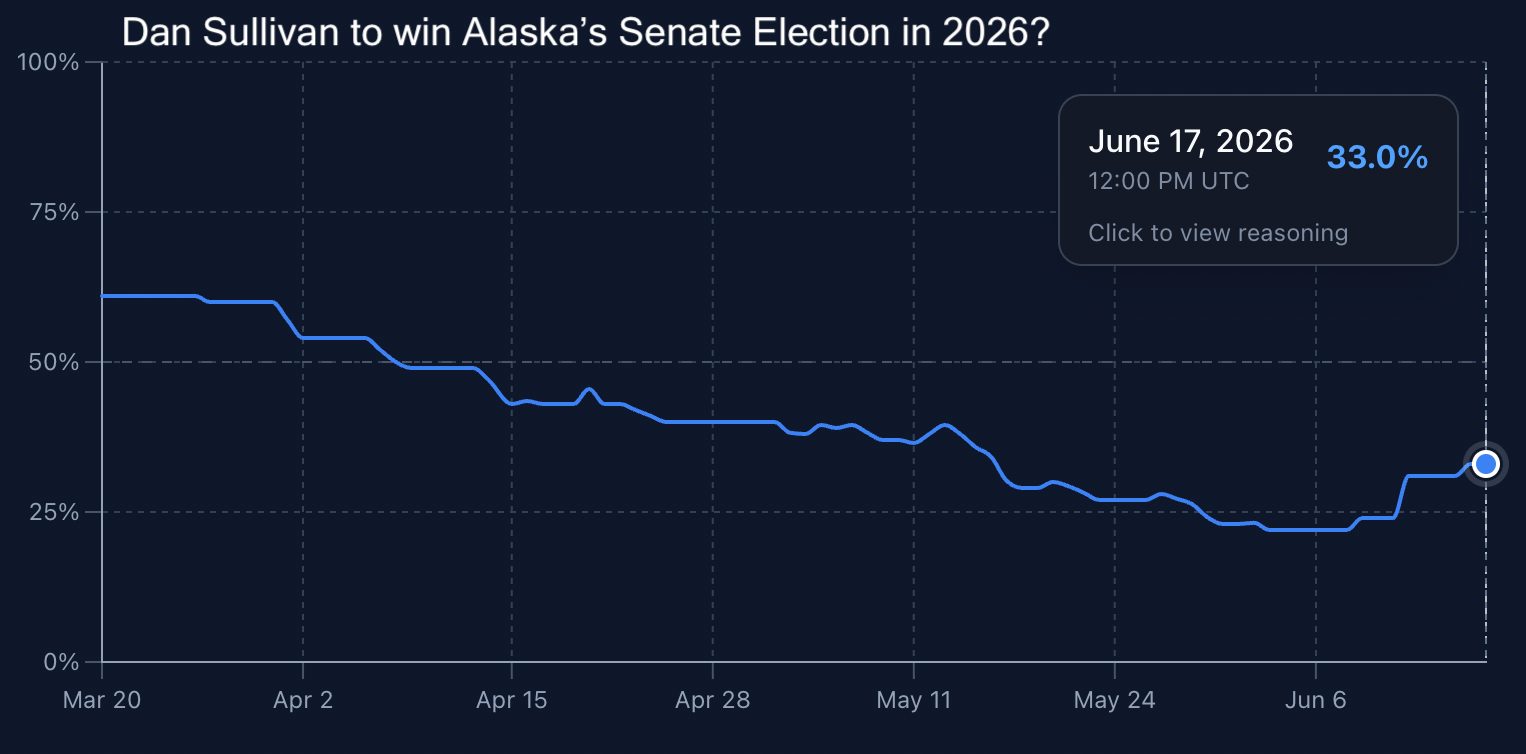
33%: The probability that Dan Sullivan (R) wins Alaska’s Senate Election.
The VICO model jumped slightly following the expulsion of Sullivan’s namesake challenger, but still remains low relative to earlier this year, as recent polling has shown Mary Peltola (D) with a 4-5 point lead.
FISA 702 Expiration
62%: The probability that Congress extends section 702 of FISA by March 31, 2027.
Despite receiving relatively little news coverage, the VICO model argues that the extension of Section 702 is far from certain. Current surveillance authority is locked in until March of 2027, but no extension by the end of March could significantly impact US intelligence-collecting capabilities.
Economics: SpaceX IPO, Claude Fable 5 Shutdown
SpaceX officially IPO’d last week, ending its first trading day with a valuation of roughly $2.1 trillion. Meanwhile, Anthropic shut down its Fable 5 model in response to export controls from the US government. This week:
SpaceX IPO
In our newsletter from last week, we forecasted the probability for SpaceX to end its first trading day with at least a $2.2 trillion valuation at 14% compared to Polymarket’s 41%. We called it. That forecast resolved to no at the close of business on Friday.

Claude Fable 5 Shutdown
42%: The probability that Claude Fable 5 is restored to US users by July 1. (Polymarket: 48%)
28%: The probability that Claude Fable 5 remains restricted to only US citizens in the next 60 days.
Special Section: VICO Indices
We are officially launching VICO Indices.
VICO indices are benchmarks for political, geopolitical, and economic exposures. Each index translates probabilistic forecasts of significant world events into a single, continuously updated daily value, providing a comparable, quantitative signal for exposures that have historically been difficult to quantify.
In this special section, we’ll take a deeper look into the first three VICO indices, now live at www.vico.io and on the Bloomberg Terminal.
Hard Power Index
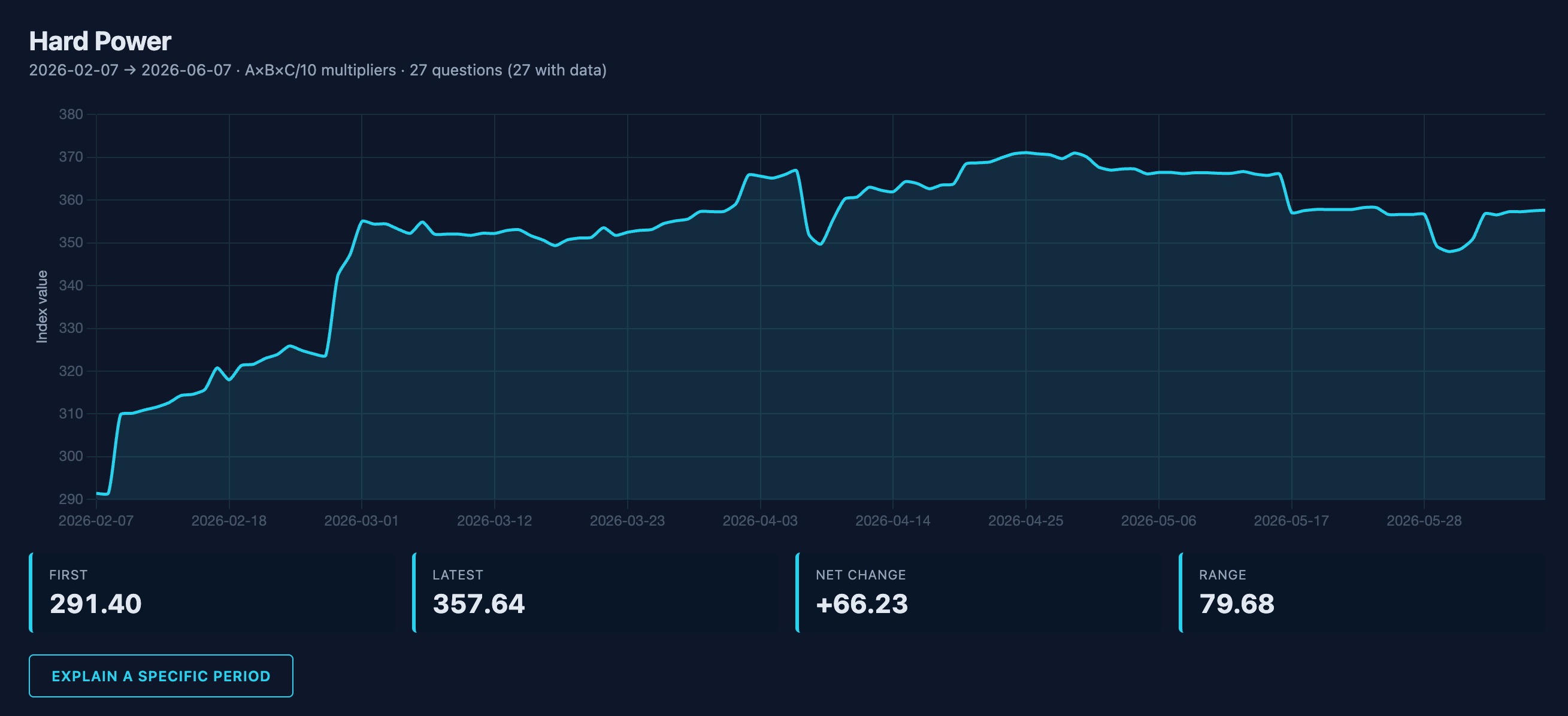
Our Hard Power Index is designed to track the US’s aggressive posturing and use of hard power (military force) as a tool of international relations.
The constituent forecasts track various events from direct military action to arms purchases across Use of Force, Strategic Commitments, and Capability/ the US Industrial Base.
Deglobalization Index
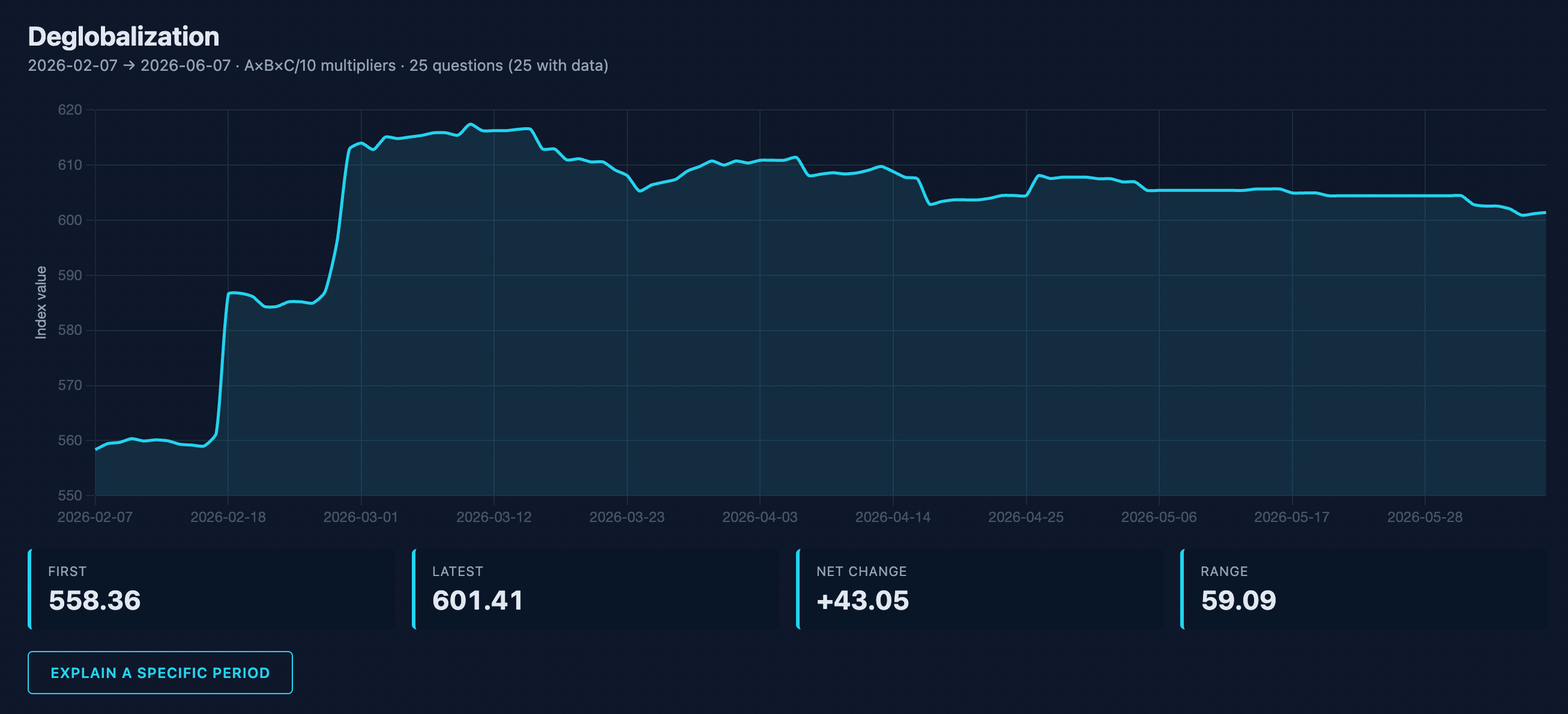
Our Deglobalization Index tracks the decline of large multilateral institutions in favor of bilateral agreements and “coalitions of the willing.”
The constituent forecasts track Security and Military Coalitions, Trade and Economic Governance, Global Health and Climate Cooperation, Technology and Non-Proliferation, and Humanitarian and Institutional topics.
Tokenization Index
Our Tokenization Index tracks the tokenization of financial assets in the broader US market. The index tracks Market Size and Growth, Institutional Adoption, Regulation and Infrastructure, and Asset Class and Cross-border issues.
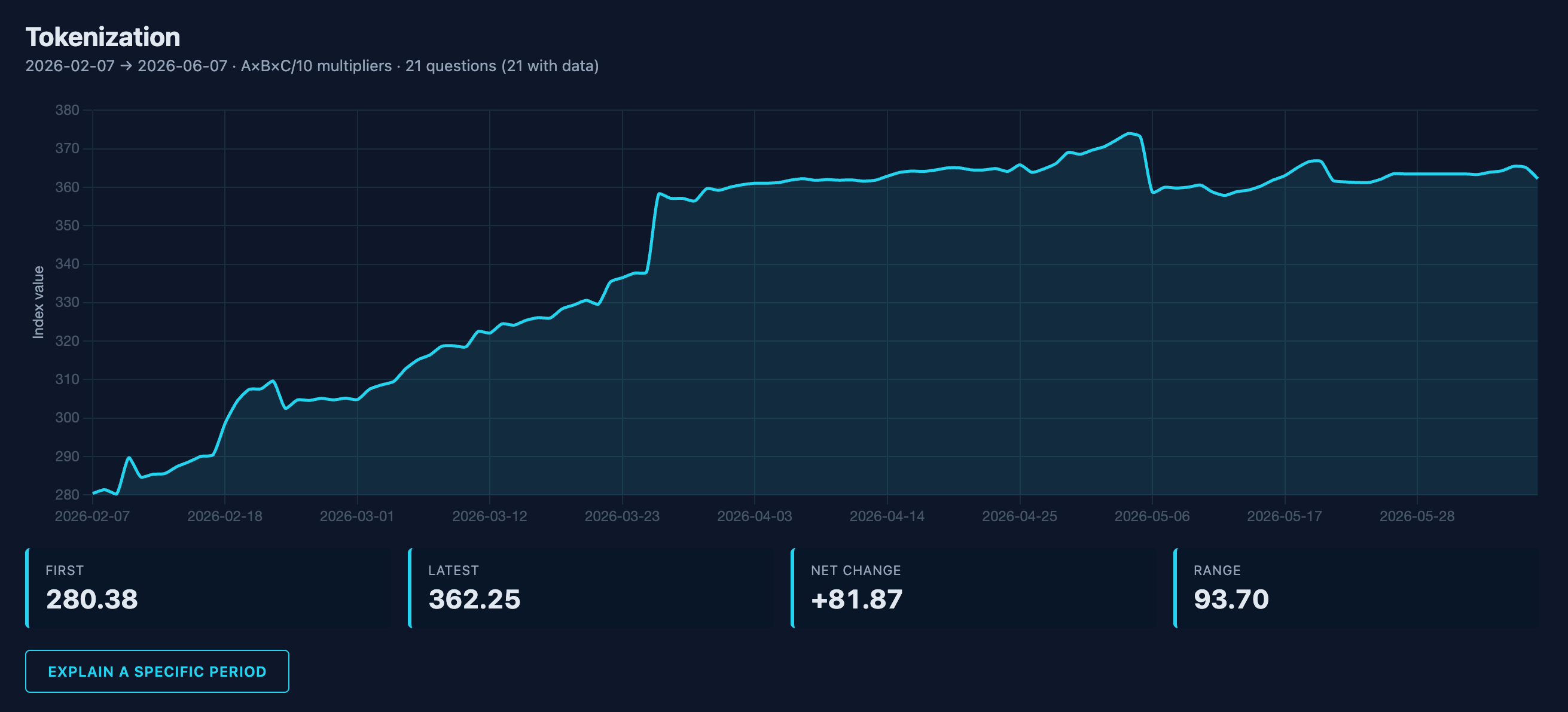
VICO Indices have three benefits versus traditional financial, political risk or related indexes:
The VICO indices allow for the quantification of historically nebulous macro trends in politics, geopolitics, and economics. For example, it’s easy to say that the world is becoming less globalized, but we quantify exactly how much less globalized.
Our indexes are forward-looking rather than reactive. Typical indexes shift after significant events; the VICO index shifts before. This creates a leading indicator for those looking to do anything from trading a stock to making a major corporate decision.
In contrast to traditional risk indexes curated by human analysts, every forecast that comprises VICO indices updates daily, as the VICO AI model continuously processes thousands of sources, providing a unique tool for measuring changes in ever-shifting trends. You don’t need to wait until next month for an updated risk index; VICO will deliver you a fully updated index tomorrow.
Learn more about the VICO Index methodology here and subscribe to VICO to access these indexes or check us out on the Bloomberg Terminal.
About Us
VICO empowers decision makers to quantify and navigate event risk. Forecast, simulate and monitor political, geopolitical and economic events.
Learn more and obtain a beta account at www.vico.io or email us at inquire@vico.io
Methodology and Copyright Notes:
All percentage changes are over the last week except where noted.
Our proprietary AI models are rigorously backtested and do not rely on any betting market information.
All data and content are owned by and copyrighted by VICO Technologies Inc.