VICO FUTURE MONITOR · NEWSLETTER
VICO 2026 Midterm Preview
Forecasts on the biggest races in the 2026 midterms.
This issue was published in the VICO Future Monitor newsletter and is archived here; edits and forecast links were added by the VICO editorial team.
Access VICO forecasts or make your own at www.vico.io as well as on the Bloomberg Terminal at WSL PREDICT<GO>, WSL ELECTION<GO> and WSL VICO<GO>.
VICO 2026 Midterm Preview
Issue: Our final read before the polls close
Polls are open, and the VICO model has Democrats favored to win both chambers: strongly in the House, and by a clear but narrower margin in the Senate. The model and the prediction markets largely agree on who controls each chamber; where they split hardest is on a handful of individual races. Follow it live on our midterm tracker.
Every percentage is a candidate’s VICO-modeled chance of winning, not a projected vote share. “R+14” refers to a district that voted for President Trump by 14 points in 2024.
The House: Five Races to Watch
The VICO model’s central estimate is a Democratic House of about 230 seats, well past the 218 for a majority, and the prediction markets are even more confident, pricing Democratic control around 95%. The suspense is in the Senate.
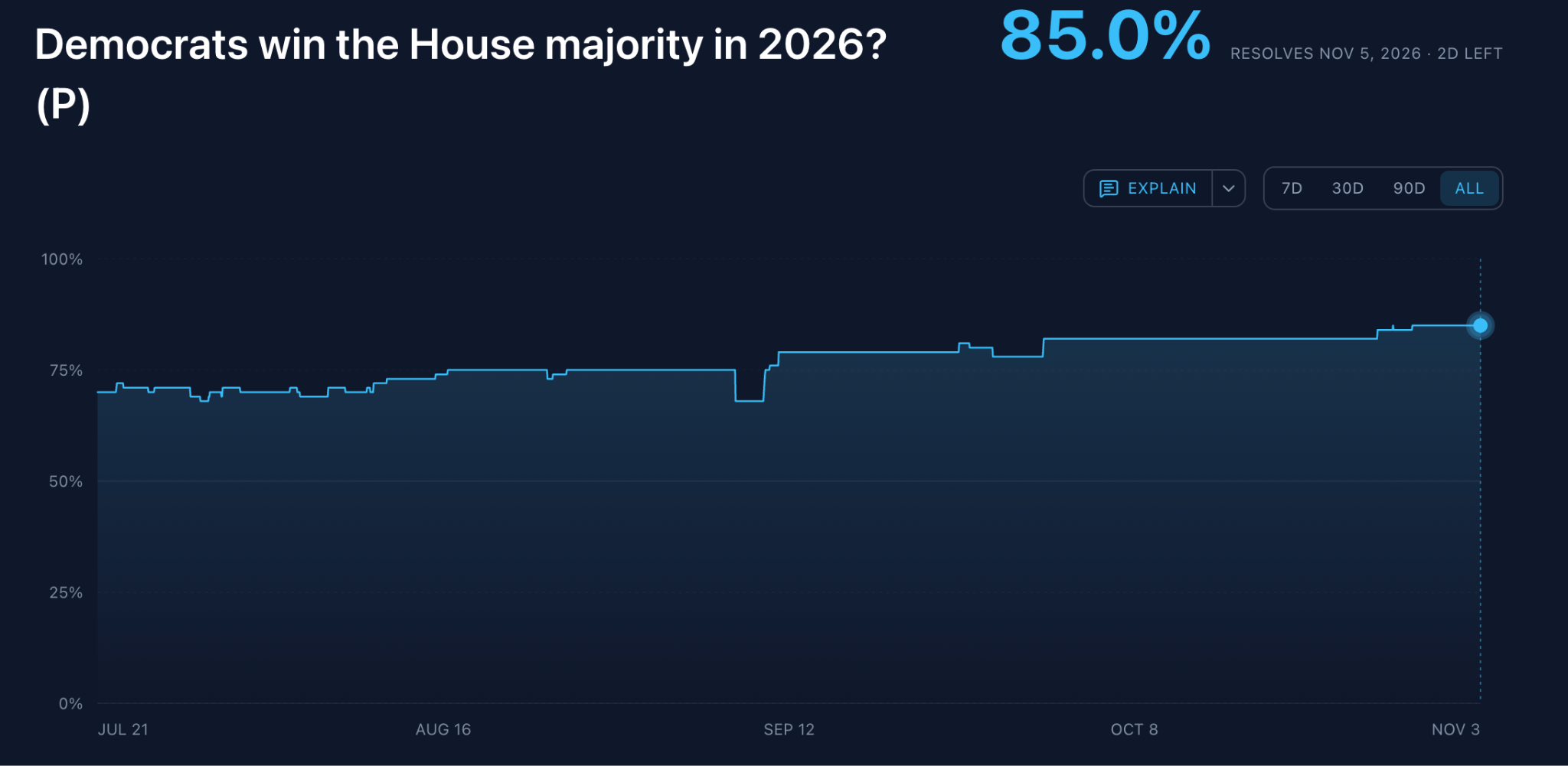
85%: The VICO model’s probability that Democrats win the House majority.
Pennsylvania 1:
Brian Fitzpatrick (R) 52%, versus Kalshi at 45%.
Fitzpatrick is one of the most moderate Republicans in Congress. Since his election in 2018, Democrats have targeted his seat repeatedly but he has often overperformed other Republicans with his bipartisan brand.
A Fitzpatrick loss would signal a Democratic breakthrough in a seat they have been targeting for multiple cycles, a bad sign for the GOP.
Virginia 1:
Rob Wittman (R) 48%, versus Kalshi at 37%.
The ten-term incumbent won by 13 points in 2024, but challenger Shannon Taylor leads recent polling (a Washington Post-Schar School survey had her up 50-46 in late September) and a sharp early-vote surge historically favors challengers in wave years.
The VICO model keeps Wittman a hair behind, a clearer underdog in the prediction markets.
Texas 15:
Monica De La Cruz (R) 46%, versus Kalshi at 11%.
The widest split of these races. De La Cruz enjoys a district that Trump carried by 14 points, incumbency, and a fundraising edge which keeps the model from writing her off.
But she is running against Bobby Pulido, a Tejano singer well known in Texas, particularly among Mexican-Americans.
The VICO model makes Pulido the slight favorite but gives De La Cruz a far better chance than the prediction markets do.
A strong Pulido victory could indicate that Senate candidate James Talarico (D) is likely to make gains in traditionally red areas of Texas.
New York 17:
Mike Lawler (R) 37%, versus Kalshi at 43%.
The one race where the VICO model is tougher on the Republican than the prediction markets.
Lawler is another moderate Republican whose personal brand will determine whether or not he can hang on in a district that Harris won by a point in 2024.
Polling shows Democrat Cait Conley with a slim lead, consistent with the model’s view that Lawler is a genuine underdog.
Florida 9:
Darren Soto (D) 44%, versus Kalshi at 38%.
Soto is one of just two incumbent Democrats the VICO model has below 50% (the other is Don Davis NC-1).
Florida Republicans redrew Soto’s district, which he has held since 2017, but even with an R+8 registered voter advantage, the national mood is Democrat-friendly enough that the VICO model still gives Soto a 44% chance to win.
So what:
The VICO model gives a few important Republicans better chances than Kalshi, but still expects Democrats to take the House. Watch whether the Republicans the model rates more resilient than the prediction markets, Fitzpatrick, Wittman, and De La Cruz, hold on; if they start falling, the House is trending well past 230 seats.
85%: The VICO model’s probability that Democrats win the House majority.
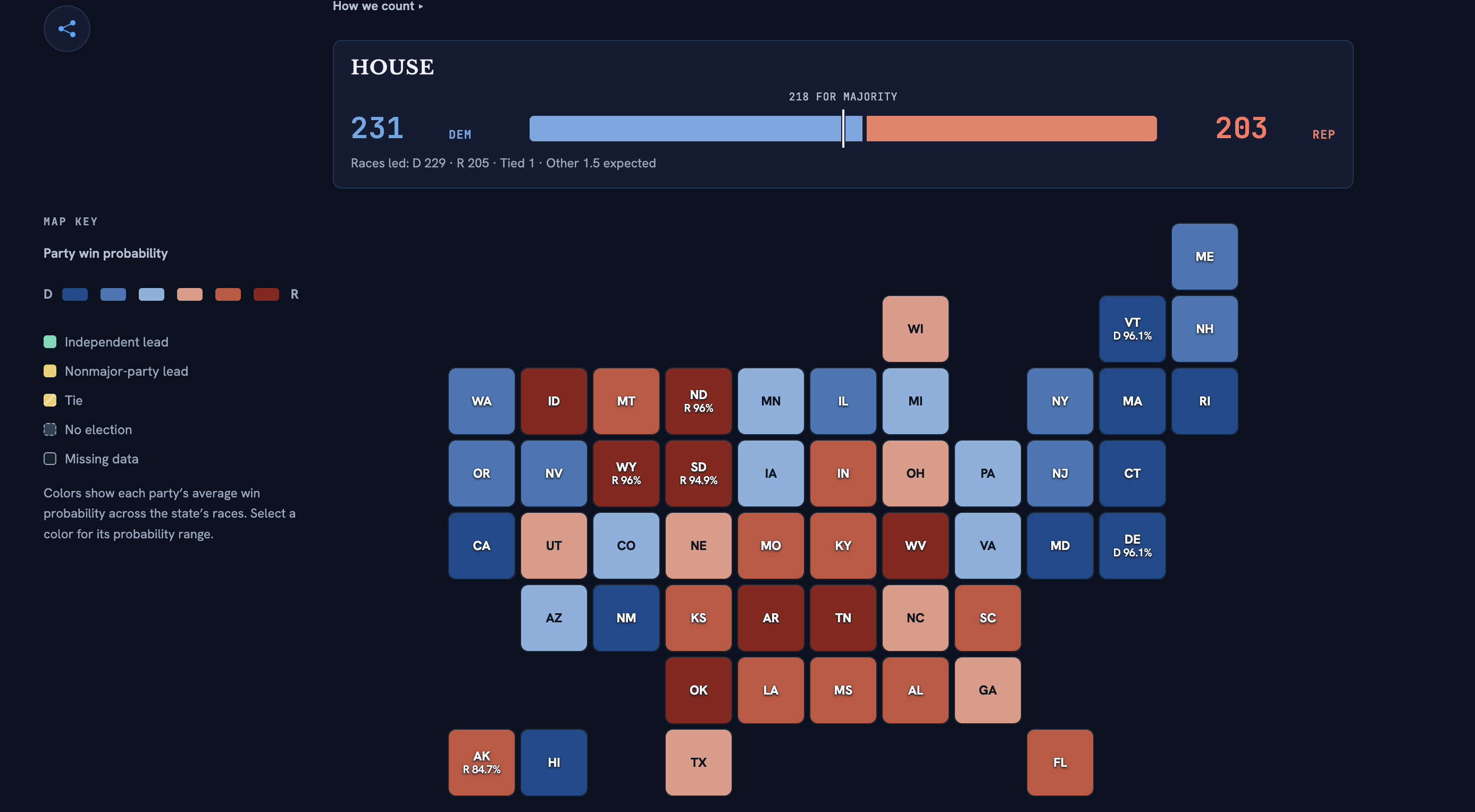
The Senate: Every Major Race
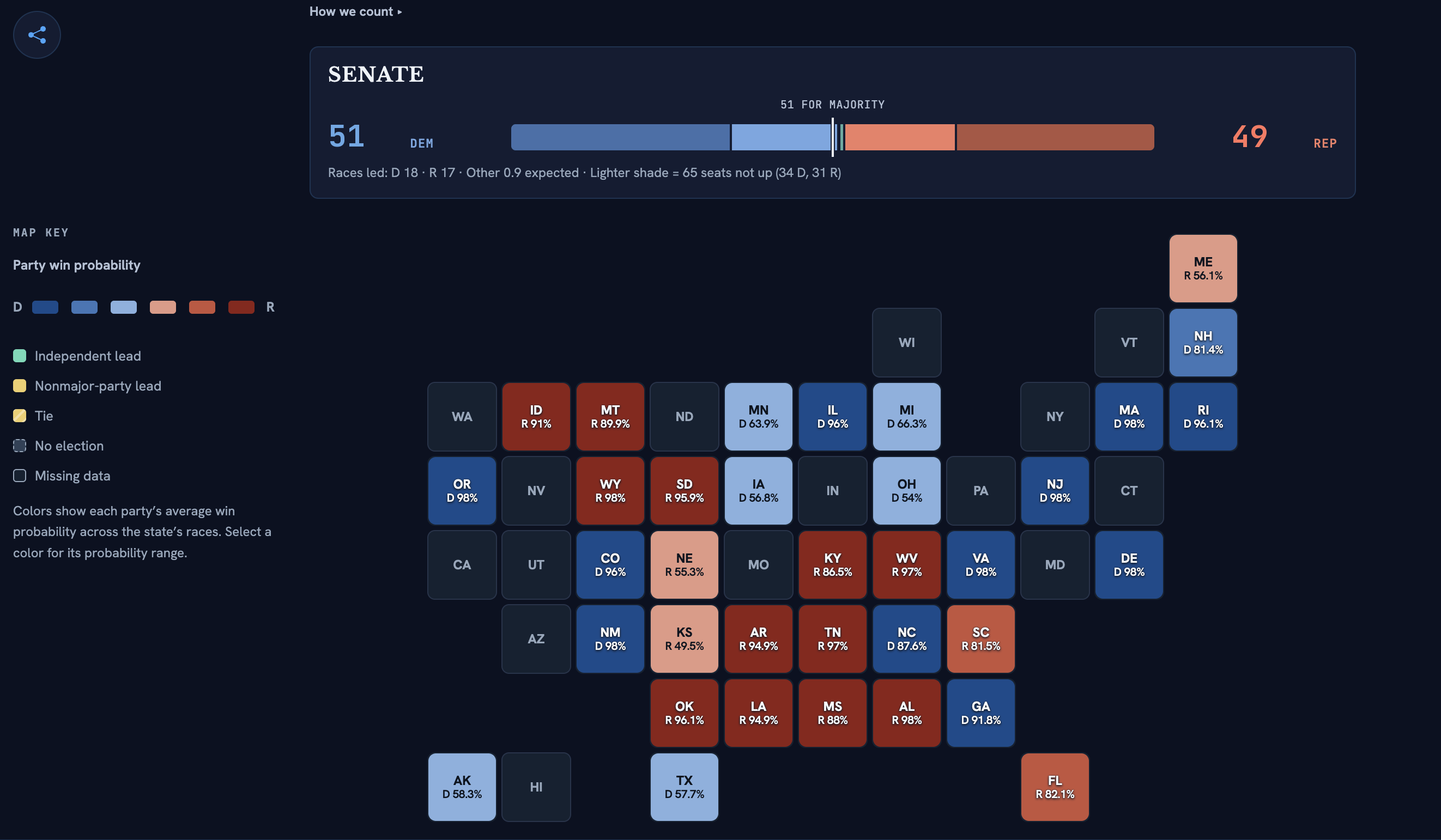
74%: The VICO model’s probability that Democrats win the Senate majority. Versus Kalshi at 76%.
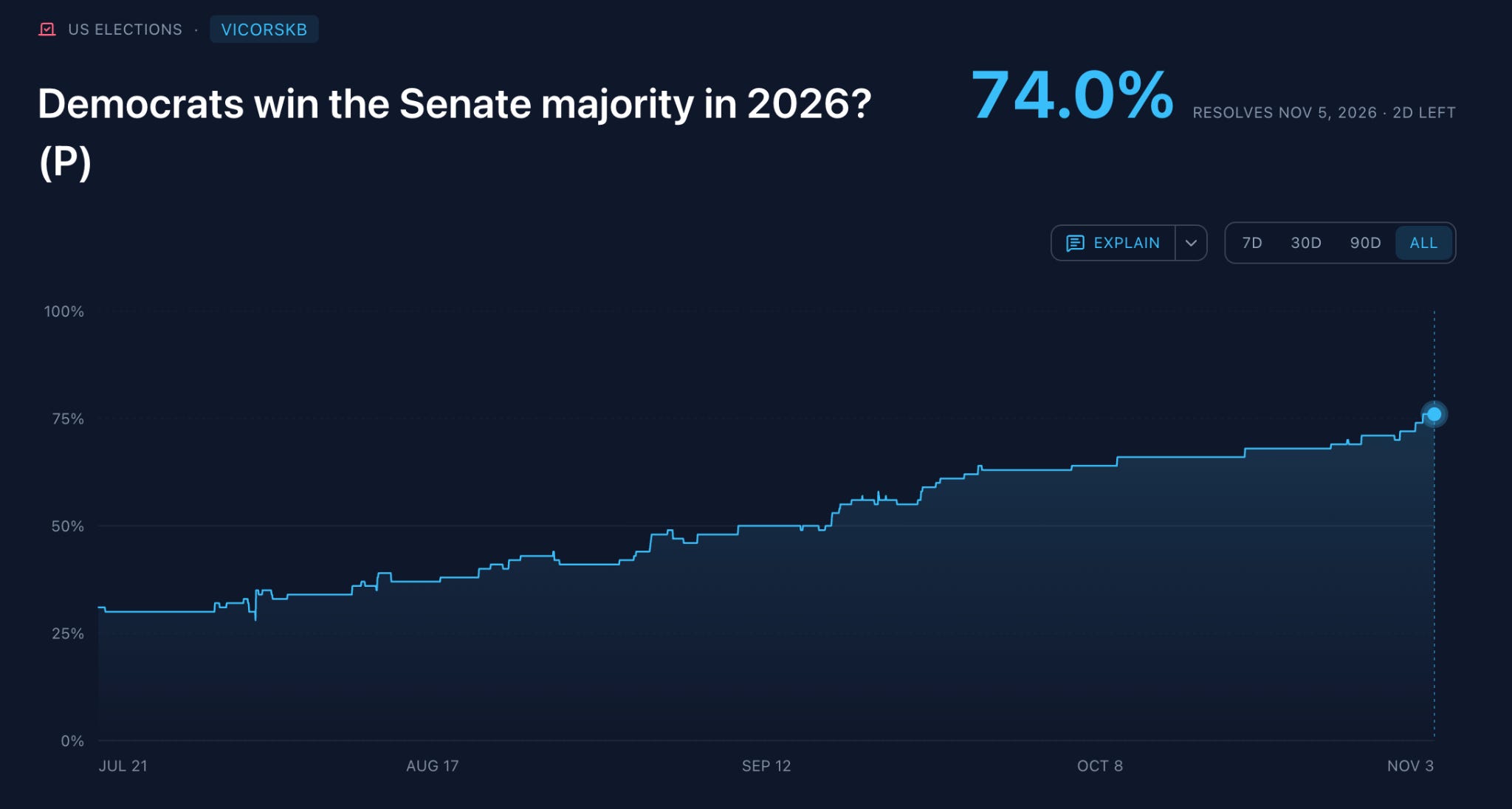
The VICO model has Democrats favored to win the Senate, at 74%, near the prediction markets’ 76%. The model’s expected result is roughly 51 Democratic seats to 49 Republican, so control comes down to a cluster of close races.
That is where the model and the prediction markets part ways: VICO trusts incumbency, fundraising, and a state’s partisan history more than the polls the prediction markets take at face value. Tightest first:
Ohio:
Sherrod Brown (D) 51%, versus Kalshi at 71%.
This is a special election for the seat JD Vance vacated to become vice president, now held by appointed Republican Jon Husted. Brown is the Democratic former senator who narrowly lost his other Ohio seat in 2024 and is trying to return on a personal brand that has outlasted the state’s rightward drift.
Late polls give Brown the edge (Marist +8, Suffolk +3), but the VICO model keeps it nearly even because Ohio now carries an R+11 lean and Republicans are pouring outside money in against him.
The closest seat on the board, and the first real test of whether a well-known Democrat can still win statewide in red-trending Ohio.
Alaska:
Mary Peltola (D) 56%, versus Kalshi at 71%.
Peltola is the former US representative who became the first Alaska Native in Congress in 2022 before losing her House seat in 2024. She is now challenging Republican incumbent Dan Sullivan, and Alaska’s ranked-choice system gives her room to grow as minor candidates are eliminated.
A recent New York Times investigation found that Alaska Democrats found a second Alaskan named Dan Sullivan and encouraged him to run in order to confuse voters who mean to vote for the incumbent. The scandal could hurt Peltola’s chances in a state that is typically red.
The DOJ is preemptively challenging the results of the election on the grounds that the second Dan Sullivan could confuse voters. But the VICO model argues it is unlikely to succeed:
17%: The probability that the lawsuit succeeds in annulling the Alaskan election results.
Nebraska:
Dan Osborn (I) 44%, versus Kalshi at 31%.
Osborn is the independent union mechanic who nearly toppled a Republican senator in 2024 and is running again by petition, with no party label, against Pete Ricketts, the appointed incumbent and former governor. His populist, anti-establishment pitch has kept a deep-red seat surprisingly close.
Ricketts still has the structural edge (incumbency, heavy funding, Nebraska’s R+13 baseline), which keeps him favored in the model. But VICO is markedly more bullish on Osborn than the prediction markets, treating his mid-October polling as real rather than noise.
Kansas:
Adam Hamilton (D) 41%, versus Kalshi at 63%.
Perhaps the biggest test of polls vs fundamentals, Adam Hamilton is a Christian minister and has caught fire in recent polls. One Washington Post poll from a week ago showed Hamilton up by nine points.
Those strong polls have shot Hamilton up on prediction markets from under 30% a month ago to above 60% today.
The VICO model still favors Marshall. Kansas has not elected a Democrat to the Senate in 94 years, and the state broke for Trump by 16 points in 2024. If Democrats carry Kansas, they could be on track to win as many as 53 or 54 seats in the Senate.
Maine:
Susan Collins (R) 56%, versus Kalshi at 27%.
Collins is the veteran moderate first elected in 1996, known for outrunning her polls and winning ticket-splitters. Her challenger, Democrat Troy Jackson, is a former state Senate president and logger running a populist campaign, and he holds a narrow polling lead plus an early-vote surge.
This is the widest gap between the VICO model and the prediction markets on the map. The prediction markets have Jackson as the heavy favorite, but the VICO model has Collins ahead.
In 2020, Collins was down five points in polling on election day. She won that election by 8 points. The VICO model argues she may overperform her polling numbers again this year.
Iowa:
Josh Turek (D) 57%, versus Kalshi at 51%.
Turek is a Democratic state representative and two-time Paralympic gold medalist in wheelchair basketball, running against Republican Ashley Hinson. He has the fundraising lead, favorable polling, and strong early turnout.
This is the one Senate race where the VICO model is more bullish on the Democrat than the prediction markets. Iowa’s R+13 lean is Hinson’s floor, and Republicans are banking on a late turnout push, with Trump holding a closing rally in Dubuque to lift her.
Texas:
James Talarico (D) 58%, versus Kalshi at 75%.
Talarico is a young former public-school teacher and state representative, but more important, according to the VICO model, is his opponent.
Ken Paxton is the Texas attorney general who has been bogged down by repeated scandals. The VICO model argues Paxton’s weaknesses put Texas in play.
Talarico has the fundraising lead and a polling edge, but the model stays cautious because of Texas’s deep Republican lean and a heavy GOP ad blitz.
Michigan:
Abdul El-Sayed (D) 63%, versus Kalshi at 78%.
This is an open seat, pitting El-Sayed, a progressive former Detroit health director and 2018 candidate for governor, against Republican Mike Rogers, the former congressman who narrowly lost Michigan’s other Senate race in 2024.
The late twist: two days before the election, Democratic Representative Haley Stevens (whom El-Sayed beat in the primary) endorsed Rogers. The VICO model nudged El-Sayed down on the risk that moderate Democrats defect or stay home, while the prediction markets moved the other way and kept him a strong favorite.
Minnesota:
Peggy Flanagan (D) 64%, versus Kalshi at 91%.
This is an open seat created by Senator Tina Smith’s retirement. Flanagan is Minnesota’s lieutenant governor and a member of the White Earth Band of Ojibwe who would be the first Native American woman elected to the Senate. Her Republican opponent is Michele Tafoya, the former Sunday Night Football sideline reporter turned conservative commentator.
An October 21 Newsweek poll put Flanagan up just 3 to 4 points, and the DFL’s 24-year winning streak in Minnesota Senate races reinforces her position.
One of the clearer model-versus-market splits: the prediction markets treat Flanagan as a near lock at 91%, but her slim polling lead and progressive reputation in a more moderate state make the VICO model less bullish on Flanagan than the prediction markets.
North Carolina:
Roy Cooper (D) 84%, versus Kalshi at 96%.
Cooper is the popular two-term former governor running for an open seat against Republican Michael Whatley, a former Republican National Committee chairman. Cooper has held a steady 10-to-11 point lead.
In the closing stretch the NRSC pulled its money from Whatley, leaving him underfunded. The seat looks likely Democratic; the model just sits a notch below the prediction markets’ near-certainty.
Georgia:
Jon Ossoff (D) 88%, versus Kalshi at 95%.
Ossoff is the first-term Democratic incumbent who won his seat in the 2021 runoffs, now defending it against Republican Congressman Mike Collins. He leads by 7 to 10 points, holds a roughly 10-to-1 fundraising advantage, and benefits from a Democratic tilt in early voting, where 2.36 million ballots are already cast.
The real risks are Georgia-specific: if Ossoff dips below 50% he could be forced into a January runoff, and a lingering polling error could narrow his lead. A Republican outright win is not the likely danger.
Other races:
Florida: Ashley Moody (R) 82%, versus Kalshi at 87%.
New Hampshire: Chris Pappas (D) 81%, versus Kalshi at 94%.
Kentucky: Andy Barr (R) 86%, versus Kalshi at 95%.
South Carolina: Darline Graham (R) 80%, versus Kalshi at 68%.
So what:
The VICO model agrees with the prediction markets that Democrats are favored to hold the Senate, but it gives a slimmer majority built on a stack of close individual races the prediction markets have priced with greater certainty. If the model is right, expect a longer, closer night than the prediction markets suggest, with Ohio, Alaska, Maine, and Kansas most likely to decide the majority.
74%: The VICO model’s probability that Democrats win the Senate majority. Versus Kalshi at 76%.
About Us
VICO empowers decision makers to quantify and navigate event risk. Forecast, simulate and monitor political, geopolitical and economic events.
Learn more and obtain a beta account at www.vico.io or email us at inquire@vico.io
Methodology and Copyright Notes:
All percentage changes are over the last week except where noted.
Our proprietary AI models are rigorously backtested and do not rely on any betting market information.
All data and content are owned by and copyrighted by VICO Technologies Inc.