The VICO Way-too-Early 2028 Election Preview
With President Trump term-limited, 2028 is the first race in a decade with no incumbent on the ballot and an open contest on both sides.
Underneath the surface, the two fields could not look more different. One has a clear pecking order. The other is a scrum.
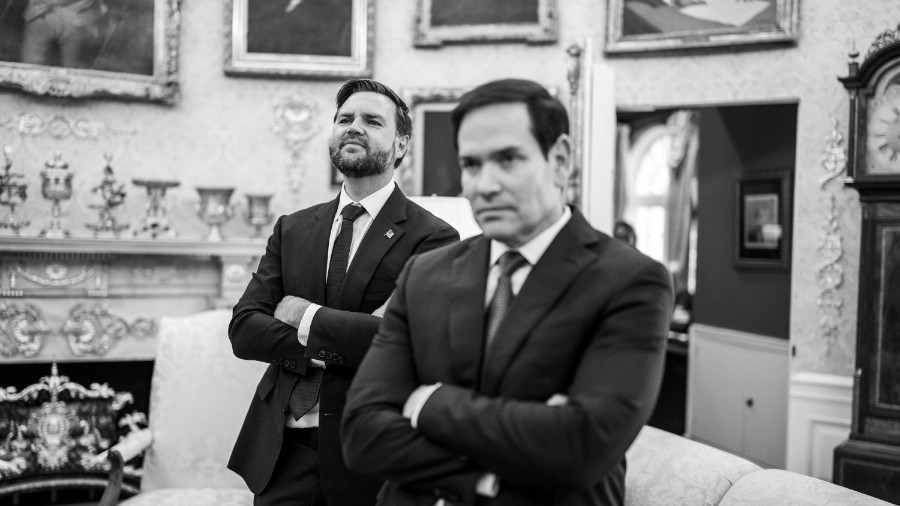
The Republican race is dominated by the top. As the sitting vice president, JD Vance is the heir apparent at 38%, with Secretary of State Marco Rubio as the main alternative at 25%.
Together, Vance and Rubio account for more than half of the field. The VICO model reads it as a two-man race, with Ron DeSantis (14%) the only other candidate in double digits and Tucker Carlson (4%) a long shot.
The Democratic side is more crowded, but it still has a surprising leader: Kamala Harris at 25%.
The VICO model gives Harris a large edge on the strength of her name recognition and early polling, where the former vice president starts out well ahead of the rest of the field. Many have written her off after 2024, but the VICO model sees a serious possibility of her winning the nomination in 2028.
Behind her the pack is tight: Pete Buttigieg (19%), Alexandria Ocasio-Cortez (17%), Josh Shapiro (15%), Jon Ossoff (12%), and Gavin Newsom (10%).
The model notably discounts Ossoff, holding his number down because it takes seriously the possibility that he does not run at all, no matter how strong a candidate he might be if he did.
Two patterns emerge from the VICO Options Explorer analysis. First, Democrats broadly have an advantage in 2028. Second, the more anti-establishment candidates on both sides like Carlson and AOC perform weaker than more moderate candidates like Rubio, Shapiro, and Ossoff.
On the left, Alexandria Ocasio-Cortez is the only Democrat the VICO model makes an underdog against the serious Republicans, losing to Vance (41%), Rubio (36%), and DeSantis (41%). On the right, Tucker Carlson is the mirror image, losing every single matchup by double digits.
The model’s favorites are the opposite profile. Jon Ossoff and Josh Shapiro win every matchup they are in, from 63% up to 77%, and Marco Rubio is the strongest Republican, holding every Democrat to their lowest number and fighting Kamala Harris to a dead-even 50%.
So while Democrats broadly have an advantage, the specific nominee determines whether they expand or shrink that lead. Importantly, the VICO model maintains that while Harris may be a strong primary candidate, she is actually the second weakest option we forecasted in the general election.