VICO FUTURE MONITOR · NEWSLETTER
Diesel Detente
Trump x Russia Diesel Deal, Saudi x Houthis, US x Iran, Midterms, Permitting Reform, Fed Rates, Housing Market
This issue was published in the VICO Future Monitor newsletter and is archived here; edits and forecast links were added by the VICO editorial team.
Access VICO forecasts or make your own at www.vico.io as well as on the Bloomberg Terminal at WSL PREDICT<GO>, WSL ELECTION<GO> and WSL VICO<GO>.
What we are following this week:
Geopolitics: Trump x Russia Diesel Deal, Saudi x Houthis, US x Iran
Domestic Politics: Permitting Reform, Midterms
Economics: Fed Rates, Housing Market
Geopolitics: Trump x Russia Diesel Deal, Saudi x Houthis, US x Iran
Trump x Russia Diesel Deal
Issue: President Trump reaches a diesel deal with Russia
Trump’s October 9 deal to import Russian diesel, backed by a Treasury waiver suspending sanctions until April 2027, reverses the energy-sanctions law he signed last month.
It is framed as gas price relief before the midterms, but the VICO model argues the price drop will be minimal. In response, Zelenksy announced that Ukraine will be resuming strikes on Russian refineries.
Reasoning: Moderate relief before the midterms, with a deal set to last
Delivery is credible but slow, given weeks-long tanker transits and Russian refining output down about 30% from Ukrainian strikes.
The VICO model argues the deal is likely to last through the April 2027 date, meaning the effects (for both the US and Russia) will last for months after the midterms.
22%: The probability that the US sanctions exemptions on Russian diesel are terminated before their April 2027 end date.
So what: Little effect on midterm prices, and continued strikes on Russian energy
In the near term, the deal is unlikely to bring prices down before the midterms, but it makes conditional military aid for Ukraine more likely.
That means little help for struggling Republicans in the midterms, and it means worsening problems for Russia’s energy export economy.
Saudi x Houthis
Issue: Houthis escalate with strike on Saudi airport
As the Saudi-Houthi conflict continues, the fight has escalated beyond shipping with a Houthi strike on a Saudi Arabian airport that killed 12 and injured more than 300.
The model’s read: the Houthis are likely to lose the Bab el-Mandeb Strait, but could bring the US into the conflict with new strikes.
Reasoning: The Houthis are still likely to lose Bab el-Mandeb, but US entry is a coin toss
The Houthis are likely to lose control of the crucial Bab el-Mandeb Strait but keep up strikes with no off-ramp in sight.
70%: The probability that the Houthis lose control of the Bab el-Mandeb Strait before December 31, 2026.
88%: The probability that the Houthis launch another attack on a Saudi airport or major city in the next 30 days.
1%: The probability that Saudi Arabia and the Houthis reach a formal permanent ceasefire before December 31, 2026.
US entry is below 50% but still plausible as pressure grows to intervene.
41%: The probability that the US strikes Houthi positions in the next 60 days.
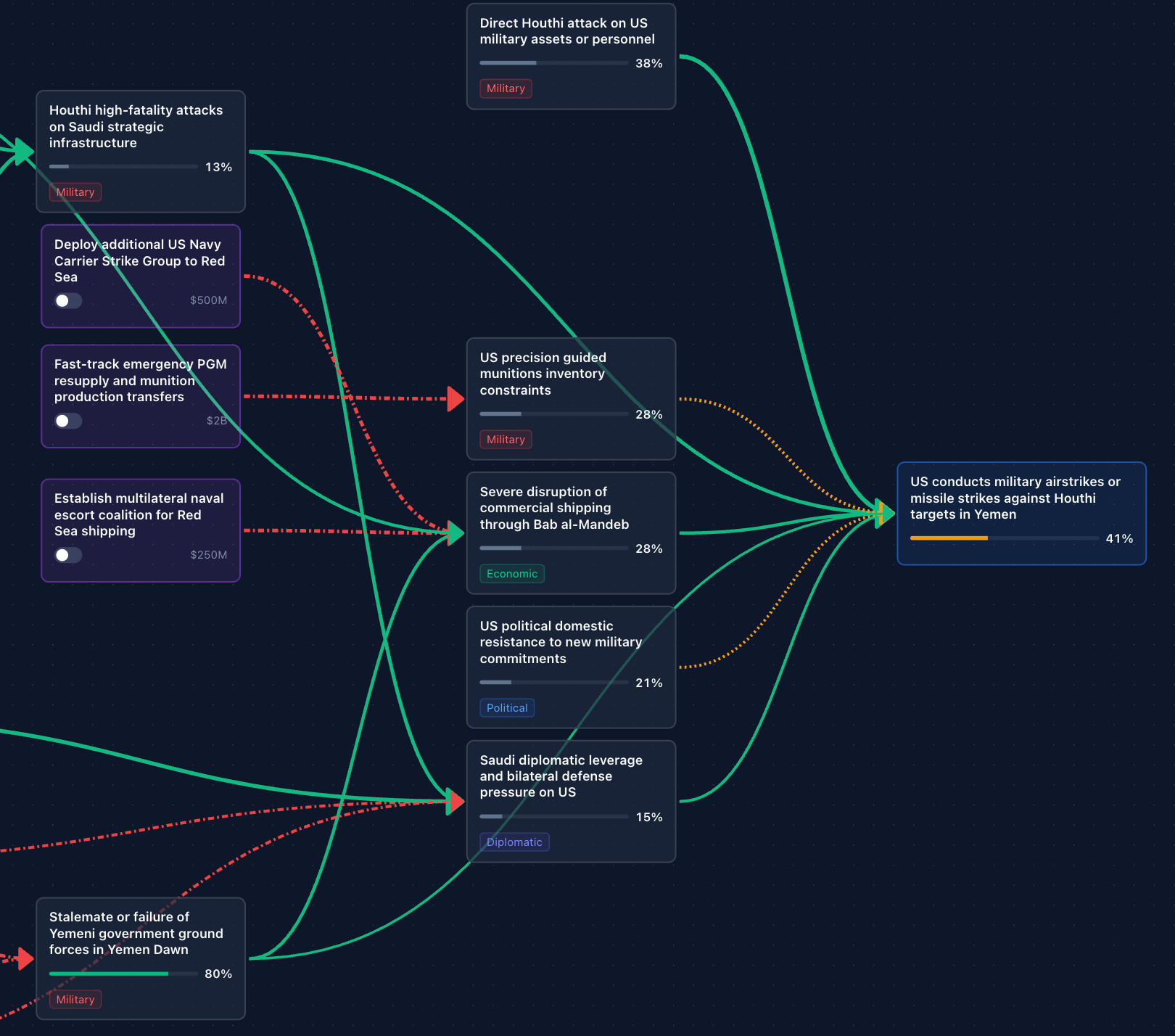
A VICO Causal Explorer on US entry shows what pulls the US in: a Houthi attack on US forces (38%), a severe disruption of Bab el-Mandeb shipping (28%), or high-fatality strikes on Saudi strategic infrastructure (13%).
What holds the US back: precision-munitions shortages (28%), which could bite if the Iran war escalates and now has the two conflicts competing for the same missiles, and domestic political resistance such as a war powers resolution (21%), a tool that has failed in Congress before.
So what: Houthis have limited chance to disrupt Saudi oil
The biggest thing holding the US back is running low on missiles, not politics. The real economic risk is a confirmed hit on Saudi oil output, which would push oil prices higher and mean more orders for the weapons makers whose stockpiles are being drained, mainly Lockheed Martin (LMT) and RTX (RTX).
28%: The probability that a Houthi strike causes a confirmed disruption to Saudi Aramco oil production or exports before December 31, 2026.
The VICO model argues that the Saudi East-West transport corridor allows them to reroute crude flows and maintain exports even in the event of a Houthi strike on processing facilities.
US x Iran
Issue: Iran fortifies nuclear targets
Iran is reportedly fortifying sensitive nuclear sites in preparation for American strikes in the near future. President Trump has stated the US will not attack until after the midterms, but has left options on the table after November 3.
Reasoning: Strikes beat a deal
Diplomacy is close to dead near-term, with the two sides still split on sanctions relief and enrichment and Trump ruling out deals until at least the election.
6%: The probability that the US and Iran hold formal negotiations in the next 30 days.
The model reads Trump as more likely to resume strikes after November 3 to strengthen his hand, consistent with prior US hits on Iranian nuclear sites. And continued military and economic pressure leaves the door open for Khamenei’s exit in 2026.
So what: Hormuz stays closed, Republicans keep hurting
A near-term off-ramp looks all but closed, keeping both the energy shock and the political damage in place.
The war and its high oil prices are dragging on Republicans, part of why the model now has Democrats at 66% to take the Senate.
Oil stays expensive on a war-risk premium, defense makers like Lockheed Martin (LMT) and RTX keep landing missile orders, and the closed strait keeps shipping costs high.
Domestic Politics: Permitting Reform, Midterms
Permitting Reform
Issue: Bipartisan permitting reform introduced
A bipartisan mix of committee leaders introduced a permitting reform bill in the Senate, meant to speed up the approval of energy projects. Pressure is building in Washington to pass the legislation before Congress turns over in January.
Reasoning: Unlikely this year, maybe this term
Near-term passage is unlikely, with the lame-duck Congress simply too short on time to finish a bill this big.
22%: The probability that a permitting reform bill passes before the next Congress convenes on January 3, 2027.
The longer fight is political and close to a coin flip. The bill has bipartisan support, but strong opposition from environmental groups and Native tribes makes it dangerous for Democrats worried about being primaried.
48%: The probability that a current or similar permitting reform bill is signed into law before the end of President Trump’s term.
So what: If it passes, a grid, gas, and minerals buildout
Enactment would unleash a wave of energy and infrastructure investment. A VICO Scenario Explorer on passage:
77%: If it passes, NextEra Energy, Southern Company, and American Electric Power issue over $14 billion in purchase orders for high-voltage transformers and grid equipment within 12 months.
71%: If it passes, faster pipeline permitting expands Permian and Haynesville gas takeaway capacity by over 4 billion cubic feet per day within 24 months.
68%: If it passes, the BLM fast-tracks Records of Decision for Lithium Americas’ Thacker Pass phase 2 and South32’s Hermosa project, lifting domestic lithium, manganese, and zinc output commitments by over 100,000 metric tons per year by 2028.
28%: If it passes, wages in US heavy civil and industrial construction rise 6.8% annualized, versus a 3.4% baseline.
Even if it stalls, the demand behind it, the AI-era crunch for power and transmission, is not going away, so the pressure carries into the next Congress.
Midterms
We are continuing this week with our forecasting of potential midterm results. In last week’s newsletter, we showed what a Democratic sweep could mean, and this week we are covering the next most likely scenario: a Democratic House with a Republican Senate.
Issue: Divided government returns
Democrats flip the House while Republicans hold the Senate, splitting Congress and ending unified Republican control. The result is a capital built for stalemate, with a Democratic House and a Republican Senate checking each other for the next two years.
What could lead to a split:
The VICO Causal Explorer points to three factors that could lead to a Democratic House and Republican Senate.
The Democratic generic-ballot lead holding above 6 points, enough to flip the House.
Split-ticket voting in key competitive Senate states.
Republicans keeping a spending advantage in the Senate races that saved their majority.
What happens next?
The defining dynamic is gridlock with a Republican tilt on personnel. Military spending lands well short of the president’s ask, and the Senate turns to confirmations while most of the House’s agenda dies on arrival.
The FY2027 defense request was $1.5 trillion, but only the $1.15 trillion base is actually moving through Congress, and even that is stuck. Defense has run on a stopgap near $838 billion since the fiscal year began, with full-year funding not expected until spring 2027, which leaves the newly elected Congress to finish it.
92%: Congress passes a military budget around $900 billion, near the current stopgap level and far below the president’s full request.
70%: Senate Republicans prioritize judicial appointments, leaving more than 75% of major House legislation without a Senate vote.
Fiscal brinkmanship, in a milder form than the less likely split of a Democratic Senate and Republican House.
46%: A protracted debt-ceiling fight delays $15 billion in federal vendor payments and pushes 10-year Treasury yields up.
Oversight ramps up without landing a knockout.
53%: The House impeaches a high-ranking executive official who is quickly acquitted in the Senate along party lines.
48%: House Oversight and Judiciary launch more than 40 investigations within 90 days, stalling executive rulemaking.
One thing still clears on a bipartisan basis.
66%: A permitting-reform bill passes the Commerce committees, cutting NEPA review for transmission lines from 4.5 to 2.0 years and unlocking $45 billion in grid projects.
So what: Stalemate, with a fiscal tail risk
Mostly motion without movement. The market thread is the 46% debt-ceiling fight, which lifts the 10-year and pressures long Treasuries (TLT).
A roughly $900 billion defense budget, far below the $1.5 trillion ask, weighs on the aerospace-defense ETF (ITA), with RTX most exposed. The 66% permitting win is the offset, a tailwind for grid builders like Quanta Services (PWR).
Economics: Fed Rates, Housing Market
Fed Rates
Issue: Hot inflation report raises hike odds
September CPI came in hot, with headline at 3.7% and core at 2.6% year-over-year, much of it energy-driven. With the fed funds rate at 3.75-4%, the report boosts the odds of a hike before year-end even as the Fed looks set to hold later this month.
Reasoning: A hike is coming, but December, not October
The hot print pushed year-end hike odds up sharply, while leaving the October meeting most likely a hold as the Fed waits for more data.
So what: The long end stays stuck, and Washington may have to step in
The Fed controls short-term rates, but long-term rates set by the bond market are staying high, which keeps mortgages, loans, and government borrowing costs elevated no matter what the Fed does this month.
87%: The probability that the 10-year Treasury yield closes at or above 5% on December 31, 2026.
If yields keep climbing, the Treasury department may be forced to intensify the current buyback program.
32%: The probability that the US Treasury expands or accelerates its debt-buyback program beyond its August 2026 levels before December 31, 2026.
For markets, higher-for-longer yields keep pressure on long Treasuries (TLT) and rate-sensitive equities while supporting the dollar, and any sign of a buyback ramp would be the tell that officials are worried about demand for US debt.
Housing Market
Issue: A market locked in place
The 30-year fixed sits around 7.5%, nearing the highest point since the early 2000s, and existing-home sales are sliding. With expectations for persistent high rates, the housing market is freezing, and the model sees no thaw over the next six months.
Reasoning: Rates stay high, activity keeps sliding
Borrowing costs stay elevated, keeping affordability broken and buyers on the sidelines.
The freeze shows up in the activity data, with both sales and construction pulling back.
So what: The freeze starts to spread
The damage is moving beyond volume into the headline numbers and, increasingly, credit.
For markets, a frozen resale market and falling starts weigh on homebuilders like D.R. Horton (DHI) and Lennar (LEN), and the homebuilder ETF (ITB), while rising delinquencies are a slow-building risk for mortgage servicers and housing-exposed lenders.
About Us
VICO empowers decision makers to quantify and navigate event risk. Forecast, simulate and monitor political, geopolitical and economic events.
Learn more and obtain a beta account at www.vico.io or email us at inquire@vico.io
Methodology and Copyright Notes:
All percentage changes are over the last week except where noted.
Our proprietary AI models are rigorously backtested and do not rely on any betting market information.
All data and content are owned by and copyrighted by VICO Technologies Inc.