VICO FUTURE MONITOR · NEWSLETTER
Talks about Talks
German AfD Election, Israel-UK Sanctions, Russia x Ukraine, Missouri Redistricting, New Hampshire and Texas Midterms, AI Bills, Inflation, Ford Transportation Letter, Oil
This issue was published in the VICO Future Monitor newsletter and is archived here; edits and forecast links were added by the VICO editorial team.
Access VICO forecasts or make your own at www.vico.io as well as on the Bloomberg Terminal at WSL PREDICT<GO>, WSL ELECTION<GO> and WSL VICO<GO>.
What we are following this week:
Global Politics: Russia x Ukraine, German AfD Election, Israel-UK Sanctions
Domestic Politics: Missouri Redistricting, New Hampshire and Texas Midterms, AI Bills
Economics: Inflation, Ford Transportation Letter, Oil
Global Politics: Russia x Ukraine, German AfD, Israel-UK Sanctions
Russia x Ukraine
Issue: US envoys push for a deal in Moscow and Kyiv
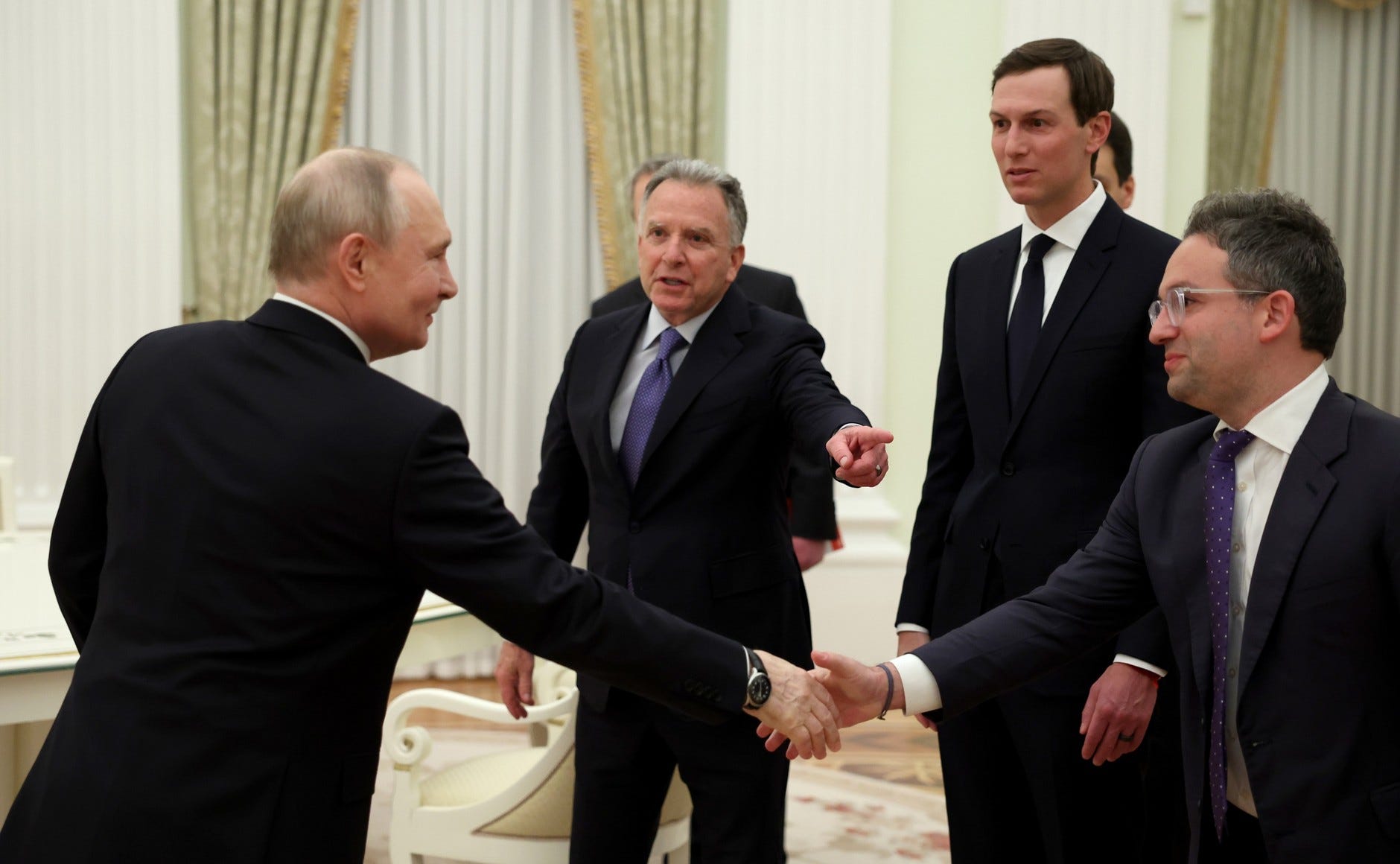
US envoys Witkoff and Kushner shuttled between Moscow and Kyiv this month, meeting Putin and Zelensky within days.
No breakthrough followed, but the model now sees trilateral US-Ukraine-Russia talks as more likely than not by the end of the year.
Reasoning: Stalemate and weakness point to negotiations
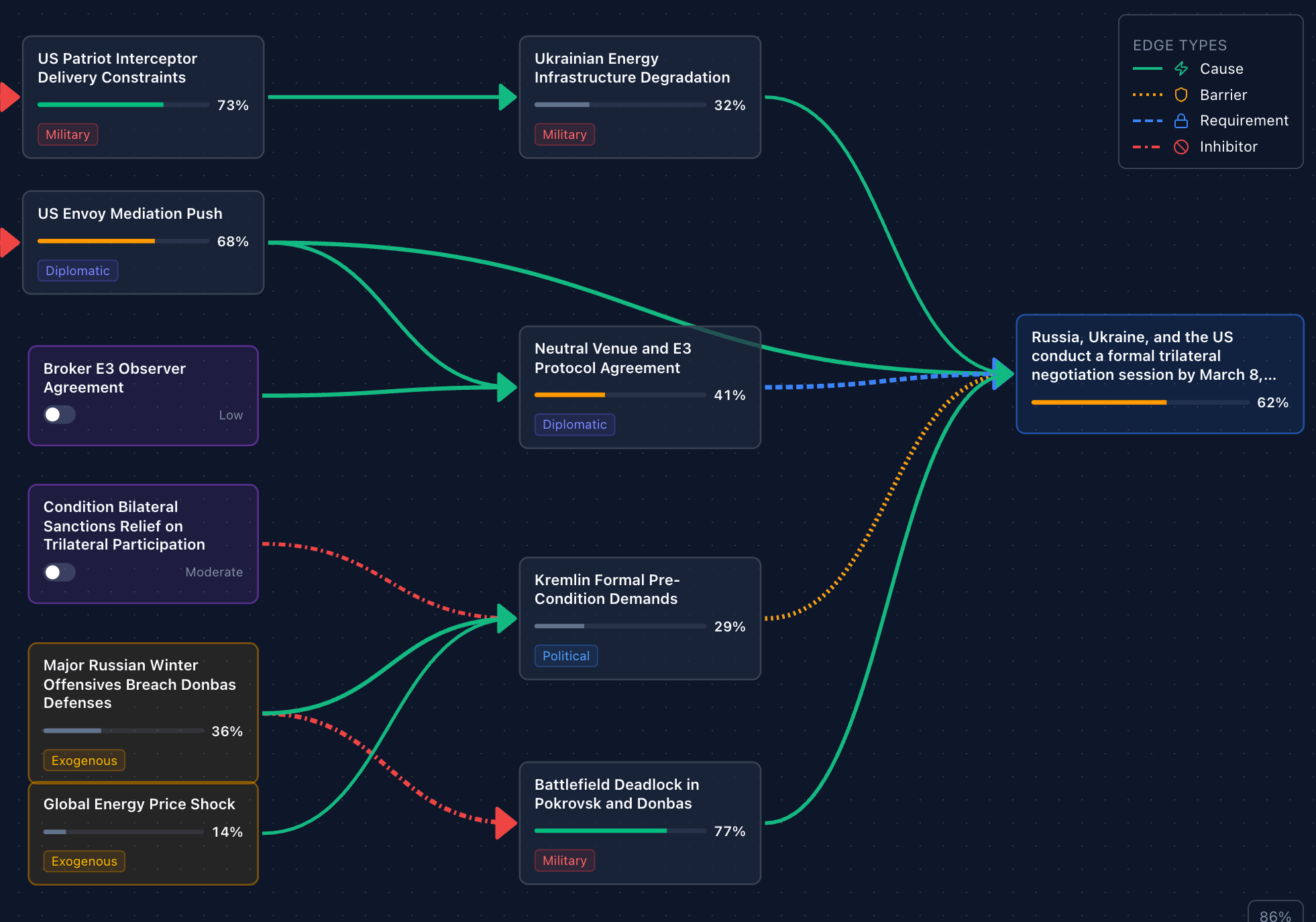
The VICO Causal Explorer identifies two factors that increase the likelihood of negotiations.
77%: The probability of continued battlefield deadlock.
73%: The probability that US Patriot interceptor deliveries to Ukraine face constraints.
As either side sees more battlefield success, negotiation odds decrease. The model argues that territorial gains, or firepower supremacy would provide the ascendant party with an incentive to continue the fight.
Together these factors help tilt the year toward negotiations.
62%: The probability that the US, Ukraine, and Russia hold trilateral negotiations in 2026.
The main threat runs the other way, in Russia’s price of entry.
29%: The probability that Russia makes maximalist demands a precondition for talks, a risk that climbs with every Russian advance.
So what: Expect progress in 2026, not a deal
Talks are now the base case, pushed by a stalling front and a Ukraine bracing for a hard winter with thinner defenses.
But getting to the table is not getting a deal. The VICO model’s expectations for a ceasefire in 2026 remain low.
20%: The probability that Russia and Ukraine reach a ceasefire in 2026. Versus Polymarket at 23%.
The model argues that both sides still remain far apart on core issues like security guarantees and territorial disputes, both of which are unlikely to be ironed out in the next four months.
German AfD Election
Issue: A record win that still leads nowhere
Fresh off a record 43.8% in the German state of Saxony-Anhalt, the right-wing AfD is still walled off from power, with a 92% chance it is shut out of the governing majority there despite finishing first.
Unable to stop the party’s growth at the polls, parts of the German establishment are weighing the constitutional option: asking the high court to ban it outright. The model warns such an attempt could strengthen the AfD rather than end it.
Reasoning: The firewall holds in Saxony-Anhalt
The firewall agreement by all non-AfD parties in Germany to refuse a coalition with the AfD is likely to keep them out of power for now.
92%: The probability that the AfD is shut out of a governing majority in Saxony-Anhalt despite their electoral victory.
But some nervous establishment members are asking for a party ban.
44%: The probability that a branch of the German government formally asks the Constitutional Court to ban the AfD, nearing a coin flip.
So what: The establishment’s dilemma
If a formal ban request comes, the Scenario Explorer sees a 94% chance the AfD casts it as a censoring attack by a frightened establishment and runs a nationwide campaign that lifts its support across the country.
And if that surge lands, the model gives a 66% chance the firewall agreement collapses entirely.
The weapon aimed at the AfD, in other words, is the likeliest thing to provide them a path to real governance.
Israel-UK Sanctions
Issue: A gesture that keeps hardening
The UK, with eleven other states, banned imports from Israeli West Bank settlements this week, despite US warnings that sanctions on Israel could provoke retaliation.
Israel hit back by closing Britain’s Jerusalem consulate and cutting security ties in the region.
The model reads this as the opening move in an escalation with a growing price tag.
Reasoning: An escalation ladder with a bill attached
The VICO model is highly skeptical of Washington’s threats, arguing that the special relationship between the two nations makes economic retaliation over anything other than a direct trade dispute unlikely.
32%: The probability that the US retaliates economically against the UK over the sanctions in 2026.
The UK is very likely to widen its measures beyond goods, to banks, individuals, and entities tied to settlements.
82%: The probability that the UK expands sanctions to include banks, people, and entities tied to settlements in 2026.
So what: A trade dispute set to deepen
If the UK does expand the sanctions:
55%: The probability that Israel freezes the 2019 trade-agreement upgrade and imposes barriers on $1.2 billion of UK exports.
Expect further retaliation from both sides as the dispute deepens into a trade war.
Domestic Politics: Missouri Redistricting, New Hampshire and Texas Midterms, AI Bills
Missouri Redistricting
Issue: Missouri Map Confusion
The US Supreme Court issued a decision siding against Republicans’ 2025 Missouri district map which would targeted Democrat Emanuel Cleaver and shored up Republican incumbents.
The new map was already used in the primary elections, but now will likely be replaced for the general, in what Missouri’s Secretary of State called a “constitutional crisis.”
The model’s read is clear: Democrats stand to hold one seat and possibly gain another under this map.
Reasoning: The confusion breaks the Democrats’ way
The model is highly confident in the old map holding for November with such little time left for a judicial reversal of the Supreme Court’s emergency decision.
2%: The probability that the 2026 general election is held under the redrawn Republican map.
On election day the map faces a referendum for its future use in 2028, which the model argues is likely to fail.
60%: The probability that Missouri voters reject the new Republican map in the November 3 referendum.
That cascades to the seats the gerrymander was meant to swing.
So what: Missouri Democrats breathe a sigh of relief
Using the old map as VICO expects moves closer to securing Democrat Emanuel Cleaver’s reelection, and puts Ann Wagner’s race in contention.
New Hampshire and Texas Midterms
Issue: Two midterm battlegrounds come into focus
New Hampshire’s primaries have finished, setting the fall matchups, while Texas Republicans gathered in Dallas for a convention that doubled as a fundraising drive, much of which is expected to reinforce Ken Paxton’s (R-TX) struggling Senate campaign.
Across both states, the model likes Democrats’ chances in the Senate, but sits below prediction markets on their odds in competitive House races.
Reasoning: Democrats favored in Senate races, overpriced in the House
In New Hampshire, the Senate looks like a solid Democratic hold, but the House seat is the surprise.
In Texas, Paxton faces an uphill battle, as the model has Talarico favored.
So what: Democratic Senate on the table
Democrats staying comfortably ahead in states like New Hampshire, and making possible gains in traditionally red states like Texas gives them a shot at the Senate majority despite a difficult path.
50%: The probability that Democrats win the Senate majority in 2026. Up from 30% on August 3.
AI Bills
Issue: A federal hole on AI regulation
In last week’s newsletter, we covered a number of AI bills likely to become law in California. By contrast, the model expects little action from the federal government, leaving a patchwork grid of laws that differ from state to state.
Reasoning: Political divisions stall legislation
The single likeliest to pass is not an AI-governance law at all, but a national-security one aimed at China.
42%: The probability that the Deterring American AI Model Theft Act, criminalizing theft of US model weights, becomes law before 2028.
Deepfake and likeness protections have a middling shot, helped by bipartisan support and concrete-harm framing.
30%: The probability that the NO FAKES Act, a federal right against unauthorized AI voice and face clones, becomes law before 2028.
The ambitious bills are effectively dead on arrival.
6%: The probability that the American AI Leadership and Uniformity Act becomes law before 2028.
This bill would create federal uniformity on AI laws, pre-empting state legislative action.
6%: The probability that the Protect Elections from Deceptive AI Act becomes law before 2028.
This bill would make distributing deceptive AI (like AI videos of candidates) with the intent to influence an election illegal.
So what: The burden falls to the states
In the federal government’s absence, expect a patchwork of different laws to be passed by different states, each taking the problem into their own hands.
70%: The probability that at least five states pass major AI regulatory frameworks by the end of 2027.
For AI firms, that means complying with a large web of legal codes, and ensuring nationwide products comply with the strictest statewide guidelines.
Economics: Inflation, Ford Transportation Letter, Oil
Inflation
Issue: Inflation report due before September Fed meeting
In last week’s newsletter, we covered Fed Chair Kevin Warsh’s hawkish speech that sent market expectations towards a rate hike.
This week, the August inflation numbers are due, which are likely to impact the Fed decision later this month.
The model is higher on the inflationary tail than the market, in line with its prediction of an increase.
Reasoning: Oil prices and the job market
The split with the market is subtle but clear: VICO is more worried about a hot surprise, even as it is slightly cooler on the middle case.
The VICO model explains that rising oil prices and a surprisingly strong jobs report combine to make a high inflation scenario more likely.
So what: The rate hike tail
The model argues that a 3.5% inflation report would all but seal a rate increase for September.
If August inflation is 3.5%, the probability that the Fed raises rates increases from its current 70% to 90%.
Ford Transportation Letter
Issue: A public fight over a Chinese battery deal
Transportation Secretary Sean Duffy sent Ford a letter demanding it cut technology ties to China, centered on a CATL-licensed battery plant in Marshall, Michigan.
With $3 billion already sunk into the plant, the model reads Ford as far more likely to dig in than to fold.
Reasoning: Hold the line, offer a token
Capitulation is the less likely path, given how much Ford has committed.
38%: The probability that Ford cancels or materially restructures its CATL licensing arrangement in 2026.
Instead, the model expects a goodwill gesture: moving a smaller, less consequential piece of its supply chain out of China to defuse the pressure.
78%: The probability that Ford relocates or re-sources a China-linked supply step to a non-Chinese partner before 2028.
But Washington is still likely to escalate the process.
65%: The probability that the US government opens a formal review of the Ford-CATL deal in 2026.
So what: Loud pressure, limited teeth
Despite a possible investigation, the move that would hurt Ford the most, pulling the plant’s subsidies, is the least likely of all.
15%: The probability that Ford is hit with a clawback of federal or Michigan subsidies in the next six months.
Oil
Issue: Little movement over Hormuz
In recent weeks we have been tracking a rising chance Iran loses control of the Strait of Hormuz. This week that climb paused, and Tehran holds the chokepoint for now.
33%: The probability that Iran loses the ability to police traffic in the Strait of Hormuz in the next 30 days.
Reasoning: Iran’s grip stays
With Iran still in control, a deal remains far off, and shipping stays throttled in the short term.
So what: Stalemate keeps crude prices up
That sustained disruption keeps upward pressure on oil prices.
32%: The probability that crude oil prices drop below $90 per barrel in the next 30 days.
About Us
VICO empowers decision makers to quantify and navigate event risk. Forecast, simulate and monitor political, geopolitical and economic events.
Learn more and obtain a beta account at www.vico.io or email us at inquire@vico.io
Methodology and Copyright Notes:
All percentage changes are over the last week except where noted.
Our proprietary AI models are rigorously backtested and do not rely on any betting market information.
All data and content are owned by and copyrighted by VICO Technologies Inc.