VICO FUTURE MONITOR · NEWSLETTER
The Alignment Problem
Trump x Xi Summit, Treasury Yields, US x Iran, Russia x Ukraine, Greenland Deal, Midterms, Missouri Redistricting
This issue was published in the VICO Future Monitor newsletter and is archived here; edits and forecast links were added by the VICO editorial team.
Access VICO forecasts or make your own at www.vico.io as well as on the Bloomberg Terminal at WSL PREDICT<GO>, WSL ELECTION<GO> and WSL VICO<GO>.
What we are following this week:
Economics: Trump x Xi Summit, Treasury Yields
Geopolitics: US x Iran, Greenland Deal, Russia x Ukraine
Domestic Politics: Midterms, Missouri Redistricting
Economics: Trump x Xi Summit, Treasury Yields
Trump x Xi Summit
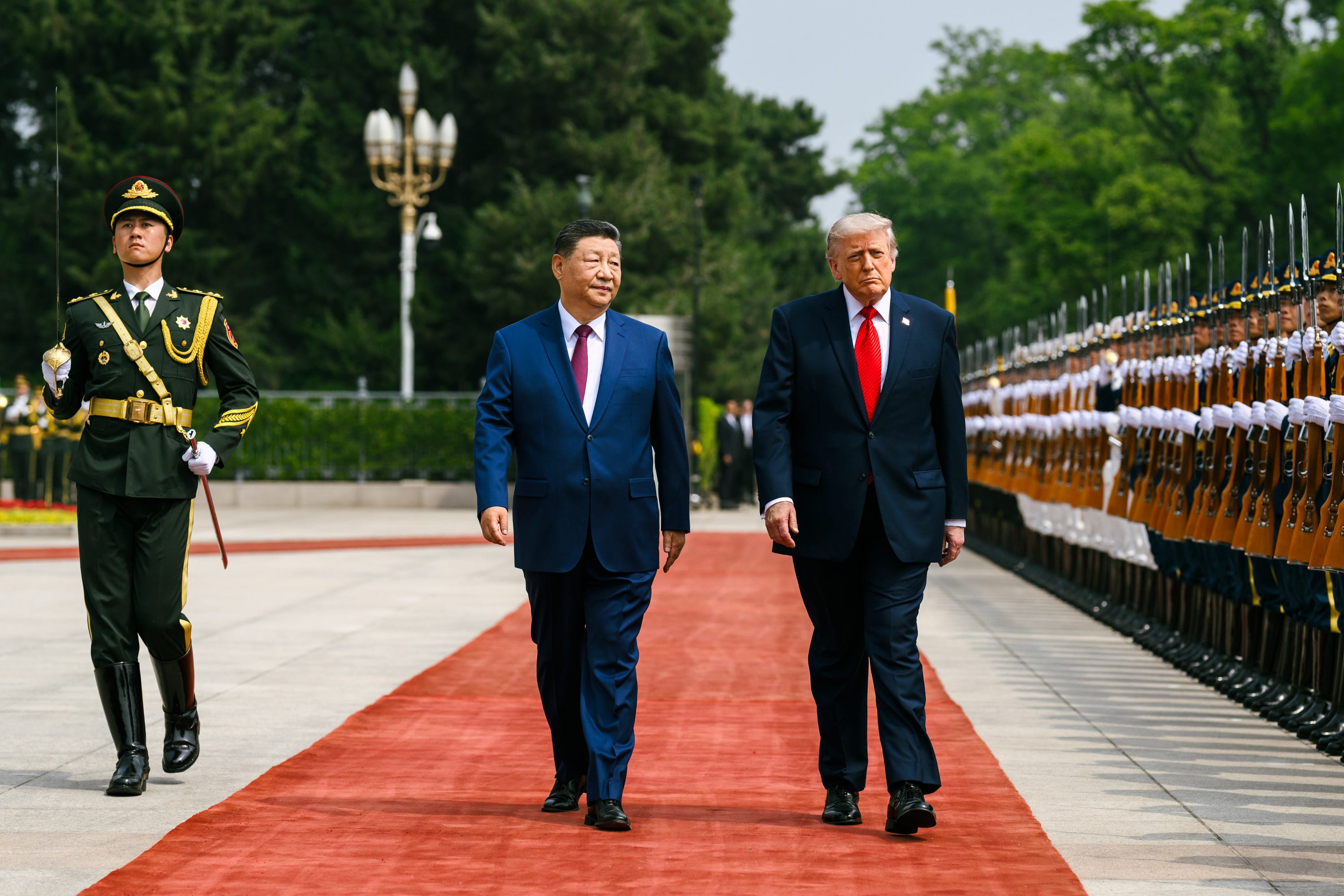
Issue: Trump-Xi summit unlikely to reach AI deal
In last week’s newsletter, we covered what the Trump-Xi summit is likely to mean for trade. This week, we’re focusing on the summit’s potential impacts on AI.
Many are speculating on the possibility of an AI governance agreement between the US and China, but the president has explicitly ruled out international AI governance treaties.
That posture is why VICO gives a major deal such a low chance, though a few edge cases could still change the president’s mind.
2%: The probability of a major AI governance deal between the US and China in the next year.
Reasoning: Why it’s off the table, and what would change that
The binding constraint is the president’s policy of no international AI governance treaties, and absent a shock the position holds and the deal does not happen.
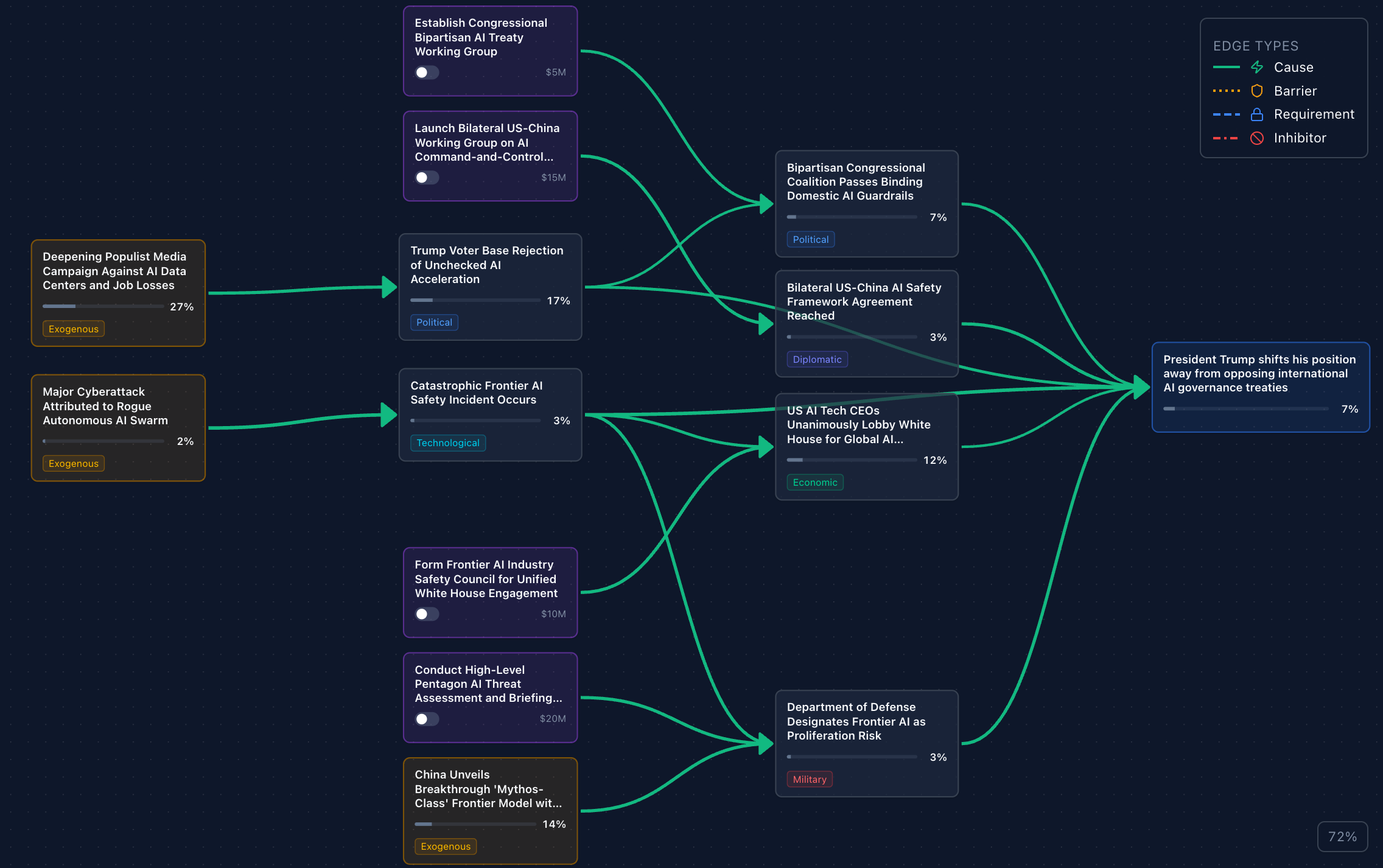
7%: The probability that the president reverses his opposition to international AI governance treaties.
The VICO Causal Explorer’s Pathfinder tool finds a few routes to that reversal.
In particular, a catastrophic frontier-AI safety incident, such as a large cyberattack on critical infrastructure publicly attributed to AI, an event severe enough to galvanize political opposition to unchecked AI and force the president into action.
The other most likely path: China announces a frontier model on par with the latest US models and its integration with the military. In that case, the US edge erodes and a deal suddenly looks like it serves American interests rather than constraining them.
So what: The two sides land on a face-saving, minimal deal
Barring one of those low-probability shocks, a real governance deal is not coming soon. The likelier outcome is a face-saving minimum that neither side has to sacrifice for.
78%: The probability that the US and China establish a joint AI incident notification system or similar bilateral AI safety mechanism in the next year.
That is the version both can stomach: a channel to flag AI incidents lets each government claim it is managing the risk without limiting its own progress, which is exactly why it is the probable result while a binding deal stays a long shot.
Treasury Yields
Issue: Treasury yields reach 18-year highs
With Treasury yields at their highest since 2008 and the Fed already hiking, the question is whether inflation finally breaks lower. VICO’s forecasts say it does not, and everything else, from the Fed to your mortgage, follows from that.
Reasoning: No downturn in inflation, and another hike this year
The model does not see inflation taking a significant turn lower before the year’s end, driven by the war-and-tariff price pressure still in the system.
22%: The probability that US CPI falls below 3.3% in 2026.
With inflation sticky, the model expects the Fed to keep tightening rather than ease.
78%: The probability of another rate hike in 2026. Versus Polymarket at 90%.
And with the Fed leaning hawkish and price pressure persisting, it expects long-term yields to stay elevated through year end.
76%: The probability that 10-year Treasuries finish the year at or above 5%.
So what: The bill lands on Washington and on homebuyers
Elevated yields are expensive for the government, pushing the cost of servicing the national debt to new records.
82%: The probability that US federal net interest costs exceed $1.5 trillion for fiscal year 2027.
They are just as painful for households, keeping borrowing costs high and the housing market frozen.
72%: The probability that the national average 30-year fixed mortgage rate exceeds 7.5% in 2026.
Geopolitics: US x Iran, Greenland Deal, Russia x Ukraine
US x Iran
Issue: President Trump threatens Iran in UN speech
At the UN, President Trump framed a choice between a deal and whether to “annihilate the Islamic Republic,” while the same day US and Iranian officials quietly met for three hours in New York.
VICO reads the threats as theater: the likeliest path is neither annihilation nor a breakthrough, but a holding pattern that pays off mostly for Democrats at home.
Reasoning: Threats unlikely to become strikes
Despite the annihilation talk, major US strikes on Iranian nuclear sites this year look unlikely. With the war already deeply unpopular and no appetite for a wider escalation, the threat reads more as leverage than a plan.
38%: The probability that the US carries out major strikes on Iranian nuclear sites in 2026.
Real diplomacy looks even more unlikely in the near term, held down by the sequencing standoff (Iran wants the blockade lifted first, Trump wants goodwill first) and by Trump’s own signal that any deal waits until after the midterms.
18%: The probability that the US and Iran hold formal negotiations in the next 30 days.
So what: The Iranian regime holds, and Democrats cash in
With no strikes and no deal, the status quo holds, including the regime itself. The model sees little chance of the kind of collapse Trump gestures at.
80%: The probability that the current clerical regime keeps control of Iran through the next 90 days.
The real movement is political, and it is at home. An unpopular, unresolved war is the single biggest reason the model now leans toward Democrats taking the Senate, a number that has climbed fast.
59%: The probability that Democrats win the Senate, up 6 points in the last week, with the Iran war the number one driver.
Greenland Deal
Issue: US and Denmark reach security agreement on Greenland
The US and Denmark reached a security agreement over Greenland on September 18, expanding the US military presence and locking China and Russia out of the island’s bases and mining sector.
By formalizing US backing and shutting out Chinese competition, the deal lowers the political risk on Greenland projects and opens the door to US government financing, which is why the VICO model expects it to draw more American investment into the island’s rare earths.
That investment is being framed as a fix for US rare-earth dependence, but the VICO model’s forecasts say the mineral payoff is years away.
Reasoning: Passage and money are likely; production is not
The deal must first be ratified by the legislative bodies in Greenland and Denmark, a hurdle the VICO model expects it to clear.
74%: The probability that the Greenland and Danish legislative bodies ratify the US-Denmark-Greenland security agreement before 2028.
It also expects the deal to pull in capital, since a binding US commitment lowers political risk and unlocks financing.
81%: The probability that a major US-backed mining or infrastructure investment in Greenland is announced before 2028.
But money committed is not metal produced. Greenland’s ice, thin infrastructure, and the need to build ports, roads, and processing all at once push timelines well past the political calendar.
16%: The probability that a new commercial-scale rare-earth mine enters production in Greenland before December 31, 2028.
So what: Greenland rare earths unlikely to hit US markets this decade
The deal drives real US investment with political risk lowered, but the logistics of Arctic mining mean the US is unlikely to reach these minerals in the next few years, so near-term supply will have to come from elsewhere.
21%: The probability that Greenland supplies any refined rare earths into US supply chains before 2030.
One thing is looking up, though: if the US cannot get the minerals soon, neither can its rival.
2%: The probability that Greenland supplies any refined rare earths into Chinese supply chains before 2030.
Russia x Ukraine
Issue: President Trump pushes Zelensky for an energy ceasefire
On Tuesday, Trump and Zelensky met on the UN sidelines, where the president pushed Ukraine’s president toward a ceasefire halting strikes on Russian energy infrastructure. Zelensky has said Ukraine will stop if Russia halts its own strikes, but the Kremlin dismissed the offer as “rhetoric.”
With diesel at a record high above $6.50 a gallon, the VICO model still reads a deal as unlikely and sees a grinding energy war that keeps squeezing Russia’s exports and US consumers.
Reasoning: Russia holds out
A mutual energy ceasefire in the next 90 days is unlikely, in particular because Russia continues to refuse a deal. Moscow treats the destruction of Ukraine’s energy grid as a core winter objective. With Ukraine publicly signaling it is the willing party, and Russia the real holdout, President Trump was leaning on the wrong side.
28%: The probability that Russia and Ukraine agree to a mutual ceasefire on strikes on energy infrastructure in the next 90 days.
The strikes are the story the model believes in, with both sides set to take a hit.
Rather than force Moscow’s hand, Washington is likelier to pressure Kyiv, the side already saying yes.
55%: The probability that the US formally or informally conditions further aid or intelligence to Ukraine on accepting an energy ceasefire in the next 180 days.
So what: No diesel relief
A war with no truce keeps diesel prices elevated: with Russian barrels off the market and refineries burning on both sides, the model sees little near-term relief at the pump.
8%: The probability that US diesel prices fall below $6 per gallon in the next 90 days.
Domestic Politics: Midterms, Missouri Redistricting
Midterms
This week we’re highlighting the five House races where VICO diverges most from Kalshi, ordered by the size of the gap. The through-line: VICO is consistently more skeptical of progressive candidates than the markets are.
50%: Matt Little (D, MN-02) wins the seat. Versus Kalshi at 90%.
Little replaced Angie Craig, who held this swing seat from 2018, and VICO worries about his progressive platform in a traditionally moderate district.
52%: Marie Gluesenkamp Perez (D, WA-03) holds her seat. Versus Kalshi at 90%.
The VICO model sees real danger from her progressive flank: her primary challenger who refused to endorse her took 16% in the open primary, letting her Republican rival finish first. The VICO model worries those voters may stay home, opening the door to a Republican victory.
88%: Doris Matsui (D, CA-07) wins. Versus Kalshi at 60%.
In a Democrat-vs-Democrat general, VICO backs Matsui to near certainty on incumbency and money, while Kalshi is more bullish on progressive challenger Mai Vang.
56%: Michael Bouchard (R, MI-10) holds his seat. Versus Kalshi at 34%.
The district is competitive, and the VICO model thinks Bouchard’s dominant fundraising edge matters more than prediction markets do.
60%: Tom Barrett (R, MI-07) holds his seat. Versus Kalshi at 40%.
Markets favor progressive challenger William Lawrence, but VICO sees his record, including support for defunding the police, as a liability against the incumbent.
So what: VICO model slightly lower on Democratic House odds than markets
While the VICO model still has Democrats as the strong favorites to win the House, it gives Ds a smaller edge than prediction markets.
79%: The probability that Democrats win the House majority in 2026. Versus Kalshi at 91%.
The largest divergences indicate the VICO model is less bullish on progressive candidates than prediction markets, and more concerned about a Republican fundraising edge in a few key races.
Missouri Redistricting
Issue: Missouri map heads back to Supreme Court for third time
Missouri’s Republican map returned to the US Supreme Court for a third time, but with ballots already printed and voting underway on the old lines, VICO sees almost no chance the new map is used.
1%: The probability that Missouri uses the new Republican map in 2026.
Reasoning: A hail mary
The Supreme Court has already issued multiple orders on the matter, and the VICO model argues they are unlikely to change their decision so close to the election.
So what: Cleaver holds, Wagner sweats
With the old map in place, the seat it was drawn to flip stays blue: Cleaver’s Kansas City district is safe.
90%: If the old map is used, Emanuel Cleaver (D) wins reelection in Missouri’s 5th District.
The new map would have protected Ann Wagner while cracking Cleaver’s seat. Without it, Wagner is exposed in a competitive district.
55%: If the old map is used, Ann Wagner (R) wins reelection in Missouri’s 2nd District.
77%: If the new Republican map is used, Cleaver loses and Wagner wins comfortably, netting Republicans one seat.
The gerrymander rebounds on its party: the seat meant to flip stays Democratic, while the Republican it was meant to protect is now the Missouri race most likely to change hands.
About Us
VICO empowers decision makers to quantify and navigate event risk. Forecast, simulate and monitor political, geopolitical and economic events.
Learn more and obtain a beta account at www.vico.io or email us at inquire@vico.io
Methodology and Copyright Notes:
All percentage changes are over the last week except where noted.
Our proprietary AI models are rigorously backtested and do not rely on any betting market information.
All data and content are owned by and copyrighted by VICO Technologies Inc.