VICO FUTURE MONITOR · NEWSLETTER
Three’s a Crowd, Two’s a Deal - November 19, 2026
Shenzhen Summit, Cuba, US x Iran, Nvidia Regulation, Anthropic IPO, 2028 Primaries, Permitting Reform
This issue was published in the VICO Future Monitor newsletter and is archived here; edits and forecast links were added by the VICO editorial team.
Access VICO forecasts or make your own at www.vico.io as well as on the Bloomberg Terminal at WSL PREDICT<GO>, WSL ELECTION<GO> and WSL VICO<GO>.
This week in 60 Seconds:
Community Forecast Requests
68%: The probability that the US and China sign a reciprocal tariff-reduction agreement before February 15, 2027.
25%: The probability that the current Cuban government falls or Miguel Díaz-Canel is removed from office within six months.
62%: The probability that the US carries out major new strikes on Iranian nuclear sites before Dec 31, 2026.
90%: The probability that the US rescinds or further tightens the approval framework for Nvidia to export H200 chips to China before June 30, 2027.
60%: The probability that Anthropic reaches a $2 trillion valuation by the end of 2027.
38%: The probability that JD Vance wins the 2028 Republican nomination.
64%: The probability that this or a similar permitting bill is signed into law before January 20, 2029.
Community Forecast Requests
Have a question you would like to ask VICO? This week, we are taking community forecast requests. While we are not publishing a newsletter next week during Thanksgiving, the following week we will feature a handful of forecasts requested by readers in a new community section.
If you would like to submit a question, email marketing@vico.io, and we may feature your requested forecast in next week’s newsletter.
Geopolitics: Shenzhen Summit, Cuba, US x Iran
Shenzhen Summit
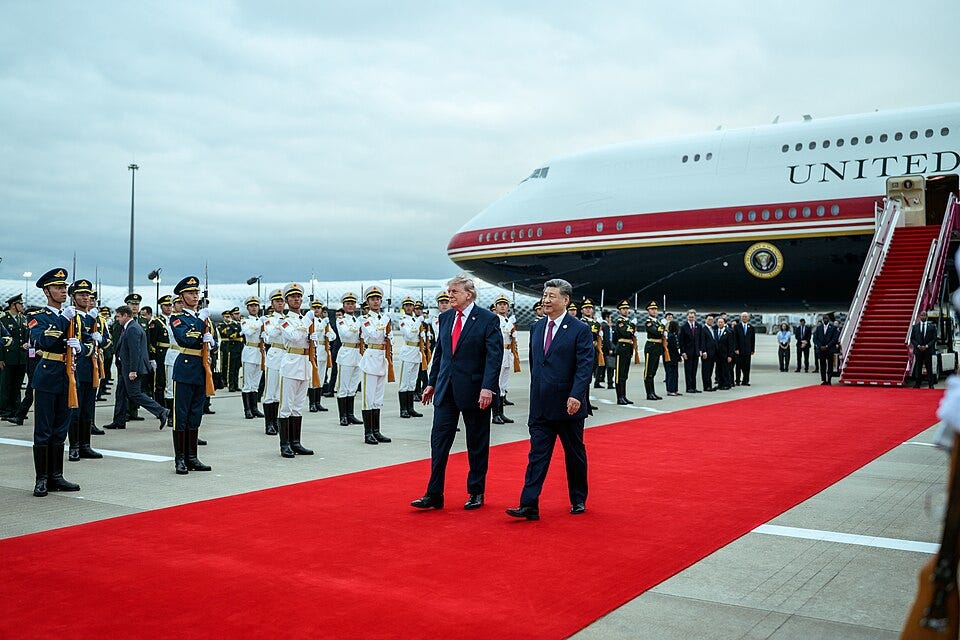
Issue: Trump, Xi and Putin met in Shenzhen
The three leaders sat down together for the first time on Wednesday, with trade, rare earths, AI chips, and the wars in Ukraine and Iran on the table. The model called what came out of the September Trump-Xi meeting before it happened; now it is forecasting the aftermath of the trilateral.
Expectations for the meeting itself were low, and the model agrees: no immediate breakthrough, but a real chance of a US-China trade deal in the near future.
Reasoning: What the trade deal actually hinges on
The one near-term deliverable is a rare-earth reprieve.
70%: The probability that China extends its rare-earth export-control suspension past January 10, 2027.
The deal itself is two numbers, unlikely now but above 50% in the next three months, with Beijing using its mineral controls as leverage.
The VICO Causal Explorer points to what actually moves towards a deal:
If China commits to buying US agricultural exports, the probability of a tariff deal jumps from 68% to 89%.
The summit itself barely affects the forecast. Instead, the real driver is the trade truce that runs out in January.
Ukraine is the longest shot.
So what: The six-month fallout is clearer than the summit
What happens over the next six months matters more than anything that happened on stage: a tariff deal brings real relief, and China’s mineral leverage pushes Washington elsewhere.
61%: The probability that US average tariff rates on Chinese goods are lower six months from now than today.
61%: The probability that China imports more US soybeans in the first half of 2027 than a year earlier.
71%: The probability that the US announces a new critical-minerals or rare-earth deal worth more than $1 billion within six months.
Cuba
Issue: Washington turns the screws on Havana
Pressure on Cuba is building in the open. In October, Secretary of State Marco Rubio publicly urged Cubans to pursue a “discreet partnership” with the CIA to bring political change, an appeal Havana mocked as a sign of US desperation, and Trump has floated sending Rubio to the island himself.
The question underneath the noise is simple: is something going to happen, and what is it? The VICO model’s answer is a financial strangulation, not an invasion. A US strike runs hot in the commentary but cold in the forecasts.
Reasoning: What actually breaks the regime
The military lane stays quiet relative to the rhetoric. A direct strike is a single-digit call, and Havana leaning on Russia or China for cover is possible but not the base case.
The probability mass sits in the economic lane. Secondary sanctions are the most likely single event on the board, and the model expects Cuba to crack open its private sector out of necessity.
75%: The probability that the US imposes secondary sanctions on a foreign bank, shipper, or insurer for dealing with Cuba before March 31, 2027.
20%: The probability that the US declares a formal, total oil embargo on Cuba by March 31, 2027.
65%: The probability that Cuba enacts major market-liberalizing reforms that expand its private sector before the end of 2027.
Rubio’s CIA appeal points to a quieter intelligence front. The model sees a covert program more likely than not to surface, though an actual defection is a longer shot.
55%: The probability that a US covert operation, recruitment network, or intelligence program targeting Cuba is publicly exposed before June 30, 2027.
20%: The probability that a senior Cuban military, intelligence, or party official defects to or is revealed cooperating with US intelligence before June 30, 2027.
So what: The bigger question is whether the regime survives
The squeeze is surer than the spectacle. The real question is whether the regime survives it, and the model’s answer is a contingent not-yet: collapse is a real tail, not a base case, and it hinges on fuel and elite loyalty rather than firepower.
25%: The probability that the current Cuban government falls or Miguel Díaz-Canel is removed from office within six months.
US x Iran
Issue: The fight is spreading across the region
The Iran war is re-escalating in the open. The US just struck an Iranian missile-launch site, and Iran is widening its attacks across the Gulf in response, the latest turn in a year that has already seen US strikes on Iran in May, Iranian barrages on Israel and Jordan, and US-Israeli strikes on Iraq and Qeshm Island.
The questions for the next six weeks: how far does Iran’s campaign spread, does it drag in oil, and how hard does Washington hit back.
Reasoning: Wide and hot, but bounded
Iran’s campaign keeps widening, with Israel and Gulf energy the likeliest next targets on top of the chokepoint it already controls.
Even so, the oil shock stays contained. Despite the Strait mining and the blockade, the model doubts a genuine price spike, a sign it expects spare supply and strategic reserves to absorb the disruption.
15%: The probability that Brent crude closes above $100 a barrel on any day before Dec 31, 2026.
Washington hits back, but stays measured. More US strikes are the base case, but a sustained campaign is just 1 in 4.
60%: The probability that the US launches more military strikes on Iran within 14 days.
25%: The probability that the US launches sustained military strikes in Iran by the end of 2026.
Importantly, oil markets have increasingly become accustomed to isolated strikes like the ones earlier this week. A sustained campaign could uniquely impact markets in a way that the model’s expected isolated strikes may not.
20%: The probability that the US or Israel strikes Iran’s oil or energy export infrastructure before Dec 31, 2026.
Economics: Nvidia Regulation, Anthropic IPO
Nvidia Regulation
Issue: Washington is not waiting for a new CEO
On November 16, the Commerce Department published an interim rule requiring licenses for advanced AI-chip exports to Malaysia, Singapore, Indonesia, Thailand, and Brazil, closing the remote-access loophole exposed by the Megaspeed scandal.
The VICO model reads it as the opening move in a broad enforcement wave, one that does not depend on who runs the company.
Reasoning: The enforcement wave is broad and highly likely
The model’s highest-conviction move is a widening dragnet.
84%: The probability that the Commerce Department adds at least five companies to the Entity List within the next 180 days.
Enforcement is turning criminal, too, and the net is going global, with the Gulf the likeliest next target.
Nvidia itself is in the frame.
So what: The wall creates losers and a winner
The same regulation hits Nvidia, drags the broad Chinese market, and hands domestic chipmakers an opening.
73%: The probability that Nvidia’s China data-center revenue falls more than 50% year over year in 2027.
82%: The probability that China’s STAR 50 tech index falls at least 10% before February 3, 2027.
If the US restricts Nvidia H200 exports to China:
95%: The probability that Cambricon stock (Chinese chip designer) rises 20%+ within 30 days, as domestic producers are forced to pick up the slack Nvidia leaves behind.
Anthropic IPO
Issue: Anthropic goes public in the biggest tech IPO ever
Anthropic went public today in the largest stock-market debut on record, pricing at $83 a share for a valuation near $1.5 trillion.
It caps a breakneck year that ran from a $380 billion round in the spring to a $1.5 trillion debut.
The question now shifts to how Anthropic’s valuation is likely to move on the public market.
Reasoning: Where the stock lands, and whether it holds
The VICO Option Space Explorer puts the first-week closing valuation on a clean curve, better than even to clear its ask but well short of a blowout.
The probability that Anthropic closes at or above each valuation after one week of public trading:
At least $800 billion: 92%
At least $1 trillion: 80%
At least $1.4 trillion: 60%
At least $2 trillion: 25%
At least $2.5 trillion: 8%
The debut looks durable through week one, even if the ceiling is not.
75%: The probability that the shares end their first full week above the IPO price.
So what: The debut is the easy win, the real test is growing into the price
The long-term questions are whether Anthropic can grow into a trillion-dollar-plus valuation and whether its economics catch up to the hype. The model sees room to grow into the price over time (a 25% shot at $2 trillion in week one rises to 60% by the end of 2027) but treats profitability as the harder test.
Domestic Politics: 2028 Primaries, Permitting Reform
2028 Primaries
Issue: An open race, two years out
With President Trump term-limited, 2028 is the first race in a decade with no incumbent on the ballot and an open contest on both sides.
Underneath the surface, the two fields could not look more different. One has a clear pecking order. The other is a scrum.
Reasoning: One field has a leader, the other doesn’t
The Republican race is dominated by the top. As the sitting vice president, JD Vance is the heir apparent at 38%, with Secretary of State Marco Rubio as the main alternative at 25%.
Together, Vance and Rubio account for more than 60% of the field. The VICO model reads it as a race dominated by two men, with Ron DeSantis (14%) the only other candidate in double digits and Tucker Carlson (4%) a long shot.
The Democratic side is more crowded, but it still has a surprising leader: Kamala Harris at 25%.
The VICO model gives Harris a large edge on the strength of her name recognition and early polling, where the former vice president starts out well ahead of the rest of the field. Many have written her off after 2024, but the VICO model sees a serious possibility of her winning the nomination in 2028.
Behind her the pack is tight: Pete Buttigieg (19%), Alexandria Ocasio-Cortez (17%), Josh Shapiro (15%), Jon Ossoff (12%), and Gavin Newsom (10%).
The model notably discounts Ossoff, holding his number down because it takes seriously the possibility that he does not run at all, no matter how strong a candidate he might be if he did.
The Republican field
38%: The probability that JD Vance wins the 2028 Republican nomination.
25%: The probability that Marco Rubio wins the 2028 Republican nomination.
14%: The probability that Ron DeSantis wins the 2028 Republican nomination.
4%: The probability that Tucker Carlson wins the 2028 Republican nomination.
The Democratic field
25%: The probability that Kamala Harris wins the 2028 Democratic nomination.
19%: The probability that Pete Buttigieg wins the 2028 Democratic nomination.
17%: The probability that Alexandria Ocasio-Cortez wins the 2028 Democratic nomination.
15%: The probability that Josh Shapiro wins the 2028 Democratic nomination.
12%: The probability that Jon Ossoff wins the 2028 Democratic nomination.
10%: The probability that Gavin Newsom wins the 2028 Democratic nomination.
So what: Who are the strongest candidates?
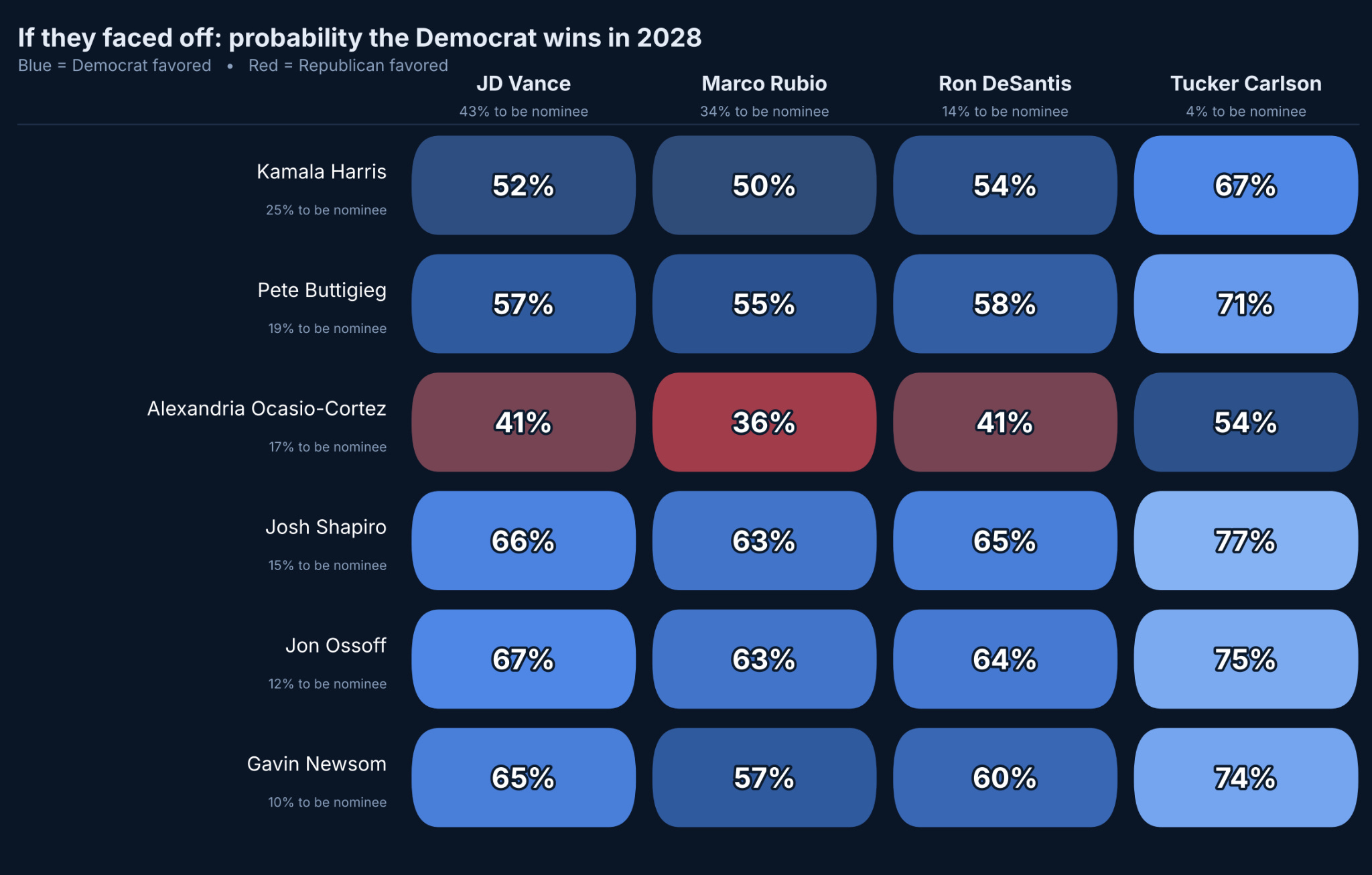
Two patterns emerge from the VICO Options Explorer analysis. First, Democrats broadly have an advantage in 2028. Second, the more anti-establishment candidates on both sides like Carlson and AOC perform weaker than more moderate candidates like Rubio, Shapiro, and Ossoff.
On the left, Alexandria Ocasio-Cortez is the only Democrat the VICO model makes an underdog against the serious Republicans, losing to Vance (41%), Rubio (36%), and DeSantis (41%). On the right, Tucker Carlson is the mirror image, losing every single matchup by double digits.
The model’s favorites are the opposite profile. Jon Ossoff and Josh Shapiro win every matchup they are in, from 63% up to 77%, and Marco Rubio is the strongest Republican, holding every Democrat to their lowest number and fighting Kamala Harris to a dead-even 50%.
So while Democrats broadly have an advantage, the specific nominee determines whether they expand or shrink that lead. Importantly, the VICO model maintains that while Harris may be a strong primary candidate, she is actually the second weakest option we forecasted in the general election.
Permitting Reform
Issue: Congress is closer than it’s been in years
Permitting reform is the closest it has come in years. On November 9 the Senate advanced the Bipartisan American Affordability and Jobs Act on a 73-25 test vote.
The bill caps NEPA lawsuits at 150 days, hands FERC backstop power to approve interstate transmission over state objections, and makes data centers pay for the grid capacity they use.
It is not done yet: final Senate passage, the House, and a signature all lie ahead, and the coalition is fragile, with progressives, the Sierra Club, tribal groups, and a wind-skeptical Trump (“I will not approve wind turbines”) all wary.
Wall Street is betting against it near-term, with TD Cowen putting enactment around 25%.
Reasoning: Likely eventually, probably not yet
The VICO model roughly agrees with the Street that it is a long shot this Congress, but likes its chances before Trump’s term is out.
The VICO Scenario Explorer identifies the possible results:
41%: The probability that, if it passes, tech giants sign additional nuclear agreements on over 3,200 megawatts of long-term power for data centers.
40%: The probability that, if it passes, next-generation energy developers secure land permitting within 120 days to begin construction on geothermal and nuclear projects.
But the bill is likely to face legal challenges
48%: The probability that, if it passes, a coalition of state attorneys general challenge the Clean Water Act preemption.
46%: The probability that, if it passes, environmental groups file petitions challenging the new permitting rules.
So what: The likeliest market impact is energy
The clearest consequence of passage is money moving. The model’s single most probable downstream outcome is a surge of private capital into clean energy and the grid once litigation risk is stripped out.
73%: The probability that, if it passes, US renewable capital expenditure jumps about 35% as roughly $48B floods into solar, wind and storage and 42 GW of stranded projects break ground within 14 months.
About Us
VICO empowers decision makers to quantify and navigate event risk. Forecast, simulate and monitor political, geopolitical and economic events.
The VICO model uses AI, data science and modeling & simulation to derive all of its forecasts. It does not use prediction market data.
Learn more and activate and account at www.vico.io or email us at inquire@vico.io
Methodology and Copyright Notes:
All percentage changes are over the last week except where noted.
Our proprietary AI models are rigorously backtested and do not rely on any betting market information.
All data and content are owned by and copyrighted by VICO Technologies Inc.