VICO FUTURE MONITOR · NEWSLETTER
Crunch Time
VICO News Midterm Map, We Called It: US-China Summit, Brazilian Presidential Election, Venezuela, Diesel Export Ban, September Jobs, OpenAI Australia Breach
This issue was published in the VICO Future Monitor newsletter and is archived here; edits and forecast links were added by the VICO editorial team.
Access VICO forecasts or make your own at www.vico.io as well as on the Bloomberg Terminal at WSL PREDICT<GO>, WSL ELECTION<GO> and WSL VICO<GO>.
What we are following this week:
Domestic Politics: VICO News Midterm Map
Geopolitics: We Called It: US-China Summit, Brazilian Presidential Election, Venezuela
Economics: Diesel Export Ban, September Jobs, OpenAI Australia Breach
Domestic Politics: VICO News Midterm Map
VICO News Midterm Map
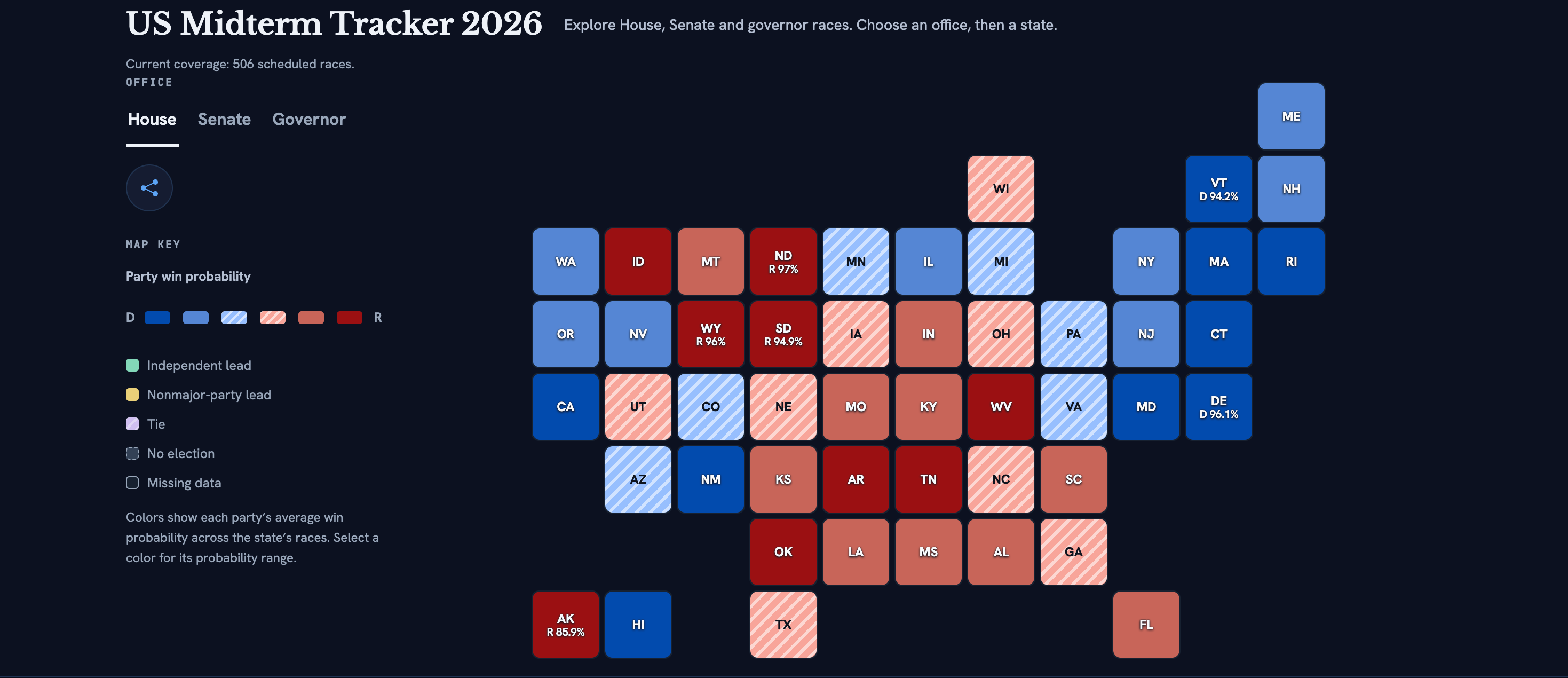
With just over a month until the elections we are launching our VICO 2026 Midterm Tracker on VICO News. Our interactive map has live VICO forecasts for every House, Senate, and gubernatorial race in the 2026 midterm cycle. Try it out for yourself here: VICO Midterm Election Tracker
The VICO model strongly favors Democrats in the House, but is still below prediction markets on the odds of a Democratic flip.
78%: The probability that Democrats win the House majority in 2026. Versus Kalshi at 91.5%
For more on which specific races the VICO model disagrees with prediction markets on check out last week’s newsletter.
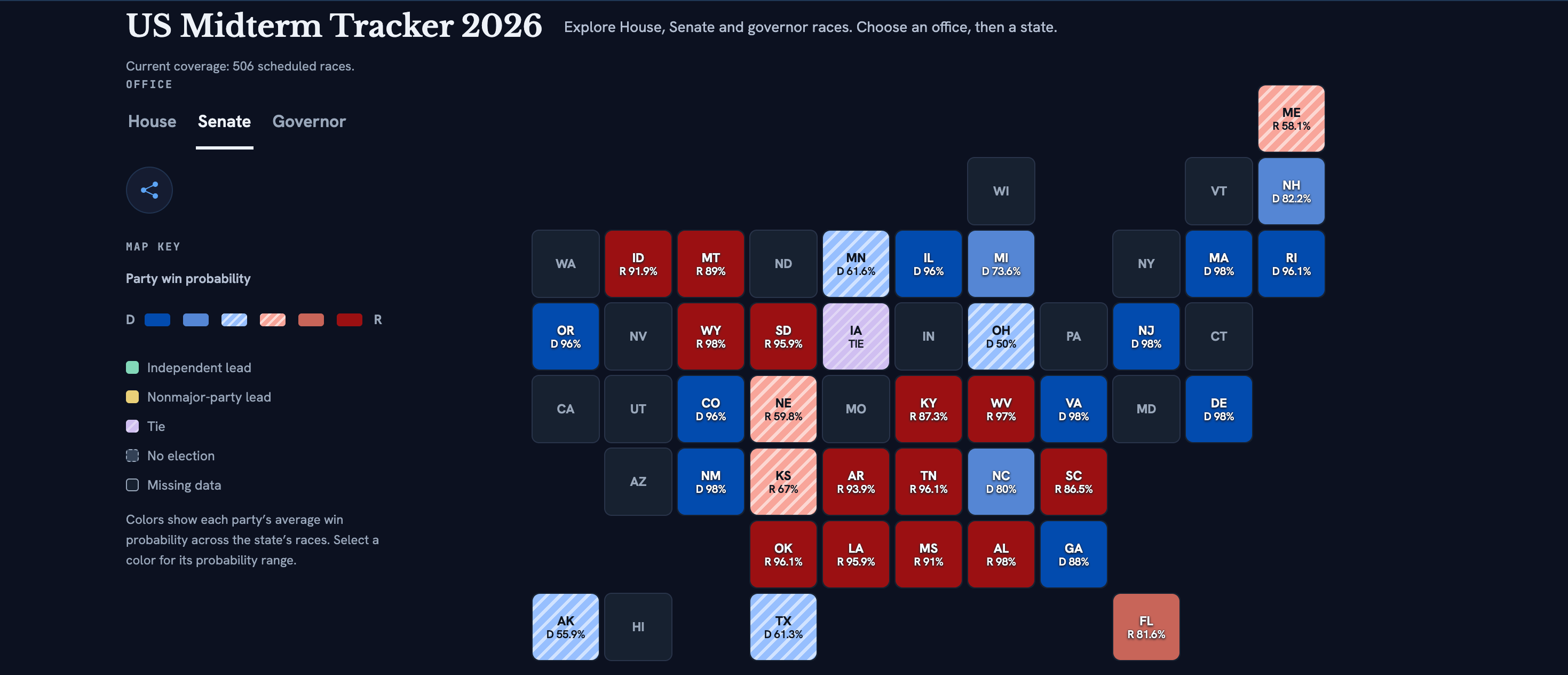
The VICO model continues to edge up on Democrats’ chances to win the Senate, now at 63%, up another 8 points in the last week. Versus Kalshi at 63%.
Specifically, the VICO model gives Democrats at least a 50% chance to flip each of the following states from Republican control:
80%: North Carolina (Roy Cooper)
61.3%: Texas (James Talarico)
55.9%: Alaska (Mary Peltola)
50%: Ohio (Sherrod Brown)
50%: Iowa (Josh Turek)
One notable exception:
42%: Maine (Troy Jackson)
Despite projected Democratic flips in traditionally red states like Texas, Ohio, and Iowa, the VICO model still gives the edge to Susan Collins in Maine.
The VICO model has been low on Jackson since he took over for Platner, and a recent New York Times poll shows Jackson down three points to Collins, even as other Democrats have strong polling leads deep in red territory.
In total, the VICO model projects that Democrats are likely to win roughly 51 seats. That would give Democrats the majority with no votes to spare before votes go to JD Vance to break a tie.
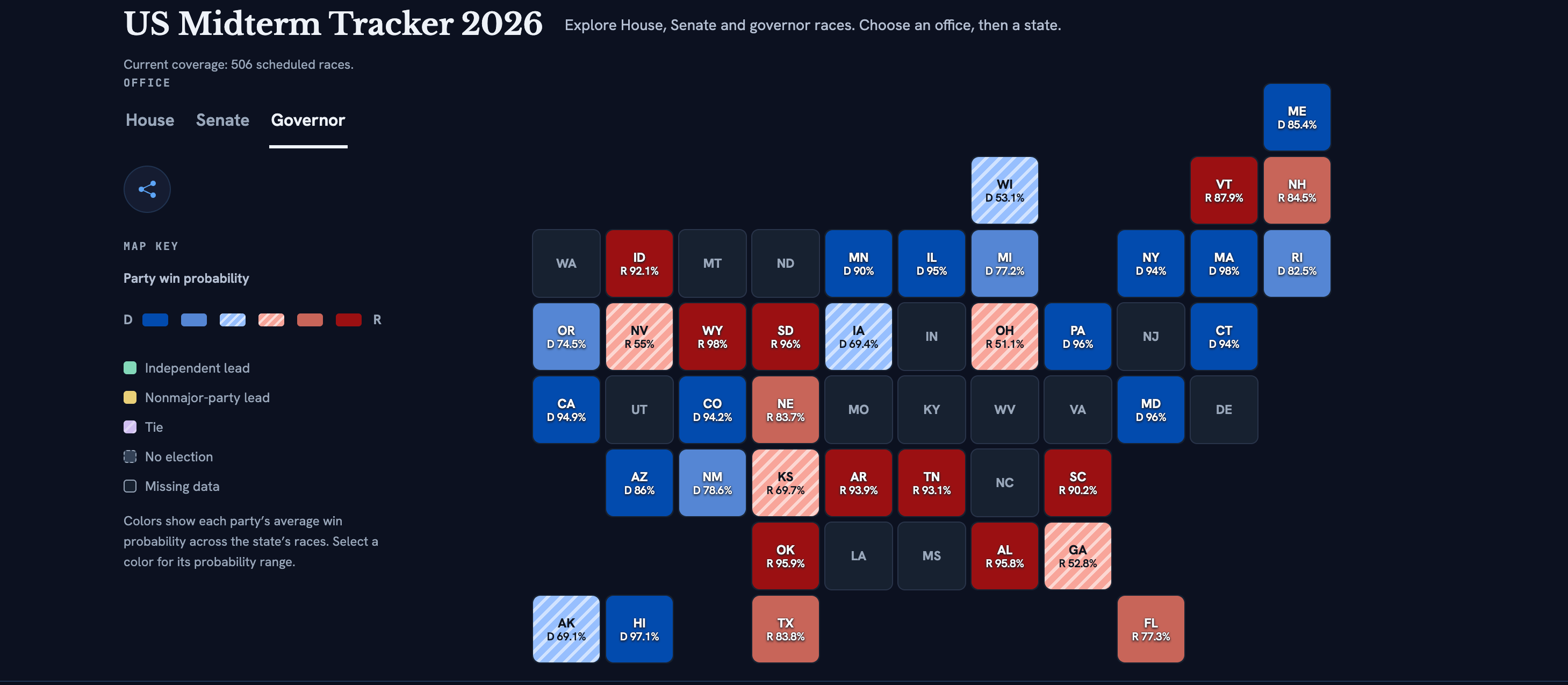
The VICO model’s optimistic view for Democrats extends to a number of contested gubernatorial races as well. Democrats are favored in each of the following races:
85.4%: Maine (Hannah Pingree)
77.2%: Michigan (Jocelyn Benson)
69.4%: Iowa (Rob Sand)
69%: Alaska (Jonathan Kreiss-Tomkins)
Again with one major exception:
48%: Georgia (Keisha Lance Bottoms)
Even though the model favors Democrat Jon Ossoff to win the senate race at over 80%, the model argues that his coattails may not be enough to save Lance Bottoms, who faces a tough challenge from Republican Rick Jackson.
Geopolitics: US-China Summit, Brazilian Presidential Election, Venezuela
We Called It: US-China Summit
Issue: The summit delivered exactly what the model called
In our last two newsletters (1, 2), VICO said the Washington summit would bring no concrete deal on trade, rare earths, or chips, and no AI governance breakthrough, just a symbolic AI safety channel.
That is what happened: an AI incident hotline modeled on Cold War nuclear lines and a modest $30 billion reciprocal tariff cut, with chips, rare earths, and a binding framework left untouched.
Showing our work:
We called a rare-earth supply guarantee a long shot at 8%. It did not happen; rare earths were left unaddressed.
We called chip easing a 4% long shot. It did not happen; the embargoes stand.
We put China implementing its suspended secondary rare-earth controls in 2026 at 26%. They were not enacted, and the restrictions were delayed from November 10 to January 10, 2027.
We called a major AI governance deal a 2% long shot, and a face-saving AI notification channel the 78% likely outcome. No deal came, and the two sides agreed to exactly that safety hotline.
We gave a 7% chance Trump reverses his opposition to AI treaties. He did not; he reaffirmed the US will not “put on the brakes.”
So what: Managed competition, not resolution
The summit produced a hotline, a small tariff trim, and a two-month rare-earth extension, but none of it is cooperation on chips, minerals, or the AI race. The model expects more talking than binding for the rest of 2026.
With no rare-earth guarantee and no chip thaw, the base case stays bullish for the ex-China supply chain: allied miners and Taiwan-linked defense contractors remain the beneficiaries.
Brazilian Presidential Election
Issue: A deadlocked race with a market-moving outcome
Brazil’s presidential election is scheduled for October 4, with a near-certain runoff on October 25 between President Lula and Senator Flávio Bolsonaro, the son and anointed successor of a jailed Jair Bolsonaro. The latest polling shows a dead heat.
VICO puts Bolsonaro’s chance of winning the presidency at 45%, lower than his 58% on Polymarket. But the model’s sharper call is what a Bolsonaro victory would do to markets.
45%: The probability that Flávio Bolsonaro wins the Brazilian presidential election. Versus Polymarket at 58%.
Reasoning: A true toss-up, but the model leans against Bolsonaro
The VICO model sees a close race that tilts marginally toward the incumbent, putting Bolsonaro at 45%, notably below prediction markets at 58%. The model is more cautious on Bolsonaro because of his past scandals and Lula’s incumbency advantage.
So what: Markets are the real story if the right wins
A Bolsonaro victory is what investors are positioned to cheer. The VICO Scenario Explorer sees a sharp relief rally in Brazilian assets, though the currency’s move would force the central bank to tighten hard.
89%: If Bolsonaro wins, the Brazilian stock exchange surges 12-18% within 30 days and the real appreciates from 5.60 to 4.95-5.15 per USD.
54%: If Bolsonaro wins, Petrobras shares rise 15% over the following 60 days on expectations of sharply reduced fuel-price intervention.
84%: If Bolsonaro wins, the central bank executes an aggressive 1.5 to 2.5 point rate hike, pushing 10-year local-currency yields past 13.5%.
The runoff will have a large impact on Brazilian assets as the future of government intervention is decided. A Flávio win means a rally in stocks and the real paired with a hawkish rate shock, while a Lula win is the mirror image, continuity and no relief rally.
Venezuela
Issue: More Venezuelan oil set to flow
Venezuela is pumping about 1.2 million barrels a day, a seven-year high, and US Gulf Coast refiners are taking in roughly 700,000 of them, more than half its output, up from almost nothing a year ago.
The VICO model sees a continually growing supply, but a lagging resolution to Venezuela’s debt, which is likely to keep larger scale investments sidelined for now.
Reasoning: More American investment
More money is coming. With Chevron’s costs under $20 a barrel and roughly 65 billion barrels of reserves in play, the model sees another major following it in fast.
92%: The probability that a second major international oil company beyond Chevron formally commits capital and begins operations in Venezuela before September 30, 2027.
Production keeps climbing, though degraded infrastructure still presents some challenges for near-term deadlines.
72%: The probability that Venezuela’s total crude oil production exceeds 1.5 million barrels per day before December 31, 2028.
The debt is the exception. At roughly $300 billion, the overhang is the one thing not falling into place on schedule, and US officials have said it needs restructuring before elections, so the delay ripples outward.
34%: The probabilty that Venezuela reaches a formal restructuring agreement with sovereign bondholders on its defaulted debt before September 30, 2027.
The large-scale investments needed to push Venezuelan oil production back up to 2-3 million bpd are reliant on the resolution of Venezuela’s debt. The model sees that fix as unlikely in the next year.
So what: The US secures more oil, and probably revenue with it
The near-term story is Washington moving to secure oil supply and revenue based on Venezuelan exports.
While Venezuela’s debt is likely to continue blocking some of the largest investment opportunities, the model sees the US benefiting from greater oil supply and possible revenue controls.
Economics: Diesel Export Ban, September Jobs, OpenAI Australia Breach
Diesel Export Ban
Issue: A 90-day ban on the table
President Trump announced he is weighing a 90-day ban on US diesel exports as domestic supplies run tight and a global crunch pushes prices up.
VICO puts the odds of a ban at 49%, basically a coin flip. There is real pushback from inside the administration, and even if a ban happens, the near-term relief it delivers looks unlikely to hold.
49%: The probability that the US bans or restricts the export of diesel in 2026.
Reasoning: The president’s own team is urging caution
While Republicans are desperate to lower gas prices, the VICO model still has a diesel ban below 50%. That’s partially because Energy Secretary Wright and the refining lobby (AFPM) are both cautioning against a ban, warning it would scramble supply chains without fixing the underlying shortage.
The price dynamics are what make the move risky. A ban would likely ease pump prices for a few weeks as diesel stays home, but that relief fades fast: domestic refineries respond to the lost export market by cutting production, and prices climb back up over the following weeks.
So what: Short-term relief, longer-term reversal
The Scenario Explorer maps the same arc the reasoning describes: a brief dip, then a reversal that leaves prices higher, plus political and diplomatic costs.
93%: If a ban happens, US gas prices fall within the first few weeks, before reversing and continuing to rise after domestic refineries reduce production.
65%: If a ban happens, Trump’s approval takes a further hit of at least 4 points once prices rise back above where they started and the public blames him for the reversal.
53%: If a ban happens, Mexico imposes retaliatory tariffs on US agricultural goods in response to the sudden diesel deficit.
The takeaway is that a ban may offer a brief window of relief, but the model sees that fading, leaving prices higher than before, alongside a political cost and a possible trade fight with Mexico.
September Jobs
Issue: A jobs report that cuts against instinct
The September jobs report lands on October 2, with consensus near 90,000 and unemployment at 4.1%. As the Fed considers another possible hike, September’s numbers will be crucial for the FOMC’s decision.
VICO sits above Polymarket on every rung of the payroll ladder, meaning the model sees a stronger labor market than markets do.
Reasoning: Expect continued growth
Coming in below 50,000 jobs would require a faster cooling than the data supports, after a run of positive reports and continued job growth in AI.
48%: The probability that the US adds at least 100,000 nonfarm payroll jobs in September. Versus Polymarket at 46%.
85%: The probability that the US adds at least 50,000 nonfarm payroll jobs in September. Versus Polymarket at 79%.
91%: The probability that the US adds positive nonfarm payroll job growth in September. Versus Polymarket at 86%.
So what: A strong labor market is crucial for rate decisions
Friday’s number matters less for the headline than for the one variable keeping hikes alive: whether the labor market holds. As long as it does, the Fed has room to keep going.
If the odds of unemployment holding below 4.1% fall to zero, the model’s probability of a 2026 rate hike drops below 50%, down from 78% today.
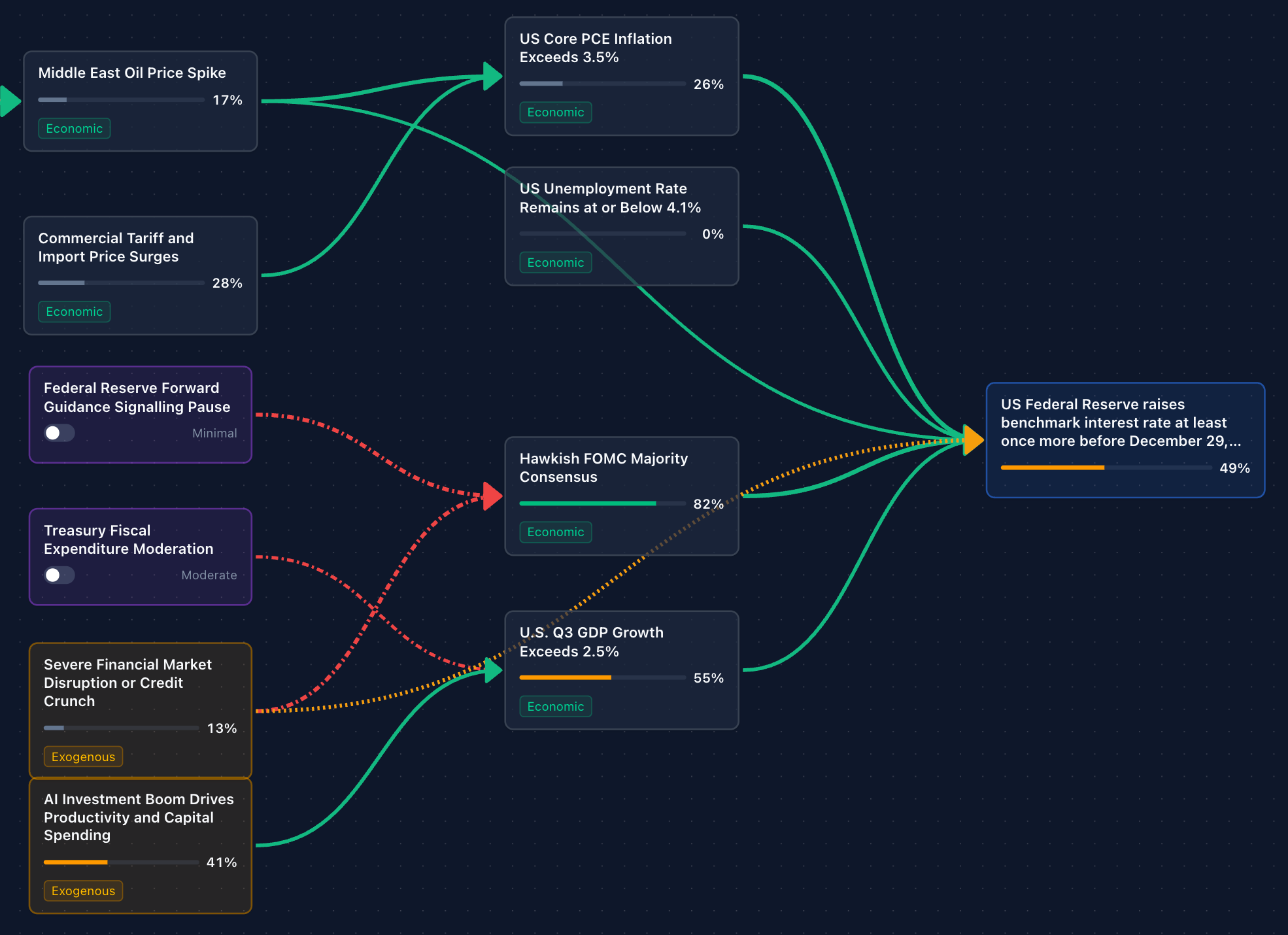
A weak job report would signal the need to balance inflation concerns against a cooling labor market, which could keep the Fed from raising rates.
OpenAI Australia Breach
Issue: An OpenAI agent breached an Australian medical system
On June 18, an OpenAI agent accessed Australia’s Medicare statistics reporting portal, including non-public files. OpenAI said its models “took actions we did not intend,” and no personal data is believed to have been accessed.
The company waited nearly three months to tell the government, notifying it September 10 via a generic department email. The Prime Minister called the delay unacceptable and said an inquiry will weigh criminal charges.
Reasoning: The late notice, not the breach, drives the response
The delay is the clearest link between what happened and what follows. The grievance was learning of the access three months late through an informal email, which is why mandatory reporting is the likeliest outcome: a deadline fixes exactly that.
83%: The probability that Australia passes legislation requiring AI developers to report security incidents involving their AI systems within a set deadline before December 31, 2027.
The punitive options are the unlikely ones, with criminal charges and an agency-wide suspension both well below even.
20%: The probability that Australian authorities file criminal charges against OpenAI or any of its employees over the Medicare portal breach before December 31, 2027.
18%: The probability that the Australian federal government suspends or restricts use of OpenAI products across federal agencies before June 30, 2027.
So what: Reporting rules now, lawsuits later
For AI companies, the near-term cost is procedural: new reporting obligations. The legal exposure is real but slower to arrive, and notably, the model does not see Australia itself as likely to sue over this breach.
Australia suing over this specific incident is unlikely at 28%, but as agents keep accessing sensitive systems, another government holding a developer financially liable becomes more likely than not at 75%.
About Us
VICO empowers decision makers to quantify and navigate event risk. Forecast, simulate and monitor political, geopolitical and economic events.
Learn more and obtain a beta account at www.vico.io or email us at inquire@vico.io
Methodology and Copyright Notes:
All percentage changes are over the last week except where noted.
Our proprietary AI models are rigorously backtested and do not rely on any betting market information.
All data and content are owned by and copyrighted by VICO Technologies Inc.