VICO FUTURE MONITOR · NEWSLETTER
What Happens Now? - November 5, 2026
What now?, Congressional Leadership Fights, Midterm Recap, US x Iran, Saudis x Houthis, China + US AI Stocks, GDP Growth
This issue was published in the VICO Future Monitor newsletter and is archived here; edits and forecast links were added by the VICO editorial team.
Access VICO forecasts or make your own at www.vico.io as well as on the Bloomberg Terminal at WSL PREDICT<GO>, WSL ELECTION<GO> and WSL VICO<GO>.
What we are following this week:
Domestic Politics: What now? Midterm Recap, Congressional Leadership Fights
Geopolitics: US x Iran, Saudis x Houthis
Economics: China + US AI Stocks, GDP Growth
Domestic Politics: What Now?, Congressional Leadership Fights, Midterm Recap,
What Now?
Issue: Democrats win both chambers
The sweep hands Democrats the gavels, subpoenas, and the confirmation calendar for the first time in Trump’s term, but not a veto-proof majority. They can investigate and say no, but their policy agenda is likely to stall on the president’s desk.
Reasoning: Investigations, not policy
The oversight machine is the part most likely to fire. The VICO model has a Democratic subpoena met by a White House refusal as near-certain, with the fight headed for the courts.
Impeachment becomes an oversight tool. The VICO model argues that the Democratic base may push Democrats to impeachment, despite strategic concerns from some moderate Democrats.
Hegseth is considered by some to be the most exposed official, with the president reportedly considering replacing him.
47%: The probability that Pete Hegseth is out as Secretary of War in 2026. (Polymarket: 50%)
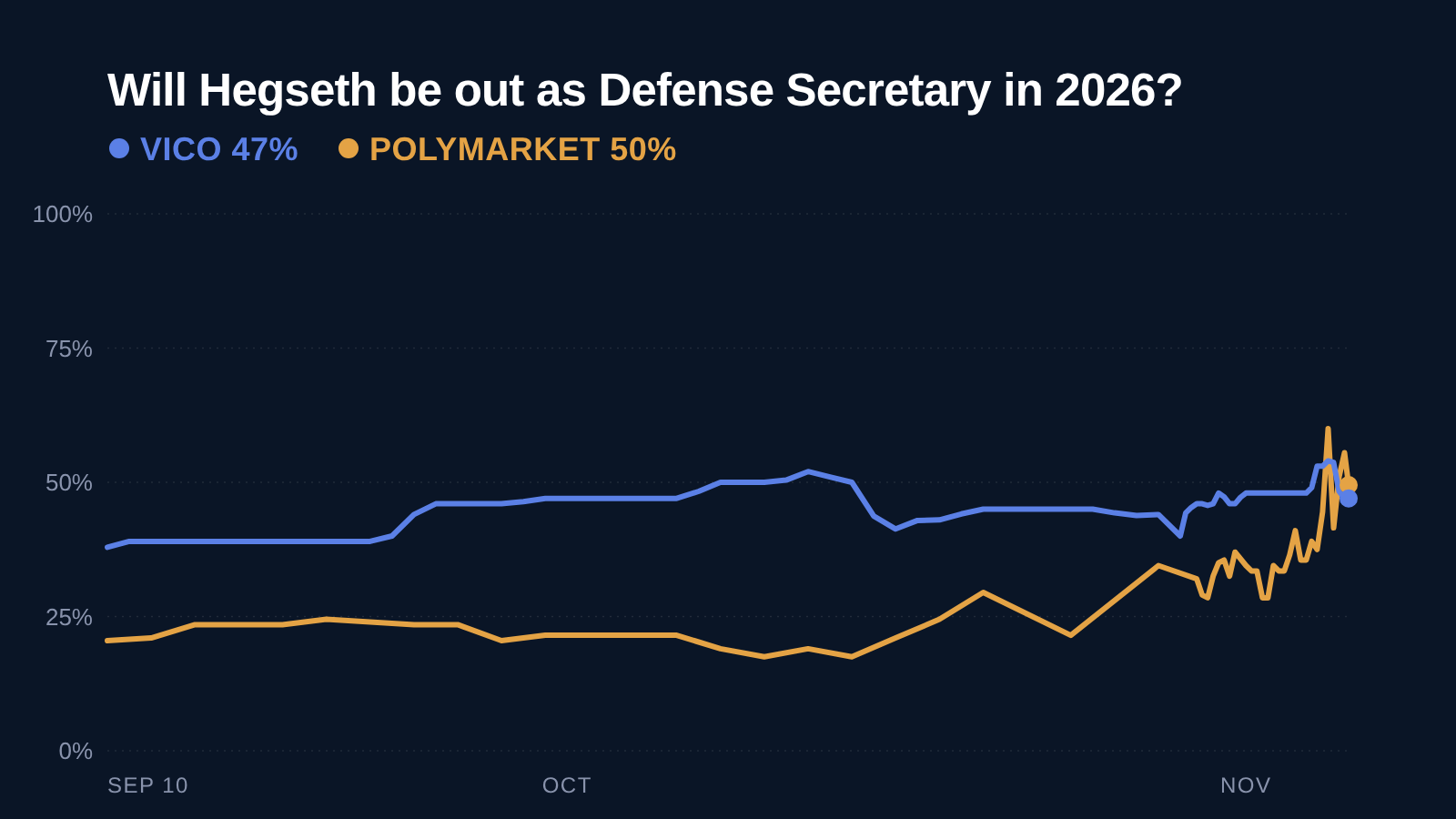
The VICO model has been ahead of prediction markets for the last 90 days on Hegseth’s possible ousting, with markets just catching up after the election.
Even confirmations are less of a wall than they look. The VICO model argues package deals are historically common, trading non-controversial district judges for policy compromises.
42%: The probability that the Senate confirms zero judicial appointments before June 30, 2027.
And the VICO model is low on any Republican Supreme Court justice retiring, with probabilities below 10% for the two oldest justices on the court.
So what: Presidential veto stalls Democratic policy priorities
Democrats can stop and expose but not enact, so for markets the takeaway is that the policy status quo holds. The VICO model notes they cannot override a veto, which leaves the two outcomes with the biggest market impact, a tariff rollback and restored health subsidies, firmly out of reach.
<1%: The probability that the US repeals all Trump tariffs in the next 180 days.
32%: The probability that the US reinstates the ACA subsidies that expired at the end of 2025 before the end of Trump’s term.
42%: The probability that the US bans Congressional stock trading before the end of Trump’s term.
Congressional Leadership fights
Issue: House Speaker Mike Johnson will not run for leadership in new Congress
After the midterm wipeout, Speaker Mike Johnson won’t run to lead House Republicans into the minority, setting up a contest between Steve Scalise and Jim Jordan. On the other side of the aisle, the Democratic sweep hands the gavel to Hakeem Jeffries and the Senate to Chuck Schumer. One party has a fight on its hands; the other has a formality.
Reasoning: A real GOP contest, with a Democratic formality
The VICO model has Scalise as the favorite over Jordan. As current majority leader he carries the institutional lane, and he beat Jordan for the conference’s nomination once before, in 2023.
The VICO model argues Trump is likely to put his thumb on the scale. Even coming off a losing midterm, his endorsement carries gravity and he has intervened in leadership contests before.
82%: The probability that Trump publicly endorses a candidate in the House Republican leadership race in the next 180 days.
For Democrats, the sweep turns the handoff into a formality. Jeffries is set to become the first Black Speaker, and Schumer to run a Democratic Senate, with little organized resistance to either.
So what: The bigger risk is outside the leadership fight
Jordan, a member of the Freedom Caucus, is seen by many as the more hardline of the two options, so his election would tilt the conference toward confrontation. And while the leadership fight plays out, the federal government’s shutdown risk is live.
42%: The probability of a federal government shutdown before Jan 3, 2027.
Midterm Recap
On election day we published our complete preview of the midterms. Today, we’re going over how we did and what we can learn.
Where we were vs prediction markets on election day:
The VICO model predicted Democratic majorities in both the House (85%) and the Senate (76%) before polls closed on election day.
The model was slightly less confident than prediction markets on the House (Kalshi: 93%), but in line with markets on the Senate (Kalshi: 76%).
On the control-of-Congress calls themselves, our accuracy actually slightly beat prediction markets close to the election: a Brier score of 0.065 to their 0.067 at 30 days out, and 0.052 to 0.056 in the final week (lower is better).
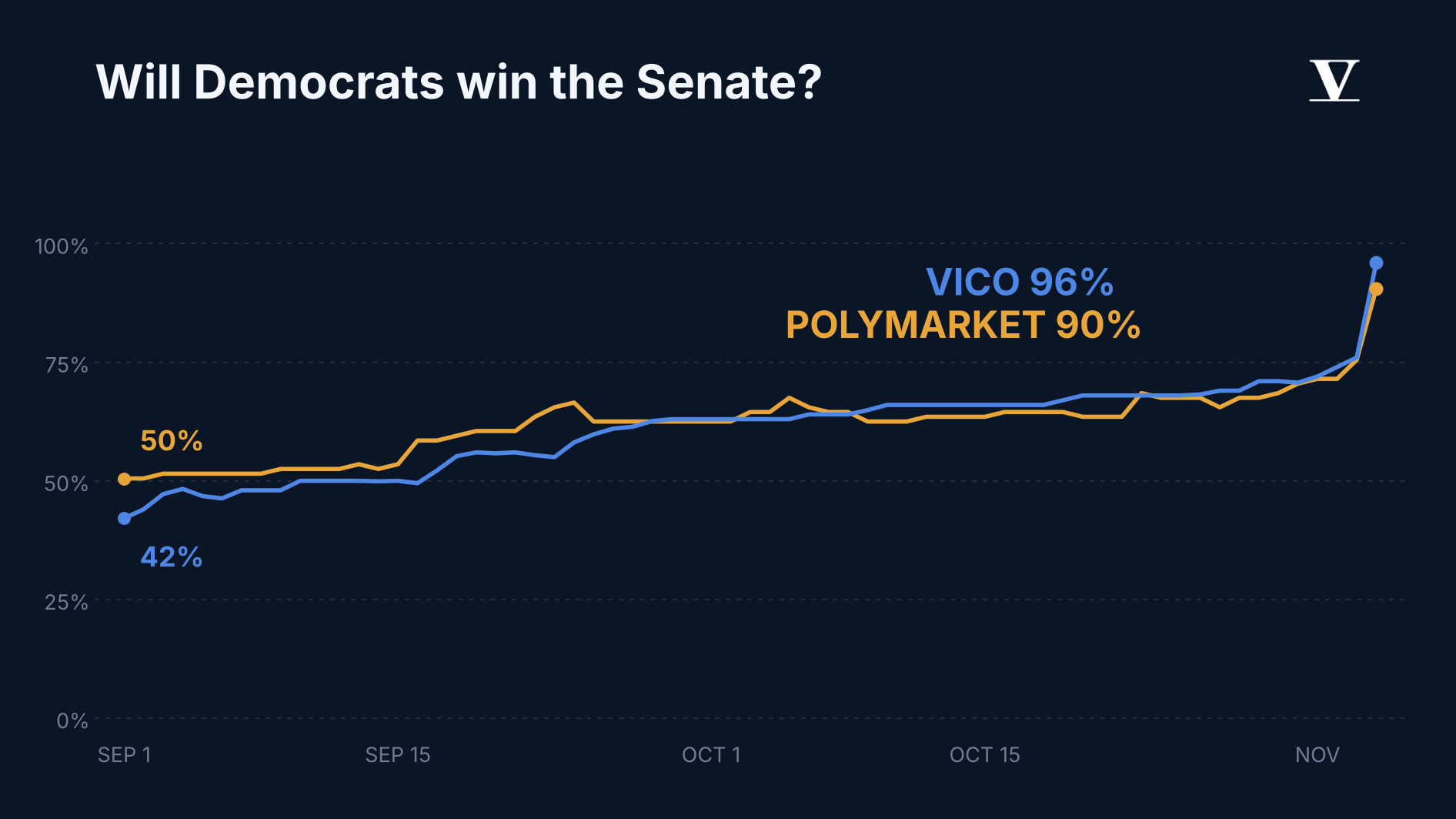
The primary difference between the VICO model and prediction markets, and what the model got wrong, was the size of the majority rather than the party.
The model projected roughly 230 Democratic House seats and 51 Democratic Senate seats; prediction markets projected roughly 240 House and 53 Senate. Currently the tally stands at Democrats winning at least 251 House seats and 54 to 56 Senate seats. Those results are above both our estimate, and the prediction markets’.
This extended to most Senate races, where the model was less bullish than markets on Democrats in swing states, with the exception being Iowa, where the model was above 50% on Josh Turek (D) well before prediction markets.
The model accurately called Democrats in Ohio, Alaska, Michigan, and Texas, but lower than prediction markets.
It also had Republicans slightly favored in Kansas (52%) and Maine (56%).
Our assessment:
As we detailed in our election day newsletter, the model was less reactive to polling data than prediction markets. Instead, it gave heavy weight to fundamentals like spending, historic voting trends, and incumbency, most of which favored Republicans in a number of major races.
For example, a late group of polls showing Adam Hamilton (D) ahead in Kansas moved the model up to 48% late on election day, but pushed prediction markets all the way to 63% before the count began.
The model gave more room for Republicans to overperform their polls as they did in 2016, 2020, and 2024.
One figure it cited in Maine, where polling showed Collins slightly behind, was her ability to beat her polls — she outran her numbers by 13 points in 2020.
But on Tuesday it was Democrats who overperformed. They are on pace to win the national popular vote by roughly 13 points and to beat projections in states like Texas, where James Talarico’s polling showed a 3-5 point lead but he is on pace to win by more than 10.
So what:
The VICO model performed well across all races. For every forecast we did around the elections (1,359 questions in total) our Brier score was 0.026, with an accuracy of 96%. Within hard to call races, we were close to prediction markets, where in the Senate, for example, they called just two races on the better side of 50% than the VICO model, and VICO called one better than them. The House was more complex but a similar comparison, VICO was at a 95% accuracy vs prediction markets at a 97% accuracy.
Geopolitics: US x Iran, Saudis x Houthis
US x Iran
Issue: How a Democratic Congress could change the war
US forces struck Iranian targets in the Strait of Hormuz on Nov 3. A day later, Democrats won both chambers, giving the opposition hearings, subpoenas, and funding fights for the first time in the war. The question is whether that changes the war or just the noise around it.
Reasoning: Few levers for Congress
The VICO model argues that the immediate strikes may not happen as President Trump and Republicans focus inwards.
42%: The probability that the US launches new strikes on Iran in the next 14 days.
But the longer-term nuclear campaign is untouched, and any diplomatic breakthrough remains highly unlikely in the near-term.
Democrats are also likely to investigate the administration over strikes.
72%: The probability that a committee subpoenas an administration official over Iranian strikes within 120 days.
So what: Limited oversight, with possible movement on Hormuz in the long-term
A Democratic Congress can investigate the war, but it cannot end it. A funding cutoff needs Trump’s signature or a veto override the new majority cannot assemble.
15%: The probability that Congress enacts a binding restriction on funding for US offensive operations against Iran in the next 180 days.
But the VICO model opens the door for the Strait to reopen in the next six months.
42%: The probability that the Strait of Hormuz reopens in the next 180 days.
P.S: Sanity check on US x Israel funding:
On Tuesday as voters went to the polls, the president announced that all US military aid to Israel would stop. The VICO model argues it’s more than just talk:
88%: The probability that the US halts or cuts its $4 billion in annual military aid to Israel by the end of 2027.
Even with the Iran strikes continuing, the model still expects the US to financially distance itself from Israel before 2028.
Saudis x Houthis
Issue: Houthi strikes in Saudi Arabia
The truce that held since 2022 collapsed in July, and the Houthis have since overrun Yemen’s Red Sea coast and carried the war into Saudi Arabia itself. In recent weeks they have hit Riyadh’s main airport, struck Aramco’s Dhahran headquarters, and launched cross-border ground raids on Saudi border posts. The question now is whether Saudi Arabia can claw any of it back.
Reasoning: More strikes coming
The strikes on Saudi Arabia are relentless. Missiles and drones have flown almost daily since September, and an October attack on Riyadh’s King Khalid airport killed 12 and forced a shutdown. The model sees no letup in the near term.
94%: The probability that the Houthis attack a Saudi airport or major city in the next 30 days.
The Houthis hold the Red Sea chokepoint, and no ceasefire is coming. They seized Perim Island and most of Yemen’s west coast in September and declared a blockade, while Saudi Arabia’s two-week truce offer through Oman went nowhere and both sides keep escalating.
So what: More oil disruption
The economic toll is spreading, and oil is now a target.
66%: The probability that a Houthi strike disrupts Saudi Aramco oil production or exports before Dec 31, 2026.
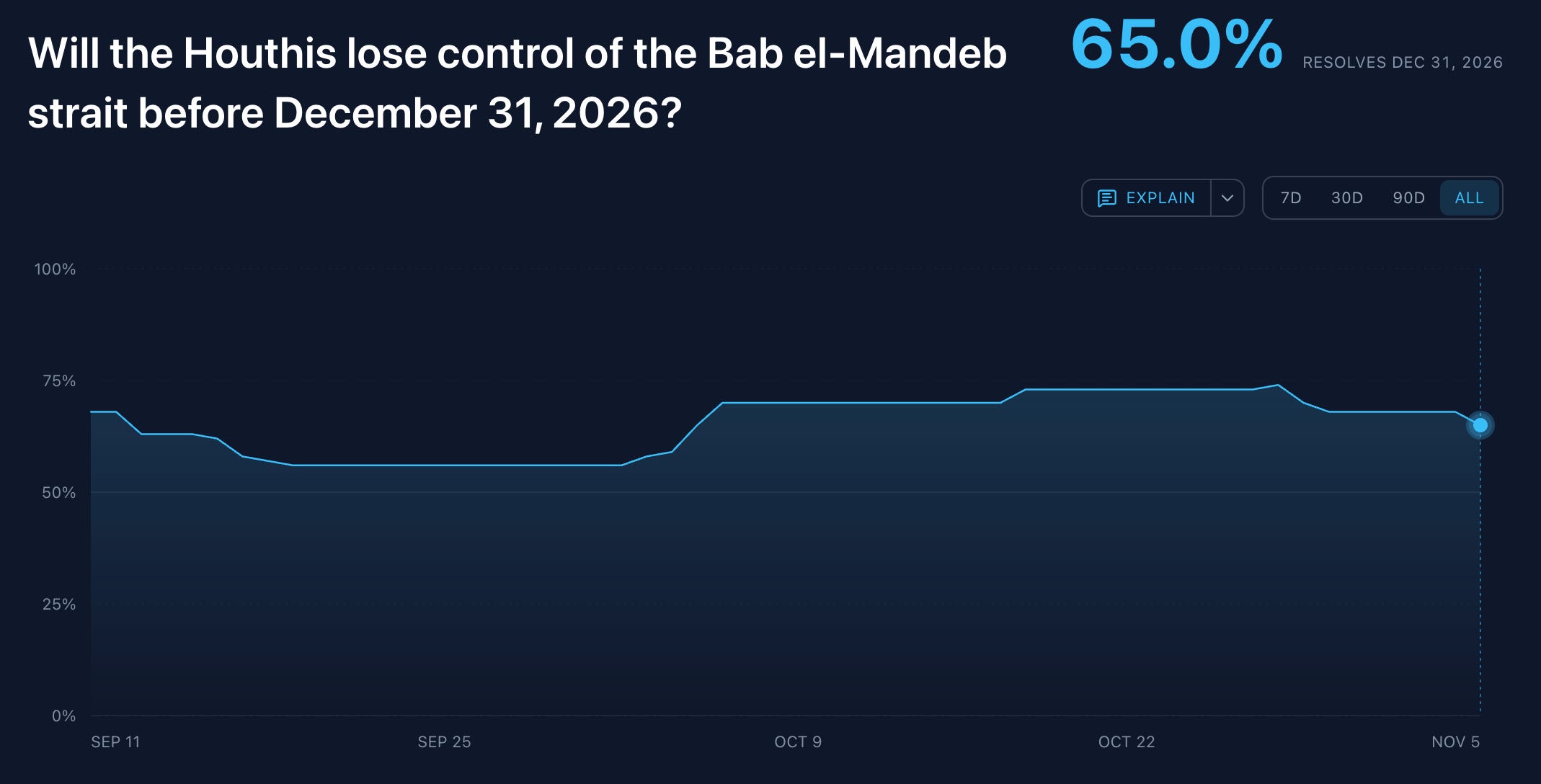
The model expects the Houthis’ hold on the Bab el-Mandeb Strait to loosen by year end, even though US direct strikes are below 50%.
65%: The probability that the Houthis lose control of Bab el-Mandeb before Dec 31, 2026.
49%: The probability that the US conducts direct strikes on Houthi positions in the next 60 days.
Economics: China + US AI Stocks, GDP Growth
China + US AI Stocks
Issue: Chinese AI stocks collapsing as the US watches
China’s STAR 50 (science and tech exchange) has lost about 40% of its value and roughly $480 billion since the summer. Now the US is following it down: the Nasdaq 100 has slid nearly 7% from its October 6th high on AI-spending and valuation fears. The question is whether the American index follows China.
Reasoning: A spending reset, not yet a demand collapse
The US selloff could deepen, but a full-blown crash is not the model’s base case. The Nasdaq is already a third of the way to a bear market, and history says a correction tips into one perhaps a third of the time in volatile regimes.
38%: The probability that the Nasdaq 100 enters a bear market (closing at least 20% down from its October 6th high) before March 31, 2027.
But capital spending may be a target. The VICO model thinks it is more likely than not that one of the tech giants cuts AI capex.
62%: The probability that at least one of Microsoft, Alphabet, Amazon, or Meta cuts its forward AI capex guidance before May 4, 2027.
But the demand for data centers continues. The model does not expect the core of the AI boom to crack.
15%: The probability that Nvidia reports a year-over-year decline in data-center revenue in any quarter before November 5, 2027.
So what: China is not done, and Beijing is likely to step in
The Chinese rout, the leading indicator for all of this, still has further to run, and the model expects the state to intervene before it’s over.
GDP Growth
Issue: The Q3 boom is not built to last
The economy grew a hot 3.4% annualized in Q3, with price pressures easing in the print. But the VICO model sees that momentum fading into 2027 while inflation stays stubborn, a mix that leaves the Fed little room to ease.
Reasoning: Growth decelerates while prices stay hot
The Q3 pace is unlikely to repeat, and a soft patch is more likely than not by spring. The model gives barely even odds the Q4 print stays strong, and better-than-even odds that growth dips below 2% by the first quarter.
Looking further out, next year’s growth is close to a coin flip to reach 2%.
54%: The probability that full-year 2027 real GDP growth exceeds 2%.
Inflation, meanwhile, is not cooperating. Core PCE is likely to stay above target, and headline CPI is likely to run hot into the new year.
So what: Inflation forces the Fed’s hand
Strong 3.4% growth with sticky inflation pushes the Fed further towards another rate hike, despite the VICO model’s projection that economic growth is likely to slow.
About Us
VICO empowers decision makers to quantify and navigate event risk. Forecast, simulate and monitor political, geopolitical and economic events.
Learn more and obtain a beta account at www.vico.io or email us at inquire@vico.io
Methodology and Copyright Notes:
All percentage changes are over the last week except where noted.
Our proprietary AI models are rigorously backtested and do not rely on any betting market information.
All data and content are owned by and copyrighted by VICO Technologies Inc.