VICO FUTURE MONITOR · NEWSLETTER
France on the Brink
French Protests/Elections, Trump x Russia Sanctions, Israeli Elections, Texas Senate, Senate Races, Scenario: Republicans Hold both Chambers, Fed Meeting, SpaceX Shares

This issue was published in the VICO Future Monitor newsletter and is archived here; edits and forecast links were added by the VICO editorial team.
Access VICO forecasts or make your own at www.vico.io as well as on the Bloomberg Terminal at WSL PREDICT<GO>, WSL ELECTION<GO> and WSL VICO<GO>.
What we are following this week:
Geopolitics: French Protests/Elections, Russia x French Protests, Trump x Russia Sanctions, Israeli Elections
Domestic Politics: Texas Senate, Senate Races, Scenario: Republicans Hold both Chambers
Economics: Fed Meeting, SpaceX Shares
Editor’s Note:
This week, we are beginning our shift to Beehiiv for our newsletters. All Substack subscribers will be ported over automatically, and we plan to publish on both platforms for the next few weeks meaning subscribers will receive two versions of the newsletter in their inbox this week. There is no need for any action on your part. All current subscribers will continue receiving editions of Future Monitor moving forward. We hope you enjoy this week’s edition.
Geopolitics: French Protests/Elections, Russia x French Protests, Trump x Russia Sanctions, Israeli Elections
French Protests/Elections
Issue: Fragile government attempts to weather protests
Prime Minister Sébastien Lecornu heads a fragile minority government facing a make-or-break budget vote, with his 2027 budget trying to cut the deficit to 5% of GDP.
Frustrations with the government have spilled into the streets, with riots across the country and Macron’s approval sinking to a record-low 15%.
Reasoning: A government on the edge, a debt pile to match
The government may not last the year, and Macron is very unlikely to step down himself to reset it.
The unrest has a chance to force a harder state response, with curfews already imposed in several cities after the October 17 violence.
32%: The probability that France declares a nationwide state of emergency in 2026.
The deeper problem is fiscal, with public debt at 119% of GDP, the highest since World War II, and the budget straining to cut the deficit to 5%.
35%: The probability that France passes a 2027 budget targeting a deficit of 5% of GDP or less before December 31, 2026.
So what: A debt crisis feeding a Le Pen moment
The debt crisis is already forcing the rating agencies’ hand and, in the extreme, could push France toward the IMF.
The protests are boosting the far right, as the governing establishment takes the blame for the chaos, which is part of why the model now has Le Pen at even odds with the rest of the field.
50%: The probability that Marine Le Pen wins the 2027 French presidential election. Versus Polymarket at 47%.
Russia x French Protests
Issue: French protests trigger fears of Russian intervention
France’s riots, ahead of its next election, have sparked suspicion that Russia helped foment the instability online, though no French government body has concluded as much. Watchdogs point to specifics, such as the Matryoshka network impersonating outlets like AFP and Le Monde and old footage recycled as current rioting.
Note that the forecast below is about whether Russia gets formally accused, not proof that it actually did it.
Reasoning: Russia has motive, and the machinery to name it is moving
Russia has clear reasons to stoke the chaos: a weaker, more polarized France means softer European backing for Ukraine, strained EU unity, and a lift for the Kremlin-friendlier far right ahead of 2027, and Moscow has a long record of cyber and influence operations abroad timed to elections.
The machinery to pin it on Russia is already moving, with Western watchdogs including France’s foreign-interference agency Viginum and a new EU probe investigating, and the model notes France has its own incentive to name a foreign hand, since it deflects criticism from the government.
68%: The probability that a Western government formally accuses Russia of amplifying or manufacturing the instability behind the recent French protests in the next year.
The caveat is scope rather than existence: early reads suggest the networks amplified the unrest rather than created it, layering fake stories on top of genuine anger, so any accusation may cast Moscow as an opportunist rather than the instigator.
So what: An accusation would carry real consequences
A formal attribution would open the door to regulation, sanctions, and alliance politics. A VICO Scenario Explorer on what follows an accusation:
75%: If a formal accusation comes, France establishes mandatory algorithmic audits for platforms like Telegram and X, and polarization deepens as opposition parties vote against specific surveillance provisions.
56%: If a formal accusation comes, the European Council imposes asset freezes and travel bans on more Russian executives, IT contractors, and state-media figures.
24%: If a formal accusation comes, Macron invokes NATO Article 4, convening all 32 allies in Brussels to present a DGSI intelligence dossier.
Trump x Russia Sanctions
Issue: Trump suspends impending new sanctions
On October 16, Trump signed an executive order indefinitely waiving the Lindsey Graham sanctions on buyers of Russian energy, two days before they were set to take effect.
At the same time, Ukraine reported a brief US intelligence blackout and Starlink throttling. Ukrainian President Zelensky has suggested both were pressure tactics from the US and Elon Musk, to hamper Ukraine’s fighting capabilities.
Reasoning: A strained relationship and investigations
The waiver and reported intelligence blackout suggest the US may keep leaning on Ukraine, with the model giving 32% that it suspends intelligence sharing again in some capacity within 90 days.
32%: The probability that the US government suspends intelligence sharing with Ukraine in some capacity in the next 90 days.
Congress is likely to investigate but unlikely to legislate, since overturning a deal Trump brands as gas-price relief is politically toxic for Republicans heading into the midterms.
75%: The probability that either house of Congress formally initiates an investigation into the Russian diesel deal or the suspension of the Lindsey Graham sanctions.
18%: The probability that Congress passes a resolution or legislation to reverse or block the Graham sanctions waiver before the next Congress.
So what: The sanctions waiver stays, but Ukrainian strikes on Russian energy continue
The sanctions relief looks set to hold. A reversal through Congress is unlikely, and even the waiver itself has only a modest chance of being pulled back, so the deal likely extends into 2027.
32%: The probability that the Graham sanctions waiver is narrowed or rescinded in 2026.
But the relief does not rescue Russia, because Ukraine’s refinery strikes keep cutting into its export revenue.
84%: The probability that Russian crude or refined-product exports fall by 10% or more in Q4 2026 versus Q3, due to refinery strikes, before January 15, 2027.
Israeli Elections
Issue: A full-term election with no clear winner
Israel votes on October 27 for the 120-seat Knesset, the first election to run a full term since 1988, with Netanyahu still on trial for corruption and running roughly even with former army chief Gadi Eisenkot of the new Yashar party.
No single party has ever won an outright majority in the Knesset, meaning smaller parties on both fringes will be critical to forming a government, which can take months or stall completely.
Reasoning: Netanyahu’s grip is slipping
The model sees Netanyahu’s time running short, with Eisenkot emerging as his likeliest replacement and the field so splintered that no party is likely to govern alone.
A VICO Causal Explorer on Netanyahu’s chances shows what boosts his odds:
80%: The opposition failing to form a coalition with the Arab-led parties, Ra’am and Hadash-Ta’al.
24%: A binding ultra-Orthodox deal on yeshiva draft exemptions with Shas and United Torah Judaism.
23%: The right secures at least 60 seats.
The most dangerous scenario which could prevent Netanyahu from forming a coalition:
21%: The far right under Ben-Gvir and Smotrich refuses to form a coalition government.
So what: What an Eisenkot government would change
An Eisenkot win would pivot Israel toward security and order over settlement expansion, though it would collide with the right almost immediately. A VICO Scenario Explorer on an Eisenkot government:
88%: If Eisenkot wins, strict enforcement against illegal West Bank outposts triggers a violent backlash from radical settler groups and sharp friction with right-wing parliamentary blocs.
67%: If Eisenkot wins, a verified ceasefire with Hezbollah lets 50,000 Israelis return to towns near the Lebanese border.
61%: If Eisenkot wins, he establishes a commission to investigate the security failures of October 7.
Even so, the 8% majority odds are the real warning: whoever wins inherits the same coalition math that has forced repeated deadlocks, so the likeliest story remains a fragile government over a decisive one.
Domestic Politics: Texas Senate, Senate Preview, Scenario: Republicans Hold Both Chambers
Texas Senate
Issue: A red-state seat turns competitive
Scandal has made a reliably Republican Texas Senate seat a genuine contest, with Democrat James Talarico favored and Ken Paxton running well under even odds to win.
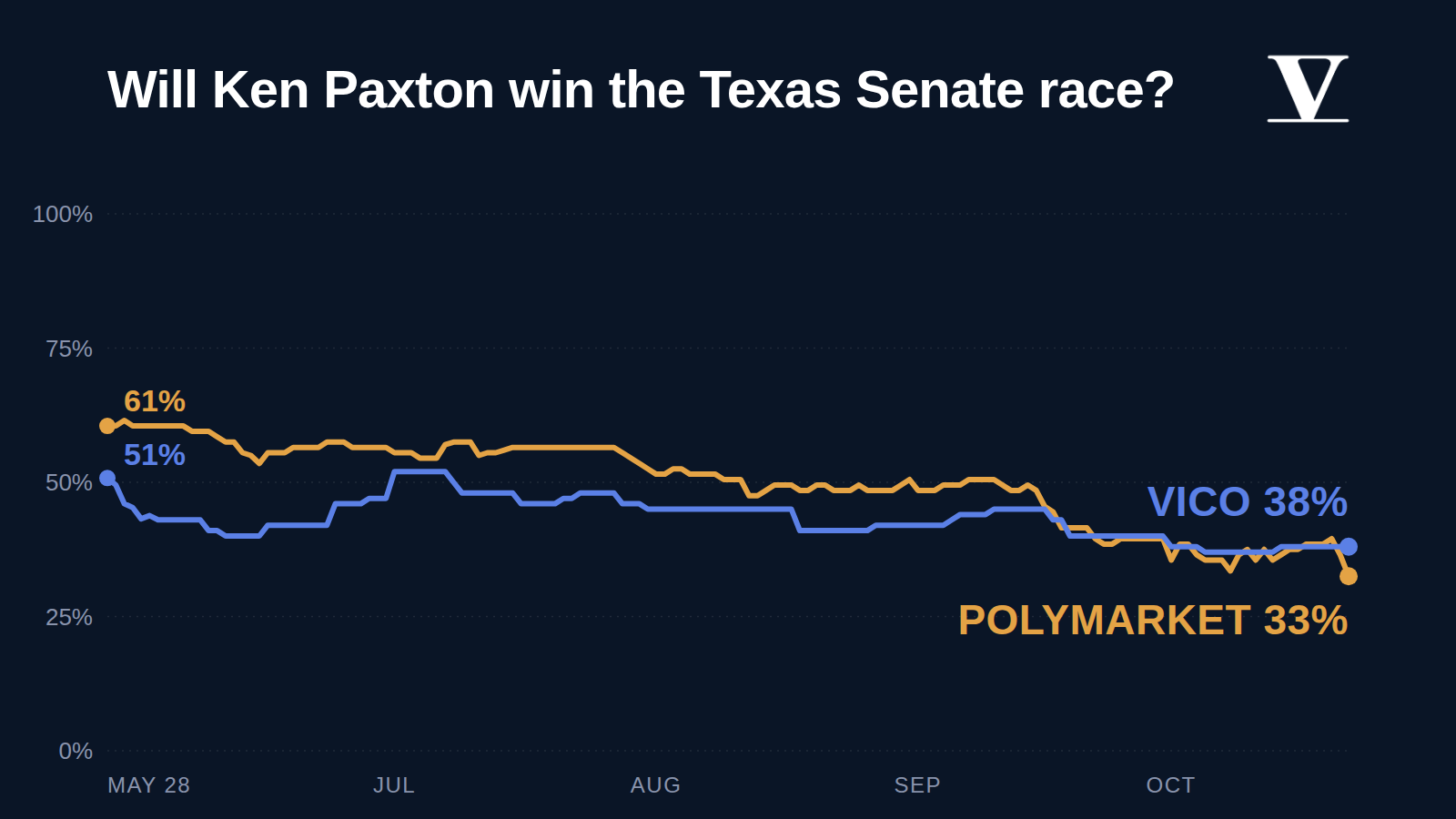
38%: The probability that Ken Paxton wins the Texas Senate race. Versus Polymarket at 33%.
The VICO model has been tracking ahead of prediction markets on the Texas race for months, with prediction markets catching up only recently:
Reasoning: Why Talarico is the favorite
A VICO Causal Explorer on a Talarico win points to three drivers:
74%: Paxton’s own high negatives and corruption which the model sees as the real reason the race is close, since a more neutrally viewed Republican would likely win on the party label alone.
68%: Strong Hispanic turnout and support, which requires clawing back many of the Hispanic voters Trump gained in 2024.
66%: Talarico’s effective moderate, faith-based messaging pulls in a sufficient number of suburban swing voters.
So what: A new seat on the Senate map
Not only could Democrats flip a seat they haven’t won in decades, but just making Texas competitive forces the GOP to invest valuable resources into a race they should win easily. That eases the financial disadvantage other Democrats are facing in other seats like Ohio, Michigan, and Maine.
Senate Preview
With less than two weeks until the midterm elections, here is where the VICO model sits on every competitive Senate race. To take a deeper look into any one forecast, or look at our House forecasts, head to our Midterm Tracker map.
Chances for Democrats to win each competitive Senate race:
90%: Georgia: Jon Ossoff (D). Versus Polymarket at 96%.
84%: North Carolina: Roy Cooper (D). Versus Polymarket at 97%.
81%: New Hampshire: Chris Pappas (D). Versus Polymarket at 91%.
74%: Michigan: Abdul El-Sayed (D). Versus Polymarket at 71%.
65%: Minnesota: Peggy Flanagan (D). Versus Polymarket at 88%.
55%: Iowa: Josh Turek (D). Versus Polymarket at 43%.
54%: Alaska: Mary Peltola (D). Versus Polymarket at 75%.
51%: Ohio: Sherrod Brown (D). Versus Polymarket at 66%.
45%: Maine: Troy Jackson (D). Versus Polymarket at 66%.
37%: Kansas: Adam Hamilton (D). Versus Polymarket at 38%.
19%: Florida: Angie Nixon (D). Versus Polymarket at 8%.
13%: South Carolina: Annie Andrews (D). Versus Polymarket at 18%.
In Nebraska, independent Dan Osborn is at 45% to unseat Republican incumbent Pete Ricketts. Versus Polymarket at 29%.
In most races, the VICO model is slightly less bullish on Democrats than the market, most notably in Minnesota, Alaska, and Ohio.
In Alaska and Minnesota, the model still favors Democrats, but sees closer races.
In Ohio, the model is forecasting a toss-up while markets see Sherrod Brown as a 2-1 favorite.
The main exception to the rule is Iowa, where the model favors Democrat Josh Turek, while markets like Republican Ashley Hinson.
Scenario: Republicans Hold Both Chambers
We are continuing to forecast each possible midterm outcome. In our last two newsletters, we covered a Democratic sweep, and a Democratic House with Republican Senate. This week, we are forecasting the scenario where Republicans hold both chambers.
Issue: Unified government continues
In this VICO scenario, Republicans hold both the House and the Senate, extending unified control and clearing the way for an agenda built around judges, domestic energy, and a harder line on China.
The VICO model gives this scenario just an 8% chance of happening, making it the third most likely scenario behind a Democratic sweep (1st), and a Democratic House with a Republican Senate (2nd).
What could push us towards a Republican hold
A VICO Causal Explorer shows what can help keep Republicans in control:
58%: Republicans narrowing the Democrats’ large candidate-level fundraising edge in competitive House races
46%: Trump’s approval holding around its current 35% rather than sliding further.
But the single largest factor is the national mood, which will be difficult for Republicans to overcome:
76%: A Democratic generic-ballot lead above 6 points, on its own, would cut Republicans’ chance of holding the House to below 5%.
What happens next?
The fastest-moving piece is foreign policy, paired with a sweeping push on the courts.
90%: Congress conditions further Ukraine aid on Europe matching spending and caps direct military transfers from US stockpiles.
79%: The Senate Judiciary Committee confirms 45 to 60 circuit and district judges within 14 months.
The domestic agenda tilts toward energy and technology competition.
62%: Congress mandates expanded onshore and offshore fossil-fuel leasing, lifting US crude output by more than 400,000 barrels a day.
50%: Congress codifies and expands export controls and outbound-investment limits on China’s advanced chips, AI infrastructure, and quantum sectors.
So what: Courts, drilling, and a China wall
A reshaped bench, more oil, and a harder China line. The 62% leasing expansion is a volume tailwind for E&P names and the oil-and-gas ETF (XOP), though the extra 400,000 barrels a day can weigh on crude (WTI).
The 50% China controls pressure chipmakers exposed to China in the semiconductor ETF (SOXX), Nvidia (NVDA) chief among them, while helping domestic-reshoring plays.
Economics: Fed Meeting, SpaceX Shares
Fed Meeting
Issue: A hot economy pushes the Fed toward a hike
On the back of a hot September inflation report, the VICO model is preparing for another rate hike in 2026. However, the model is low on the odds of a hike in October, and instead sees the board delaying to December.
Reasoning: Not October, but likely 2026
October is most likely a hold as the Fed waits for more data, and avoids a change right before the elections. However, the model gives strong odds to a hike before the end of the year.
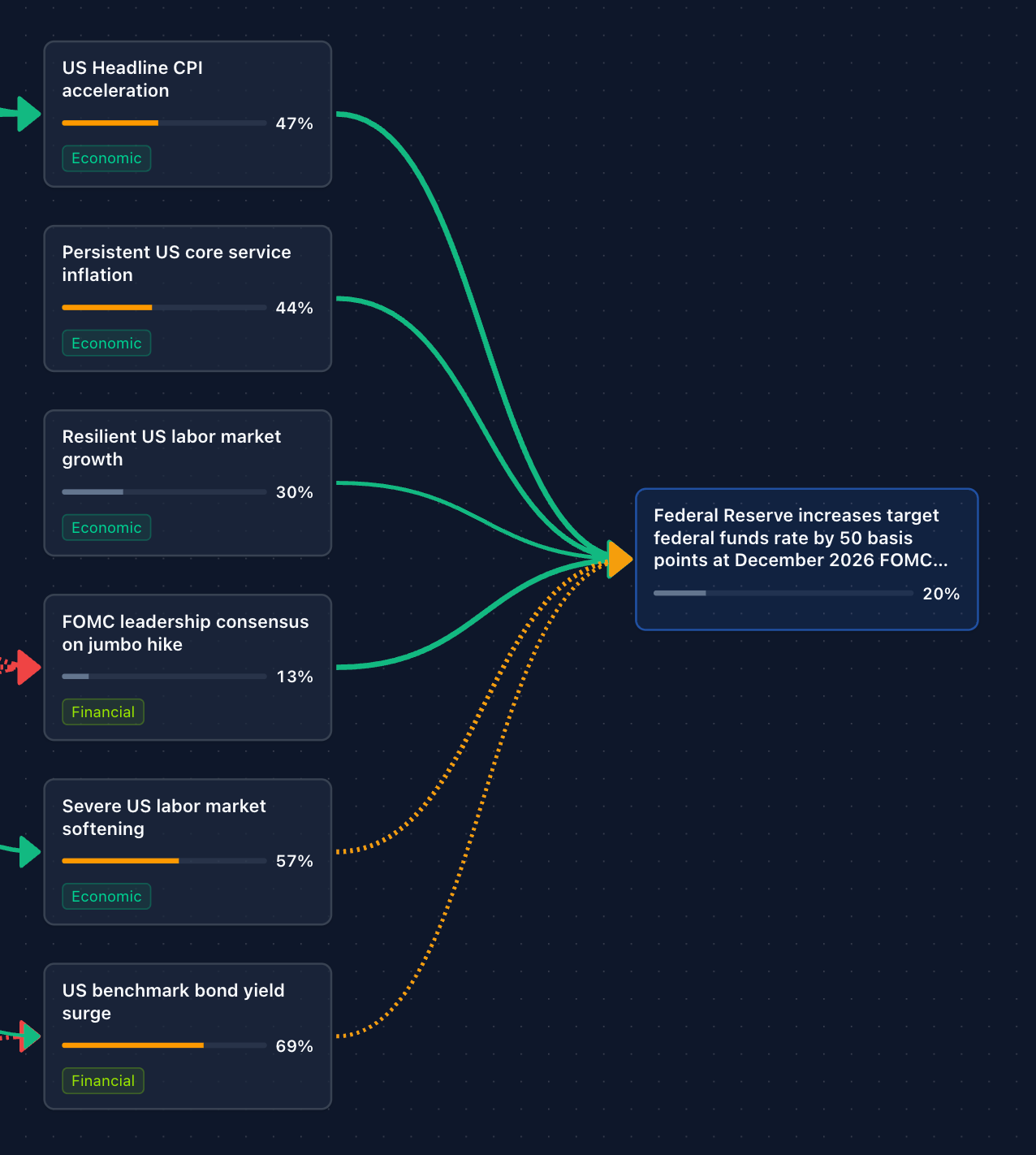
But the VICO model argues that markets are undersizing a 50 basis point hike. A VICO Causal Explorer puts a 50 basis point December hike at 20%, far above Polymarket’s 2%.
Pushing toward it:
47%: Accelerating headline CPI
44%: Persistent core-services inflation
30%: A resilient labor market
13%: Broad consensus among Fed leadership on a large hike
What would hold it back:
57%: A severe labor-market slowdown
69%: A surge in benchmark bond yields
So what: Another hike is coming, and the tail is fatter than markets think
The base case is clear: a hike before year-end, most likely in December. For markets, higher-for-longer keeps pressure on long Treasuries and rate-sensitive equities.
But the larger story is the possibility of a 50 basis point hike. The model’s 20% chance of a 50 basis point December move towers over the market’s 2%, so the risk is skewed toward a sharper tightening than investors are positioned for.
SpaceX Shares
Issue: Trillion-dollar firms start handing out equity
Within days of each other, Elon Musk pledged to give one SpaceX share to every child in America, roughly $10.5 billion worth, and Anthropic committed 5% of its stock to a new public benefit fund, both framed as answers to AI-driven job losses.
With Americans’ fears of AI job displacement at an all-time high, the trend could be spreading across AI companies as a way to give back, or prevent public animosity and legislation.
Reasoning: The wave is real and increasingly institutional
The credible version of this trend runs through standing funds, not one-off gestures, and once one lab institutionalizes giving ahead of a listing, the rest face pressure to match it.
70%: The probability that Anthropic’s public benefit fund makes its first distribution to an external beneficiary before December 31, 2027.
58%: The probability that another major AI company (OpenAI, Google, Microsoft, Meta) announces an equity-giveaway or public-benefit-fund pledge before December 31, 2027.
The VICO model argues that large AI firms, OpenAI and Anthropic in particular, have a large incentive to try to appease regulators and preempt public backlash, ultimately making philanthropic initiatives good for business in the long-run.
So what: Expect Musk’s promise further out, but legislation stays at bay
Elon Musk’s pledge is unlikely to be delivered next year as he suggested. Musk’s proposed giveaway faces large tax and regulatory issues, and historically Elon Musk’s public promises face implementation lag or end up pivoting to a similar but different mechanism.
12%: The probability that Musk or the federal government distributes at least one SpaceX share to a majority of US children before 2028.
The model is low on the odds of government action to punish AI firms with higher taxes, particularly because regulatory action requires weakening a field which is viewed as crucial for national security.
22%: The probability that the US government imposes new taxes specifically on large AI firms as a way to combat job displacement or raise revenues in the next 5 years.
About Us
VICO empowers decision makers to quantify and navigate event risk. Forecast, simulate and monitor political, geopolitical and economic events.
Learn more and obtain a beta account at www.vico.io or email us at inquire@vico.io
Methodology and Copyright Notes:
All percentage changes are over the last week except where noted.
Our proprietary AI models are rigorously backtested and do not rely on any betting market information.
All data and content are owned by and copyrighted by VICO Technologies Inc.