VICO FUTURE MONITOR · NEWSLETTER
Just The Undercard
Michigan Senate Primary, Midterms, Senate Bills, Government Shutdown, Yen, GDP Growth, KOSPI, AstraZeneca , Data Center Polarization, US x Iran, Red Sea, Spain Schengen Movement Area
This issue was published in the VICO Future Monitor newsletter and is archived here; edits and forecast links were added by the VICO editorial team.
Access VICO forecasts or make your own at www.vico.io as well as on the Bloomberg Terminal at WSL PREDICT<GO>, WSL ELECTION<GO> and WSL VICO<GO>.
What we are following this week:
Domestic Politics: Michigan Senate Primary, Midterms, Senate Bills, Government Shutdown
Economics: Japanese Yen, GDP Growth, KOSPI, AstraZeneca Merger
Special Section: Data Center Polarization Index
Global Politics: US x Iran, We Called It: Red Sea Shipping, Spain Schengen Movement Area
Domestic Politics: Michigan Senate Primary, Midterms, Senate Bills, Government Shutdown
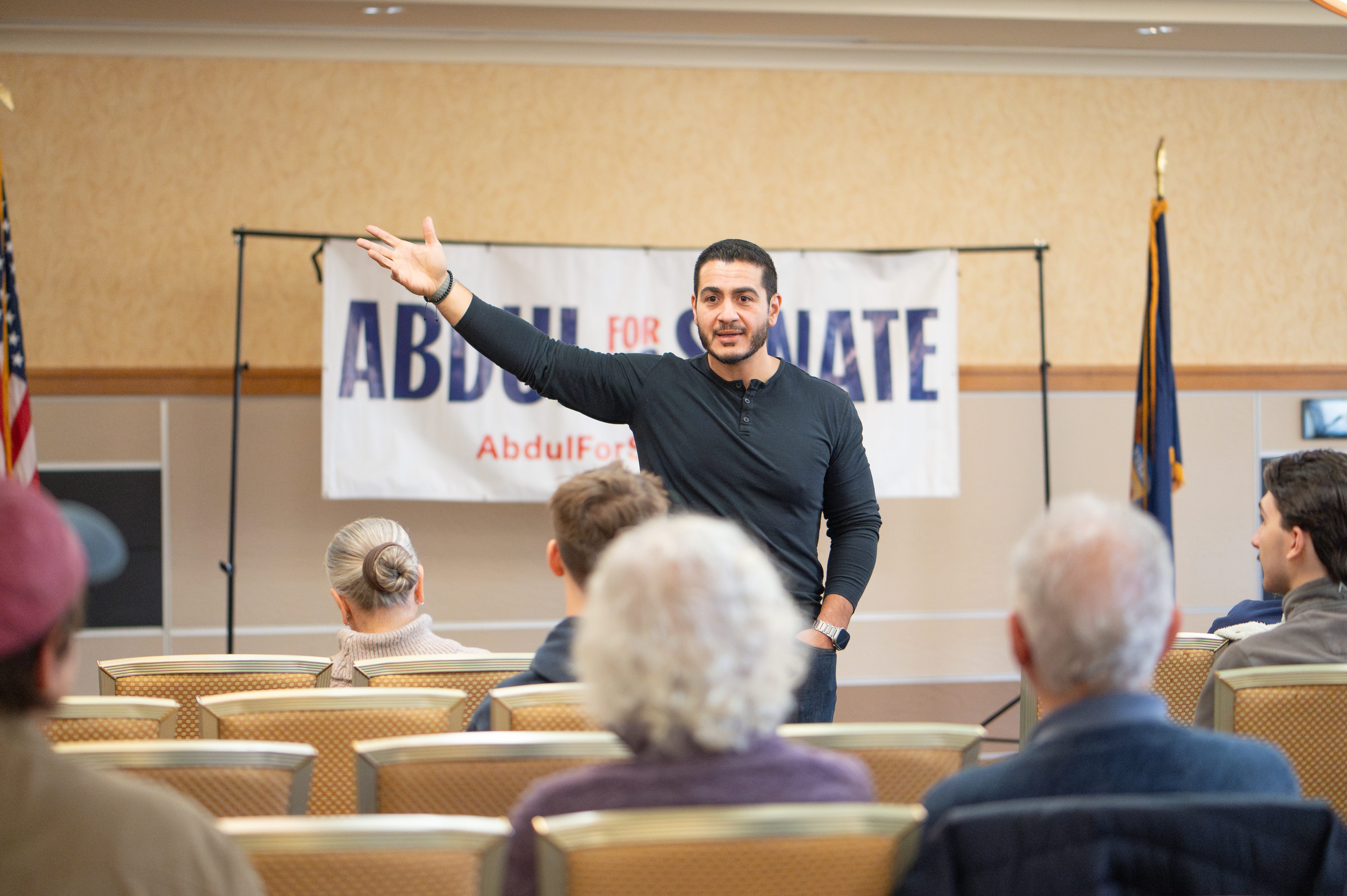
Abdul El-Sayed bested Haley Stevens for the Democratic nomination in Michigan’s Senate race by less than 1 point. The result is one of many from Tuesday that set up important races in November, including Ohio’s 11th district where Rep. Max Miller (R) is defending his seat despite domestic abuse allegations. In DC, Republicans in the Senate are scrambling to pass a slew of bills before the August recess, and we take a look at the odds of continuing dysfunction with a shutdown later this year. This week:
Michigan Senate Primary
On the day of the Michigan primary election, the VICO model forecasted a 54% chance that El-Sayed would carry the day, indicating a close race.
Meanwhile, on the eve of the election, Kalshi forecasted a 60% chance that El-Sayed would win by at least 15 points. Kalshi’s odds of El-Sayed winning by less than 3% reached as low as 2% on election day.
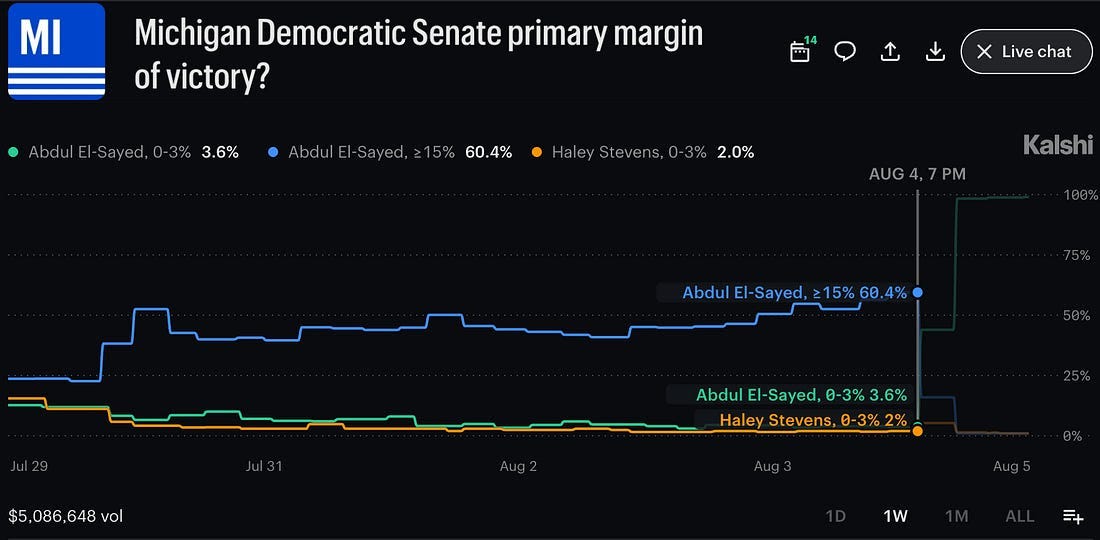
Instead of a complete blowout, the results showed a close race in which El-Sayed gained a slight edge.
Final tally as of publication:
El-Sayed: 48.48%
Stevens: 47.51%
52%: The probability that Abdul El-Sayed wins the Michigan Senate general election. (Polymarket: 60%)
The VICO model argues that Democrats should do well in a state like Michigan during a midterm year with such an unpopular Republican President. However, El-Sayed’s progressive ideology may benefit Republican Mike Rogers. The model also stresses that El-Sayed will have to win over moderate voters who went for Stevens in the primary.
Midterms
Max Miller
16%: The probability that Max Miller withdraws from Ohio’s 7th district House race.
49%: The probability that Max Miller wins Ohio’s 7th district House race.
The VICO model weighed the district’s Republican lean against challenges facing Miller personally. The model cited Ohio Senator Bernie Moreno’s call for Miller to resign as a serious hurdle for Miller.
Wisconsin Governor
40%: The probability that Francesca Hong wins the Wisconsin Governor’s race. (Polymarket: 44%)
The VICO model argues that Republicans will focus on Hong’s self identification as a Democratic Socialist, and old statements like advocating for abolishing Thanksgiving.
House Races
55%: The probability that Marie Glusenkamp Perez (D) wins the WA-03 House election.
40%: The probability that Jen Kiggans (R) wins the VA-02 House election.
30%: The probability that Tom Barret (R) wins the MI-07 House election.
Barret’s chances increased by 7% over the last week after Democratic Socialist William Lawrence won the Democratic primary.
58%: The probability that Jamie Ager (D) wins the NC-11 House election.
Ager is running a well financed campaign in a typically red seat after incumbent Chuck Edwards (R) dropped out following a House ethics report about inappropriate conduct with two female staffers.
69%: The probability the Democrats take the House in 2026.
Senate Bills
18%: The probability that the Senate delays or blocks August recess.
5%: The probability that Congress passes the SAVE Act before the midterms.
15%: The probability that Congress passes permanent daylight savings time before the midterms.
12%: The probability that Congress passes a third Republican reconciliation bill before the midterms.
8%: The probability that Congress passes the CLARITY Act before the midterms.
2%: The probability that the Senate abolishes the filibuster before the midterms.
The VICO model is broadly skeptical of upcoming Republican legislative priorities, citing both partisan infighting and united Democratic opposition, which will be difficult to overcome without the destruction of the fillibuster.
Government Shutdown
76%: The probability of a Government shutdown in the next 365 days.
VICO ticker: VICOHSYR
62%: The probability of a Government shutdown in 2026.
VICO ticker: VICODNQF
The VICO model emphasizes that a shutdown could come from either Democrats in December following a strong midterm performance, or the President and his possible refusal to sign off on appropriations without the SAVE Act.
As we near the shutdown cliff, VICO users can track both of these forecasts on our monitor.
Economics: Japanese Yen, GDP Growth, KOSPI, AstraZeneca Merger
Earlier this week the US intervened to strengthen the Japanese Yen, preventing the Japanese government from possibly selling US Treasury bonds to intervene themselves. At the same time, GDP growth for Q2 in the US was underwhelming, stoking fears of a slowing economy. The South Korean index KOSPI is down nearly 30% from its peak just over a month ago, we take a look at the index’s future. And AstraZeneca’s stock slid more than 9% after reports of a possible merger with Bristol Myers. This week:
Japanese Yen
28%: The probability that the United States government (or Fed) conducts another intervention in the Japanese Yen foreign exchange market in the next 120 days?
38%: The probability that the Japanese Ministry of Finance conducts a foreign exchange intervention operations involving the sale of more than 50 billion US dollars in a single day in the next 120 days?
72%: The probability that the Bank of Japan increases its federal interest rates at the next monetary policy meeting held in September?
82%: The probability that the Bank of Japan increase its federal interest rate from its current level of 1.0% before December 31, 2026?
The VICO model argues that while future intervention remains possible, policy changes are most likely to come in the form of Japanese interest rate boosts instead of currency injections.
GDP Growth
59%: The probability that real US GDP growth for calendar year 2026 is at least 2%. (Polymarket: 54%)
22%: The probability that real annualized GDP growth in Q3 is at least 3%. (Polymarket: 56%)
The VICO model points towards Q2’s weak 1.5% growth as a signal that 3% or greater is unlikely. 3% growth is achieved in only roughly 25% of quarterly reports, and would require a large reversal of current trends for Q3.
46%: The probability that real GDP growth for FY 2027 is higher than real GDP growth for FY 2026.
KOSPI
In our June 4th newsletter, following a decision by Goldman Sachs to up the 12 month target for KOSPI to 12,000 (8,800 at the time) we forecasted the odds of KOSPI hitting 12,000 in the next year at just 28%. Since then, the index has dropped to just above 6,500.
6%: The probability that KOSPI reaches 12,000 in the next 365 days.
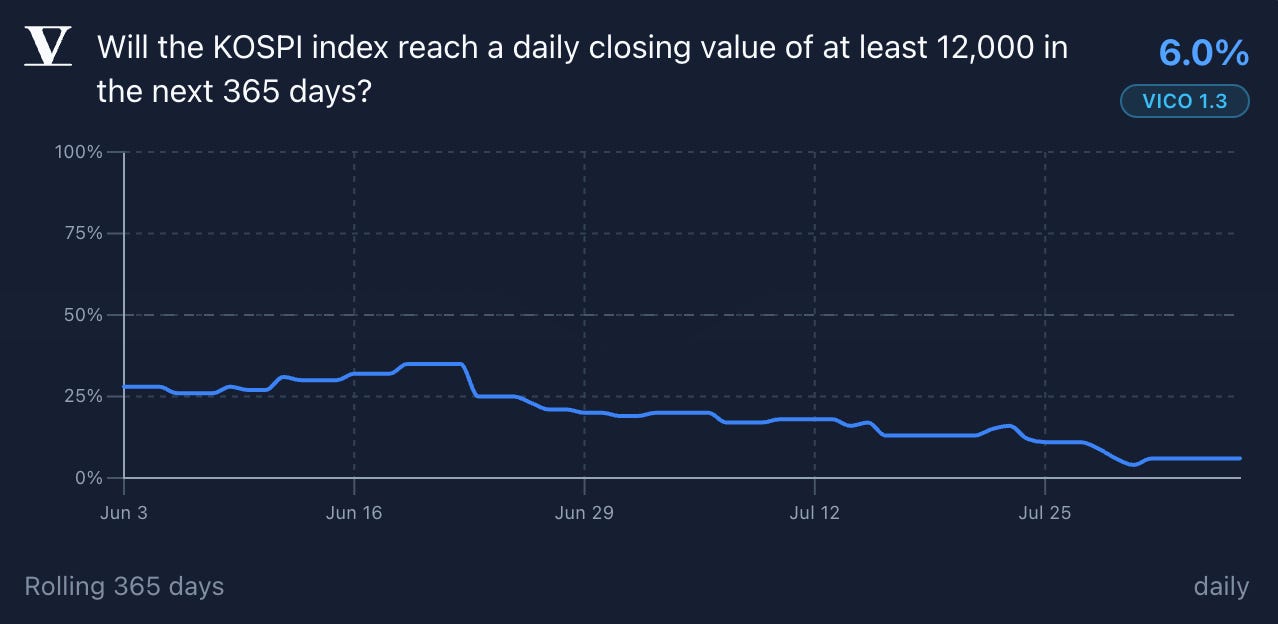
48%: The probability that KOSPI rebounds to 9,000 by the end of 2026.
The VICO model provides roughly a coin toss odds of KOSPI returning to 9,000 this year as the index has proved it is fundamentally achievable by doing it before. However, the market would need to overcome recently found skepticism in the AI and chip markets, in which KOSPI is heavily overleveraged.
AstraZeneca Merger
6%: The probability that AstraZeneca and Bristol Myers announce a merger in the next six months.
Despite compelling early reports, and a wall street reaction, AstraZeneca has released a denial of any talks which the VICO model gives heavy creadence to.
Special Section: Data Center Polarization Index
We just launched our Data Center Polarization Index on Vico.io. This index is designed to track a range of forecasts on various measures of data center polarization. This special section dives into the new index: what exactly it tracks, and why it has moved upwards in the last month.
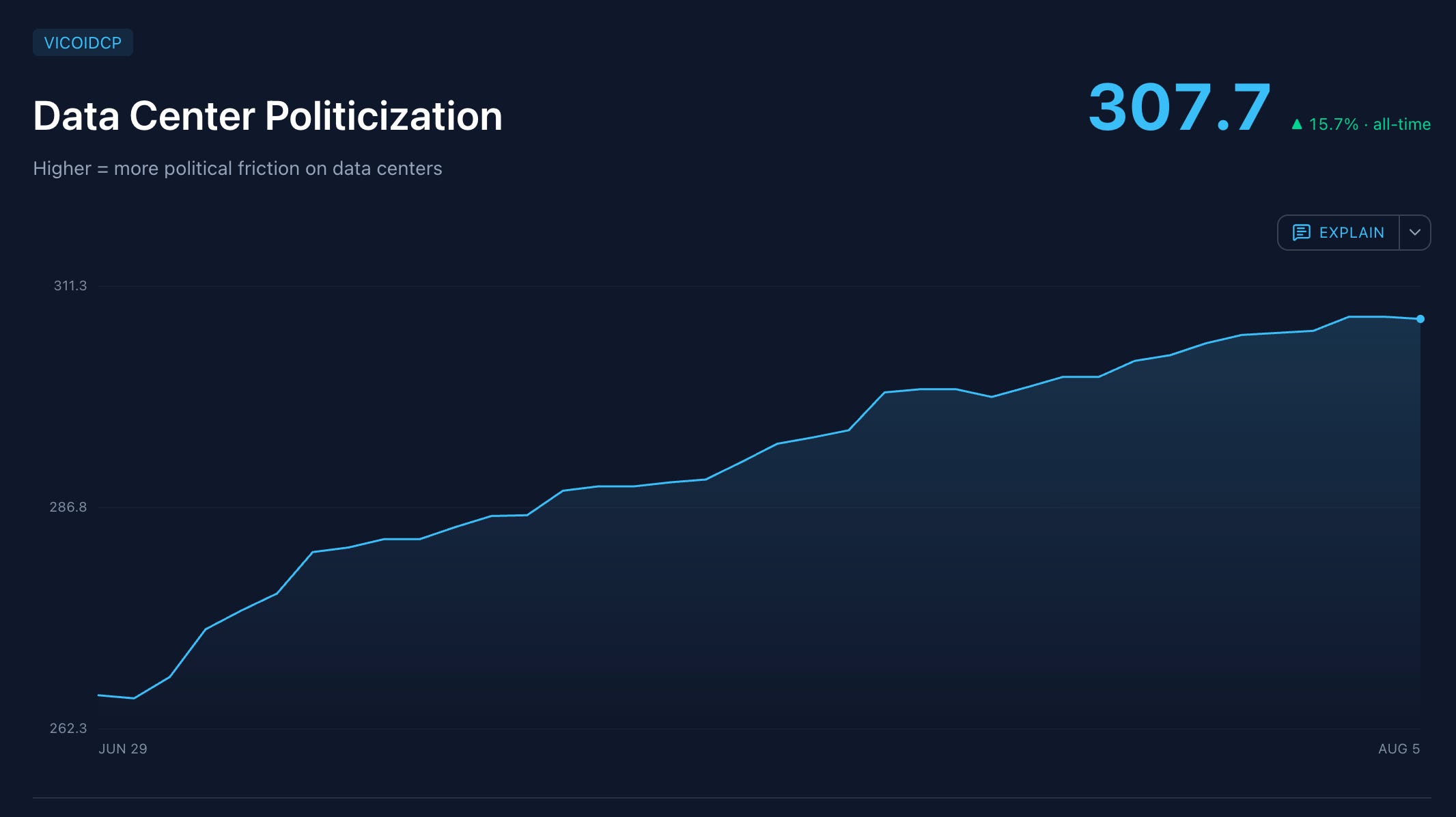
This particular index is comprised of the following subcategories which combine to inform the headline percentage:
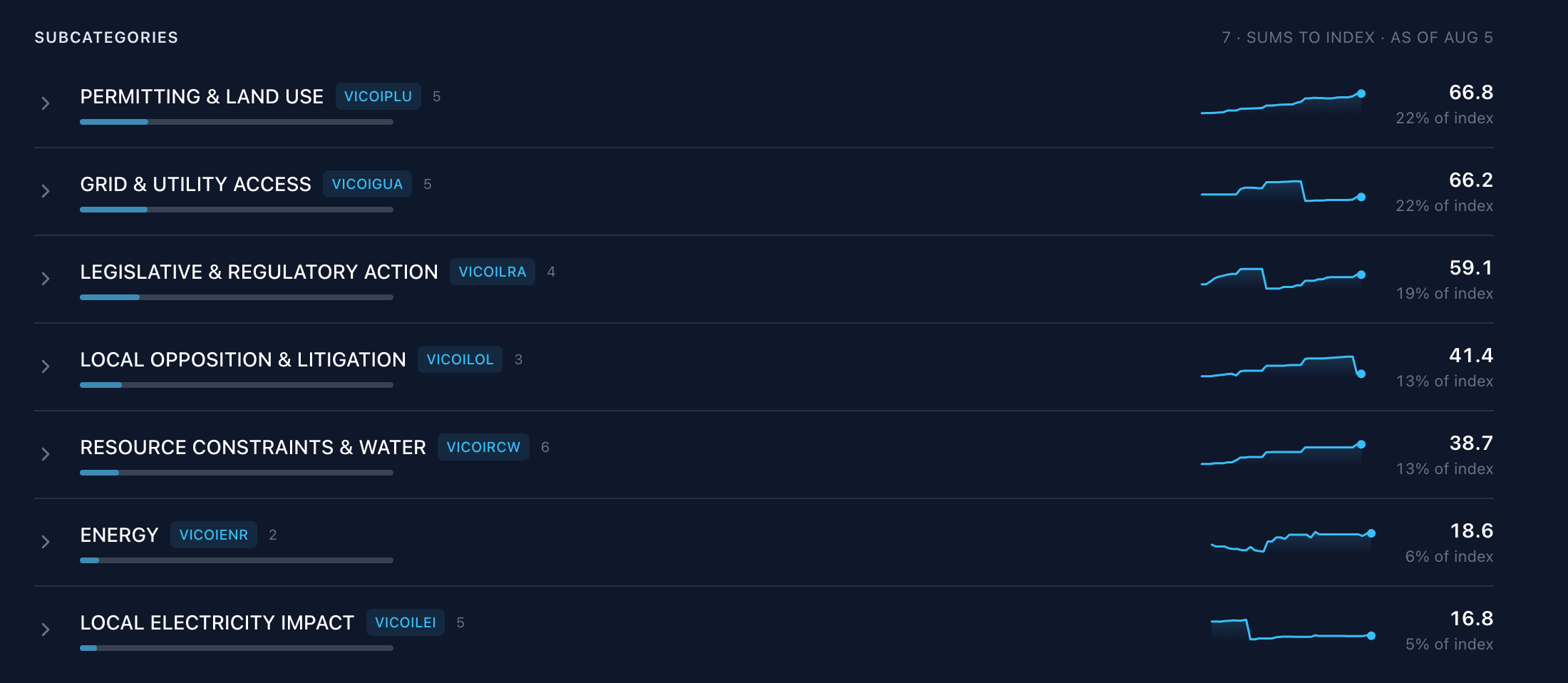
The increase in the index over the last month has been driven most significantly by an almost doubling of our permitting and land use score.
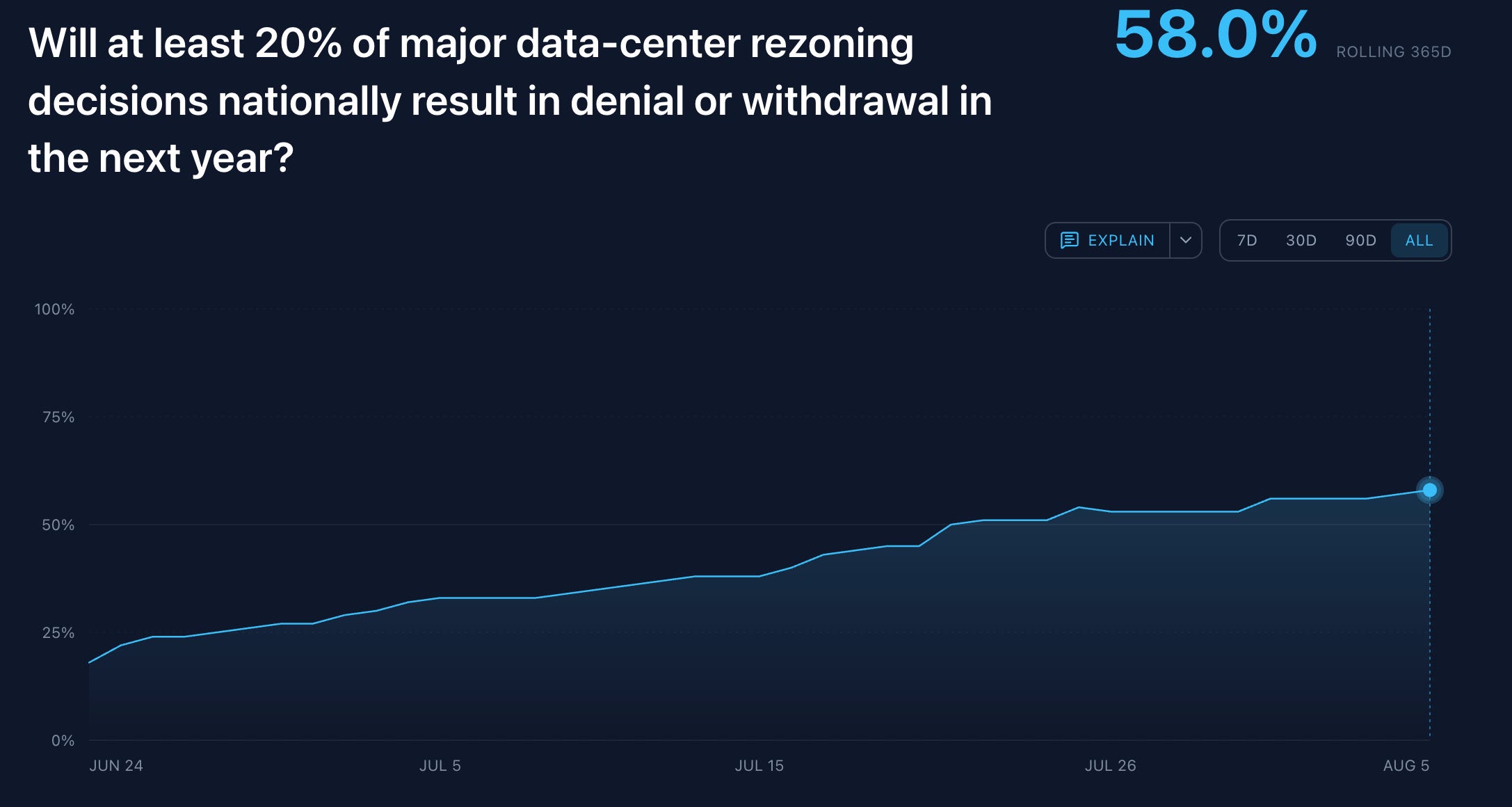
One forecast driving this increase is our forecast on at least 20% of major data-center rezoning decisions nationally resulting in denial or withdrawal within the next year.
This forecast has steadily increased as new reports of data-center rezoning denials come out.
To take a deeper look at each subcategory and forecast, head to the index section on Vico.io.
Global Politics: US x Iran, We Called It: Red Sea Shipping, Spain Schengen Movement Area
The President is touting a potential deal with Iran to reopen the Strait in the next few days. At the same time, tensions continue between Saudi Arabia and the Houthis continue this week as a ship was reportedly sunk by Houthi forces in the Red Sea. And finally, Italy suspended free travel into and from Spain for a month, citing concerns over a surge of migrants into the Spanish city of Cueta. This week:
US x Iran
Deal?
38%: The probability that the US and Iran announce a deal to at least partially reopen the Strait of Hormuz in the next 14 days.
18%: The probability that IAEA inspectors gain access to Iranian facilities in 2026.
4%: The probability that the US and Iran reach an agreement to limit Iranian nuclear capabilities in the next 14 days.
The VICO model argues that while a deal is possible in the short term, it remains unlikely given Iranian denials of negotiations, and Iranian reinforcing of military areas with Chinese anti-aircraft weapons.
If a deal does occur, the model argues it is most likely to lack any substantial nuclear terms.
We Called It: Red Sea Shipping
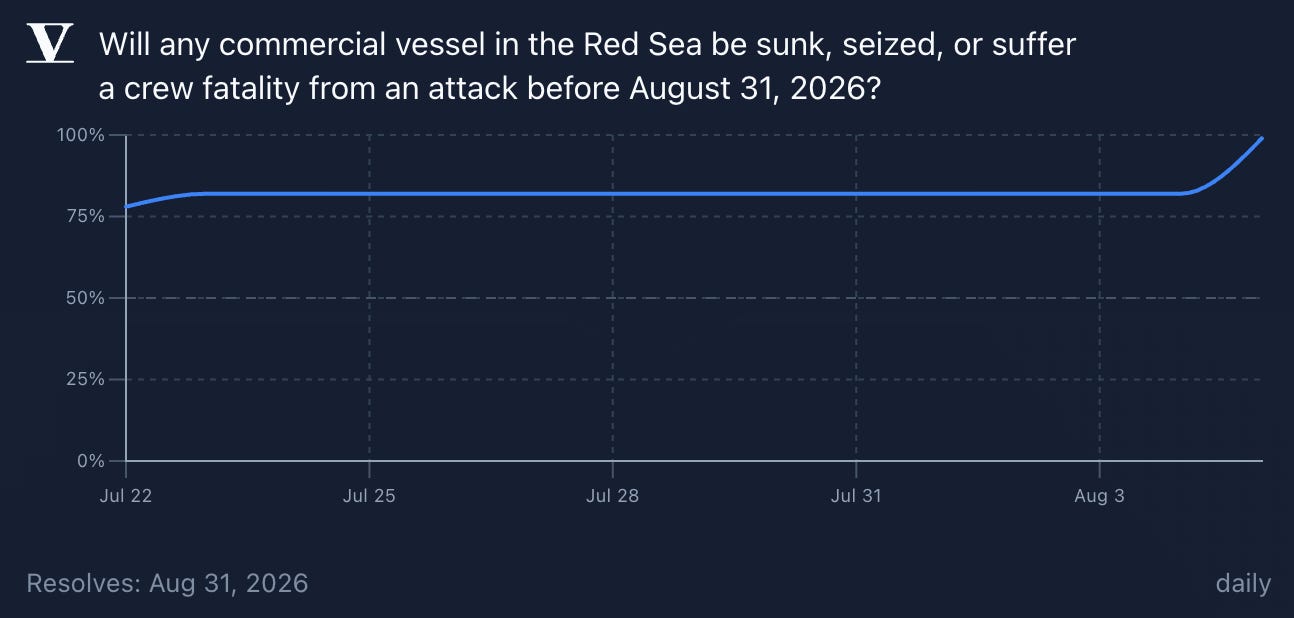
In last week’s newsletter, we forecasted an 82% chance that a ship in the Red Sea would either be sunk, seized, or suffer a fatality by August 31.
That forecast has since resolved after an Indian vessel was sunk by an attack in the Red Sea which the Yemeni government attributed to the Houthis.
86%: The probability that Maersk or MSC publicly announce the suspension of any Red Sea/Suez service and the diversion of vessels around the Cape of Good Hope before September 30, 2026?
VICO’s next call is on disruption to shipping in the Red Sea caused by insurance companies refusing service in the area.
Spain Schengen Movement Area
70%: The probability that Italy extends its’ free travel restriction beyond one month.
8%: The probability that another country besides Italy restricts free travel with Spain in the next 30 days.
4%: The probability that any nation formally announces a withdrawal from the Schengen free movement area in the next year.
The VICO model argues that this issue is likely to remain confined largely to Italy, where Prime Minister Meloni “typically prioritizes domestic border optics over EU diplomatic harmony.” So while Italy may extend their restriction beyond a month for political reasons, it is unlikely that other nations will institute their own restrictions.
About Us
VICO empowers decision makers to quantify and navigate event risk. Forecast, simulate and monitor political, geopolitical and economic events.
Learn more and obtain a beta account at www.vico.io or email us at inquire@vico.io
Methodology and Copyright Notes:
All percentage changes are over the last week except where noted.
Our proprietary AI models are rigorously backtested and do not rely on any betting market information.
All data and content are owned by and copyrighted by VICO Technologies Inc.