VICO FUTURE MONITOR · NEWSLETTER
Runoff Reversal - October 29, 2026
Brazilian Elections, We Called It: UK Tax Hike, Israeli Elections, Midterm Recap, Scenario: Democrats win the Senate, but Republicans hold the House, Microsoft Buyout, We Called It: Fed Rates

This issue was published in the VICO Future Monitor newsletter and is archived here; edits and forecast links were added by the VICO editorial team.
Access VICO forecasts or make your own at www.vico.io as well as on the Bloomberg Terminal at WSL PREDICT<GO>, WSL ELECTION<GO> and WSL VICO<GO>.
What we are following this week:
Geopolitics: Brazilian Elections, We Called It: UK Tax Hike, Israeli Elections
Domestic Politics: Midterm Recap, Scenario: Democrats win the Senate, but Republicans hold the House
Economics: Microsoft Buyouts, We Called It: Fed Rates
Geopolitics: Brazilian Elections, We Called It: UK Tax Hike, Israeli Elections
Brazilian Elections
Issue: Lula: We got it wrong, but less wrong than the markets, and that matters
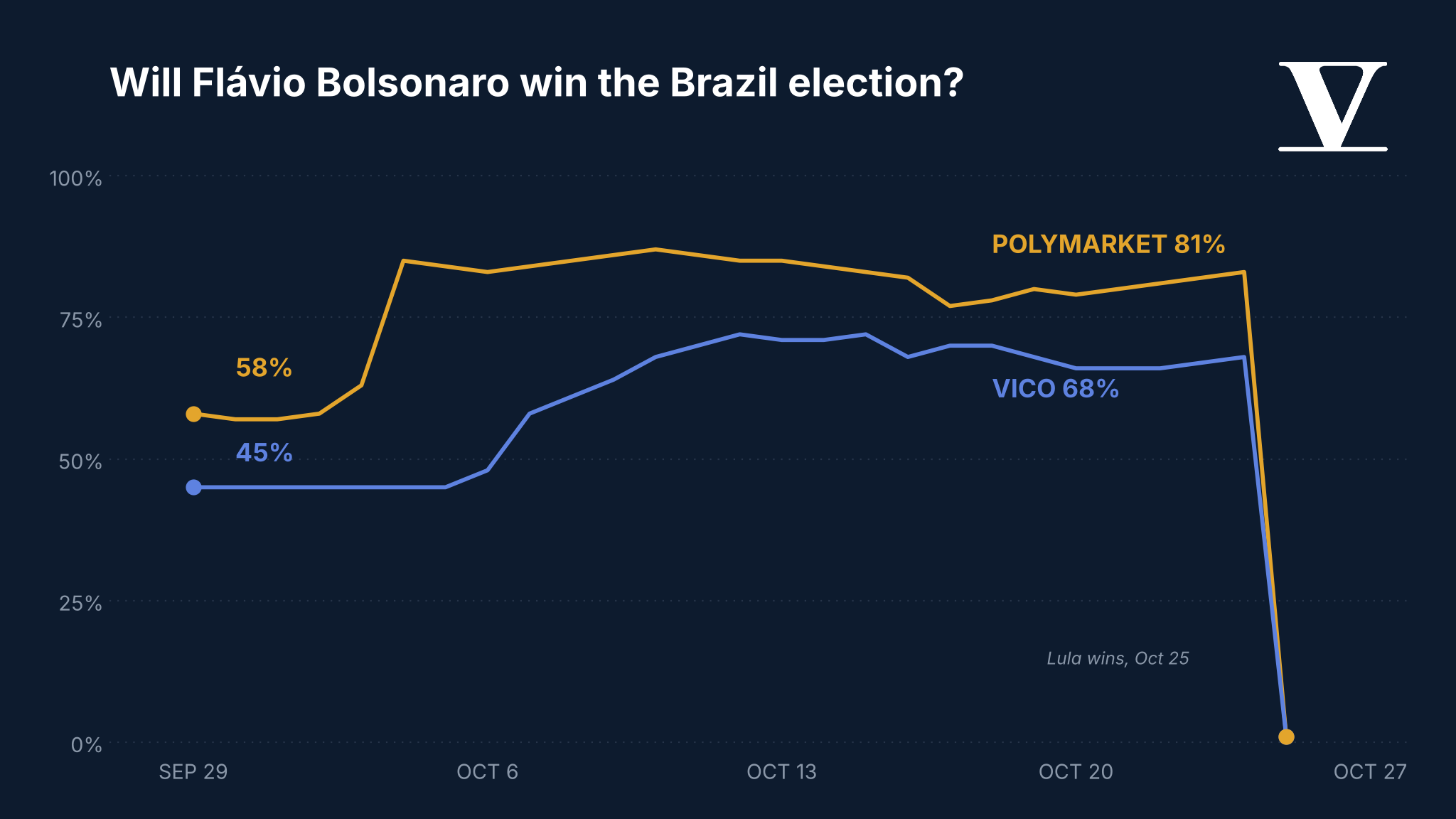
Lula won a fourth term on October 25, about 51% to 48% over Flávio Bolsonaro, who is refusing to concede. The VICO model did not call it: on election day it still favored Bolsonaro, giving Lula just 32%. But that beat the prediction markets, where Polymarket had Lula at 19%.
We flagged the gap early. In late September we had Bolsonaro at 45% to Polymarket’s 58%, and that roughly 13-point edge in Lula’s favor held to election day.
Reasoning: Why being less wrong matters
The model missed the call but tracked closer to reality than prediction markets, and that gap is where the money was. An investor trusting VICO’s 32% over the the prediction market’s 19% would have better hedged Brazilian exposure against a Lula win, cutting losses when he pulled off the upset. Being better calibrated than the market pays even when the call is on the wrong side of 50%.
Lula’s win knocked the real down about 12% against the dollar and sent the Ibovespa down over 13% in a day, tripping a circuit breaker, with futures off nearly 15% and the EWZ ETF down around 5%.
What’s next: The challenge is coming, but it won’t change the outcome
Despite Bolsonaro’s refusal to concede, the VICO model sees very little chance that Lula fails to take power on time.
So what: The real risk is in the streets and in Washington
With the outcome and the market reaction settled, the danger shifts outside the courtroom. The Trump administration is backing the Bolsonaro family, who have reportedly fled to the US, and officials have floated sanctions.
PS
42%: The probability that the Brazilian index IBOVESPA returns to pre-election levels in the next year.
We Called It: UK Tax Hike
Issue: The UK Autumn Budget confirmed the VICO call
On August 28, two months before the Budget and with PM Andy Burnham only refusing to rule tax rises out, the VICO model made three calls: a net increase in the Autumn Budget, workers shielded, and capital as the likeliest target, while deliberately pricing capital gains itself below a coin flip. Chancellor John Healey’s Budget yesterday hit all three.
Reasoning: Confident where it counted, cautious where it mattered
Two months ago the model called the rise all but certain, and it arrived. Healey’s hikes take cumulative Labour tax rises past £70bn and cut fiscal headroom to just £15bn.
83%: (forecast Aug 28) The probability that the UK Autumn budget contains a net tax increase. Confirmed.
It also bet workers would be spared, and they were. Healey kept the manifesto pledge, leaving employment income tax, employee National Insurance, and VAT untouched.
16%: (forecast Aug 28) The probability that the budget raises income tax, employee National Insurance, or VAT. Correct, it did not.
And its caution on the method paid off. Healey rejected a capital gains rate rise and hit capital through other levers instead, cutting Business Asset Disposal Relief from £1m to £500,000 and raising the bank profit levy by 3 points.
46%: (forecast Aug 28) The probability that the budget raises capital gains tax. CGT rates held, but capital was targeted by other means.
So what: Low chances for more short-term hikes
The model sees little near-term tax action and doubts capital gains or the bank levy will be expanded in the immediate future.
(Note that we made these calls with our new Scenario Explorer tool. Try it out today. Contact Us.)
Israeli Elections
Issue: A near-tie, and no clear path to a government
Israel voted on October 27, and with counting essentially complete, it is close to a tie. The Netanyahu bloc and the anti-Netanyahu bloc each landed near 50 seats, neither near the 61 needed for a majority, with the Arab parties holding the balance at roughly 15 to 20. No single party came close, with Likud the largest at about 26.
In last week’s newsletter, the model saw a tight race with no likely majority and flagged that forming a government could prove difficult.
“…whoever wins inherits the same coalition math that has forced repeated deadlocks, so the likeliest story remains a fragile government over a decisive one.”
Reasoning: We saw a tossup and flagged the coalition risk
The model treated the race as close and gave just 8% that any single party would win a majority, which held.
8%: (last week) The probability that any single party wins a majority of Knesset seats. None did.
Among the factors the VICO model’s Causal Explorer raised that could help Natanyahu was the chance the opposition fails to build a coalition with the Arab parties, and that dynamic is now live. The Arab parties overperformed at 15 to 20 seats, and both sides have promised to exclude them from their coalitions.
80%: (last week) The opposition bloc fails to form a coalition with the Arab-led parties, Ra’am and Hadash-Ta’al.
A failed coalition could leave Benjamin Netanyahu in power for now, but the model remains confident he will be out within the year as the parties work through coalition building, and possibly towards another election.
67%: The probability that Benjamin Netanyahu is out as Israeli Prime Minister in the next year.
So what: The hard part starts now
With both blocs near 50 and the Arab parties off-limits to both, another election is a real possibility, and the model now puts it just above even.
52%: The probability that Israel holds another Knesset election within the next year.
If a government does come together first, two paths are live, and neither is likely on its own. Even in that case, there is no guarantee the coalition would survive, and elections could still arrive.
Domestic Politics: Midterm Recap, Scenario: Democrats win the Senate, but Republicans hold the House
Midterm Recap
Issue: Less than a week to election day
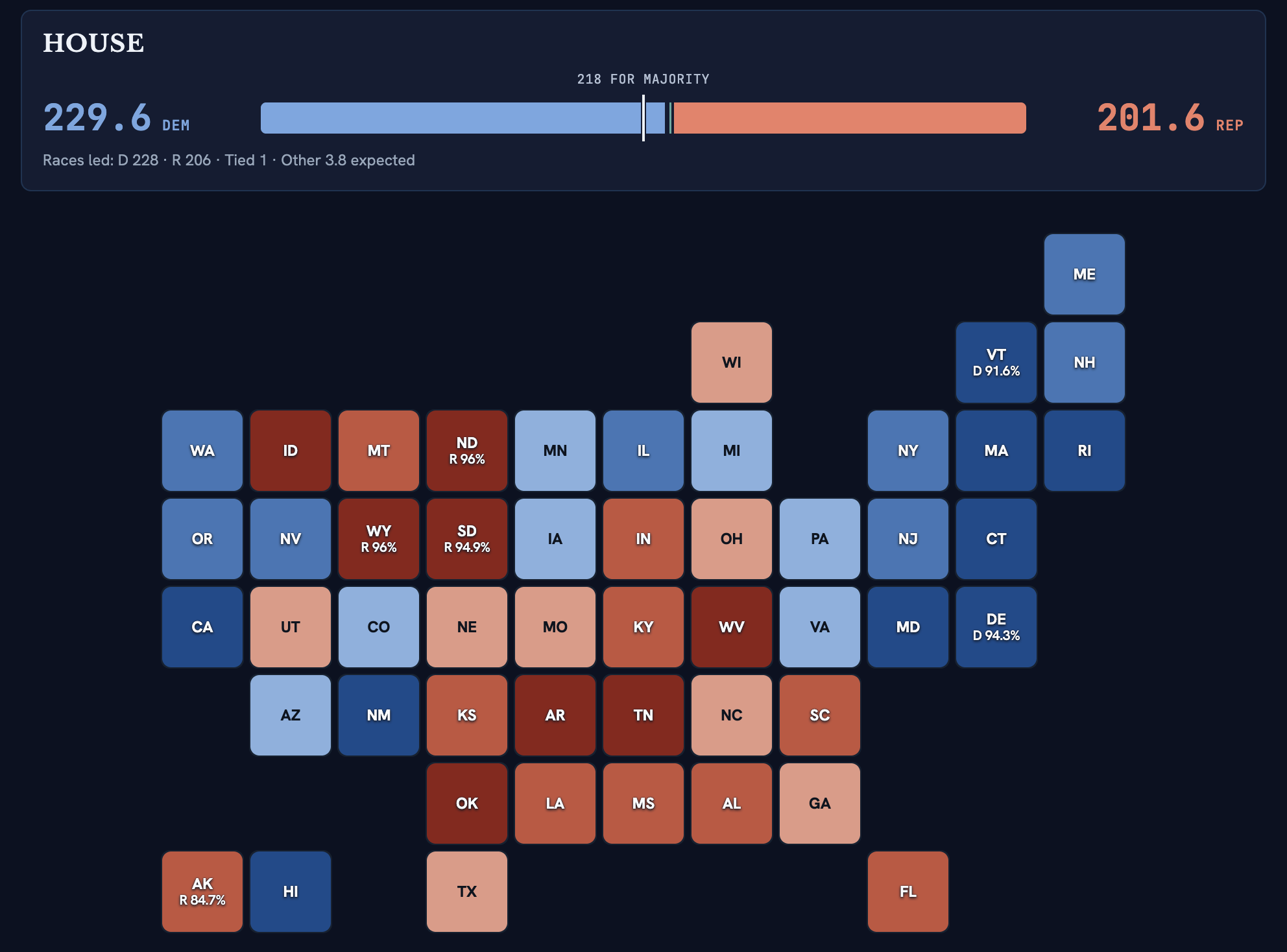
With just five days until Election Day, the campaigns are entering the final sprint. Hundreds of millions of dollars are being spent on both sides in a last-minute attempt to gain an edge. The VICO model sees a highly likely Democratic House, and a probable Democratic Senate, although the map makes a Senate majority tougher.
To see all of our projections in one place, head to our 2026 midterm tracker map.
The House: Democrats are heavy favorites
The VICO model puts the expected House result at a Democratic majority of roughly 230 seats. That would give Democrats a 25-seat majority, allowing them more room for error than the current Republican House, which operates with just a four-seat majority.
The VICO model gives Democrats an 85% chance to take the House overall, slightly below prediction markets like Kalshi at 91%, but still a strong favorite.
The Senate: Democrats reaching deep into red territory for a majority
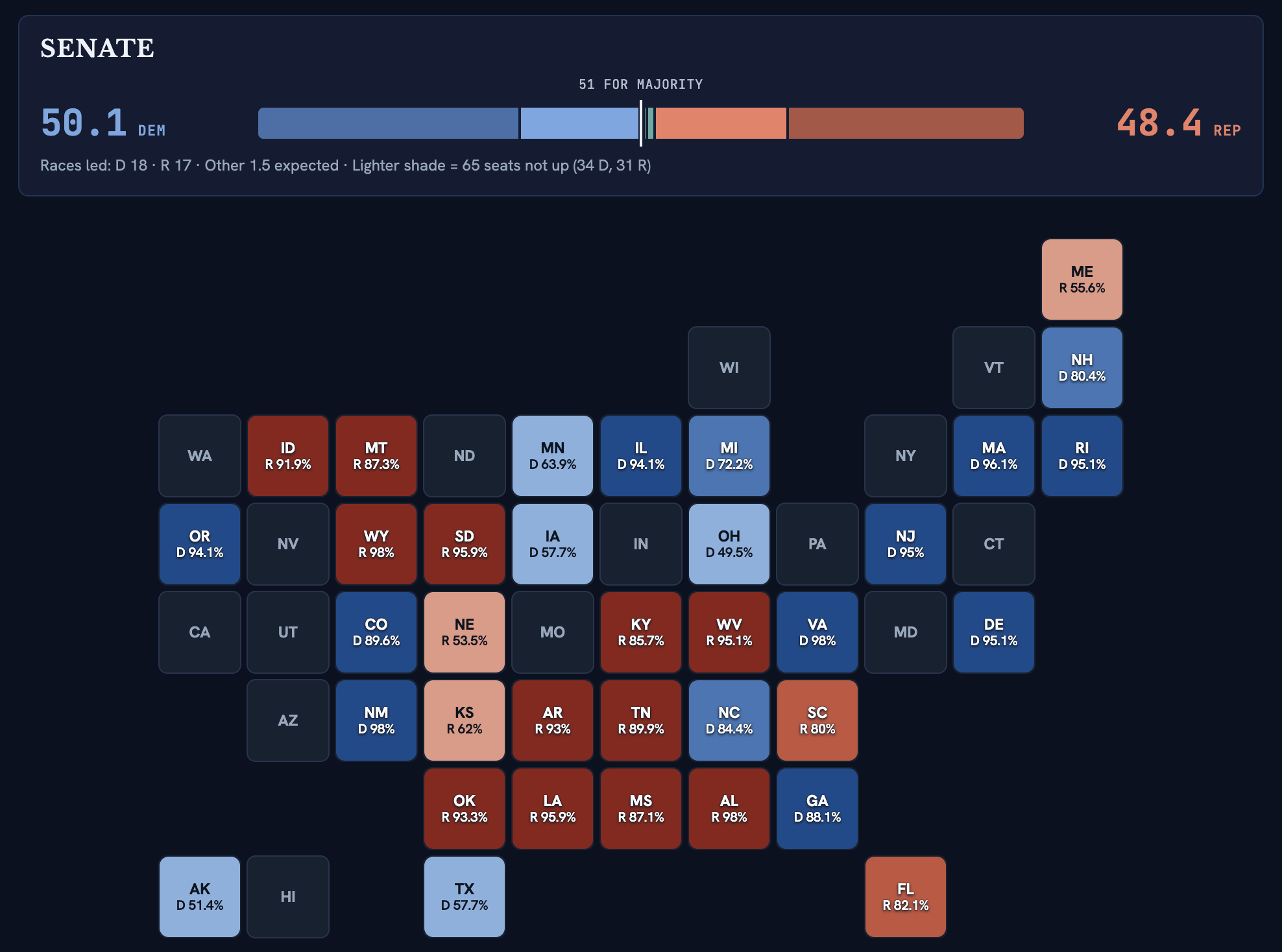
The 2026 Senate map does not provide many easy targets for Democrats. They are defending seats in Michigan and Georgia, and must pick up four additional seats to reach 51.
But the president’s poor approval ratings are dragging his party down, bringing typically red states into play, which is why the VICO model is at 71% for Democrats to win the Senate. Below is the current VICO model landscape for every competitive Senate race this year vs Kalshi:
Georgia: 88% Jon Ossoff (D) — versus Kalshi at 95%
North Carolina: 84% Roy Cooper (D) — versus Kalshi at 96%
Florida: 82% Ashley Moody (R) — versus Kalshi at 89%
New Hampshire: 80% Chris Pappas (D) — versus Kalshi at 89%
South Carolina: 80% Darline Graham (R) — versus Kalshi at 74%
Michigan: 72% Abdul El-Sayed (D) — versus Kalshi at 69%
Minnesota: 64% Peggy Flanagan (D) — versus Kalshi at 90%
Kansas: 62% Roger Marshall (R) — versus Kalshi at 60%
Texas: 58% James Talarico (D) — versus Kalshi at 66%
Iowa: 58% Josh Turek (D) — versus Kalshi at 45%
Maine: 56% Susan Collins (R) — versus Kalshi at 39%
Nebraska: 54% Pete Ricketts (R) — versus Kalshi at 70%
Alaska: 51% Mary Peltola (D) — versus Kalshi at 73%
Ohio: 49.5% Sherrod Brown (D) — versus Kalshi at 68%
Plus: The Alaska lawsuit
The DOJ is suing to preemptively annul the results of the Alaska Senate election, on the grounds that a candidate sharing the surname of the Republican incumbent will create confusion among voters.
18%: The probability that the DOJ successfully overturns the results of the Alaska Senate election.
A VICO Scenario Explorer shows what would happen next if the suit were successful:
71%: The Alaska legislature suspends ranked-choice voting to allow a two-candidate runoff.
If an emergency election is held, Dan Sullivan’s odds drop to just 20% to win, amid the fallout from the lawsuit.
Scenario: Democrats win the Senate, but Republicans hold the House
We are running scenarios for every possible midterm outcome. So far we have looked at a Democratic sweep, a Democratic House and Republican Senate, and a Republican sweep. This week, we look at the last and least likely scenario in which Democrats flip the Senate but fail to flip the House.
Issue: The other divided government
In this scenario, Republicans would hold the House while losing the Senate, producing divided government from the opposite direction: a Republican House against a Democratic Senate, with the friction landing squarely on defense and the budget.
What happens next?
The clearest effect would be on foreign aid, as the two chambers would fail to reconcile their defense numbers.
84%: The probability that chamber differences cut Ukraine aid from $60 billion to roughly $20 billion.
The bigger market risk would be fiscal brinkmanship.
58%: The probability that FY2028 budget talks deadlock into at least two stopgap CRs and a shutdown threat by October 1, 2027, with Speaker Johnson’s House demanding $150 billion in non-defense cuts against Schumer’s Democrats, as Moody’s and Fitch move US debt to a negative outlook and 10-year yields rise 25 to 40 basis points.
A Democratic Senate would reshape the personnel picture, with impeachment a long shot.
38%: The probability that a Democratic Senate Judiciary Committee under Durbin stalls conservative nominations, pushing court vacancies above 60 seats and leaving the FTC, SEC, and FERC understaffed, slowing rulemaking and delaying corporate litigation.
18%: The probability that the House passes articles of impeachment against a cabinet secretary.
The model argues it would take overwhelming political opposition to force any Republicans to vote in favor of impeaching a Trump cabinet member.
So what: Budget brinkmanship and a stalled bench
The most market-exposed of the set would be the fiscal fight. The 58% shutdown-and-downgrade path would lift yields 25 to 40 basis points and hit long Treasuries (TLT).
The 84% Ukraine aid cut would weigh on replenishment names Lockheed Martin (LMT) and Northrop Grumman (NOC), and the defense ETF (PPA), while the 38% regulator understaffing would slow deal review and lengthen M&A timelines.
Though this is the least likely scenario, it helps to understand all the possible scenarios as a means to plan consequences and hedge.
Economics: Microsoft Buyouts, We Called It: Fed Rates
Microsoft Buyouts
Issue: Microsoft offers buyouts to a quarter of its workforce
Microsoft offered voluntary buyouts to about 60,000 employees, roughly a quarter of its workforce, at vice-president level and below across the US, Canada, India, and the UK, with a decision deadline in early December and exits at year-end.
Reasoning: The cuts are about funding the buildout, not replacing the workers
The driver is capex. The company is trimming an ongoing cost, its people, to fund a growing one, its AI infrastructure.
73%: The probability that Microsoft’s quarterly capital expenditures rise year-over-year in every quarter of fiscal 2027.
The pattern is sector-wide, with the industry already near 154,000 layoffs by mid-year, 2026 is on track to exceed 2025’s tech-sector layoff totals.
65%: The probability that total tech-sector layoffs in 2026 exceed the 2025 total of 246,000.
So what: The buyout is a test balloon for all of Big Tech
Buyouts may not be the end of it. If too few people take the offer, Microsoft is likely to move to forced cuts, and the model already leans that way.
55%: The probability that Microsoft announces new involuntary layoffs beyond those already underway before June 30, 2027.
The bigger question is whether rivals copy the mechanism, shifting money toward AI without the fallout of mass firings. The VICO model argues most big tech firms have already seen the bulk of their workforce reductions.
32%: The probability that at least one Big Five firm other than Microsoft (Alphabet, Amazon, Apple, or Meta) announces a voluntary buyout or separation program covering at least 5% of its workforce before June 30, 2027.
We Called It: Fed Rates
Issue: The Fed held, just as the model expected
The Fed kept rates at 3.75-4% on October 28 with two officials dissenting in favor of a hike, days before the midterms. Going in, the VICO model put an October move at just 15%, and the hold is exactly what it expected.
15% (pre-meeting call): The probability that the Fed raises rates at its October 28 meeting. Correct, it held.
Reasoning: A pre-election hold, with inflation and jobs deciding what’s next
As we covered in last week’s newsletter, by remaining steady the Fed avoids moving right before the midterms, but delays hike pressure to December.
The model sees inflation persisting. At just 38% to cool by the end of the year, hot prices push the Fed towards another hike this year.
38%: The probability that US inflation reaches or falls below 3.5% in 2026.
The labor market is holding up, with a coin flip on adding at least 75,000 jobs. A report that strong would give the Fed room to raise rates without stalling the labor market.
48%: The probability that the US adds at least 75,000 jobs in October. Versus Polymarket at 44%.
So what: The model still expects a 2026 hike
As the VICO model has expected for weeks, we are still very likely to get a hike in 2026.
85%: The probability that the Fed raises rates at least once in 2026. Versus Polymarket at 79%.
About Us
VICO empowers decision makers to quantify and navigate event risk. Forecast, simulate and monitor political, geopolitical and economic events.
Learn more and obtain a beta account at www.vico.io or email us at inquire@vico.io
Methodology and Copyright Notes:
All percentage changes are over the last week except where noted.
Our proprietary AI models are rigorously backtested and do not rely on any betting market information.
All data and content are owned by and copyrighted by VICO Technologies Inc.